“This semester is our last semester in our current radio station, so we would love the opportunity to show off our wacky and wonderful space,” emailed WAMH-FM station manager Finley Liu in response to my request for a tour. With the clock ticking before the planned move, I was especially eager to visit the longtime student-run station at Amherst College in western Massachusetts.
Scanning the Walls of WAMH: Murals, Graffiti and Manatees
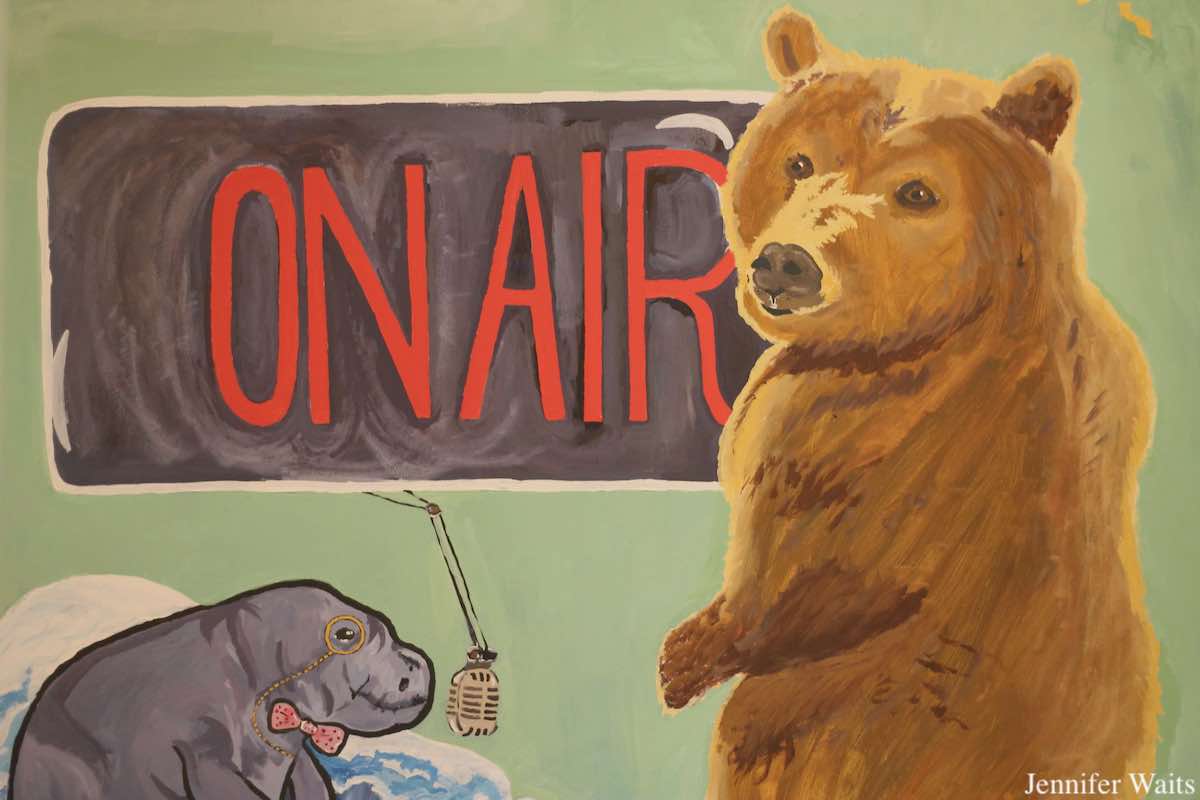
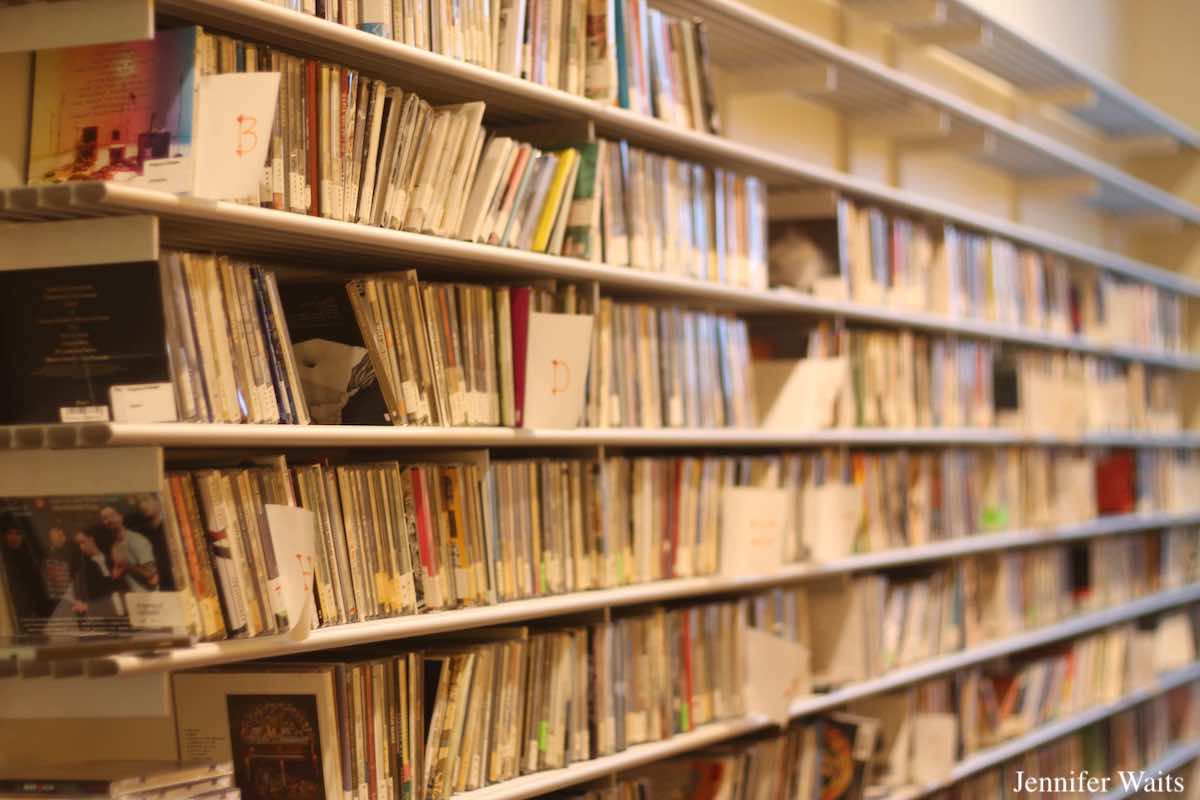
And indeed my trip to WAMH (pronounced “wham” conversationally among station members) did not disappoint. Its home on the 2nd floor of the Keefe Campus Center is full of personality. One wall of its entryway is decorated with a vibrantly painted mural featuring a bear, transmitter tower, vinyl records, and a manatee. A few years ago WAMH “adopted” two manatees, Howie and Nick, so the animal has become an unofficial mascot, even though there’s no obvious connection to Amherst College or the station (the school’s official mascot is the mammoth). Adjacent to the mural, a narrow hallway contains shelves of CDs as well as other miscellaneous items, including boxes of WAMH materials, file cabinets, and audio equipment.
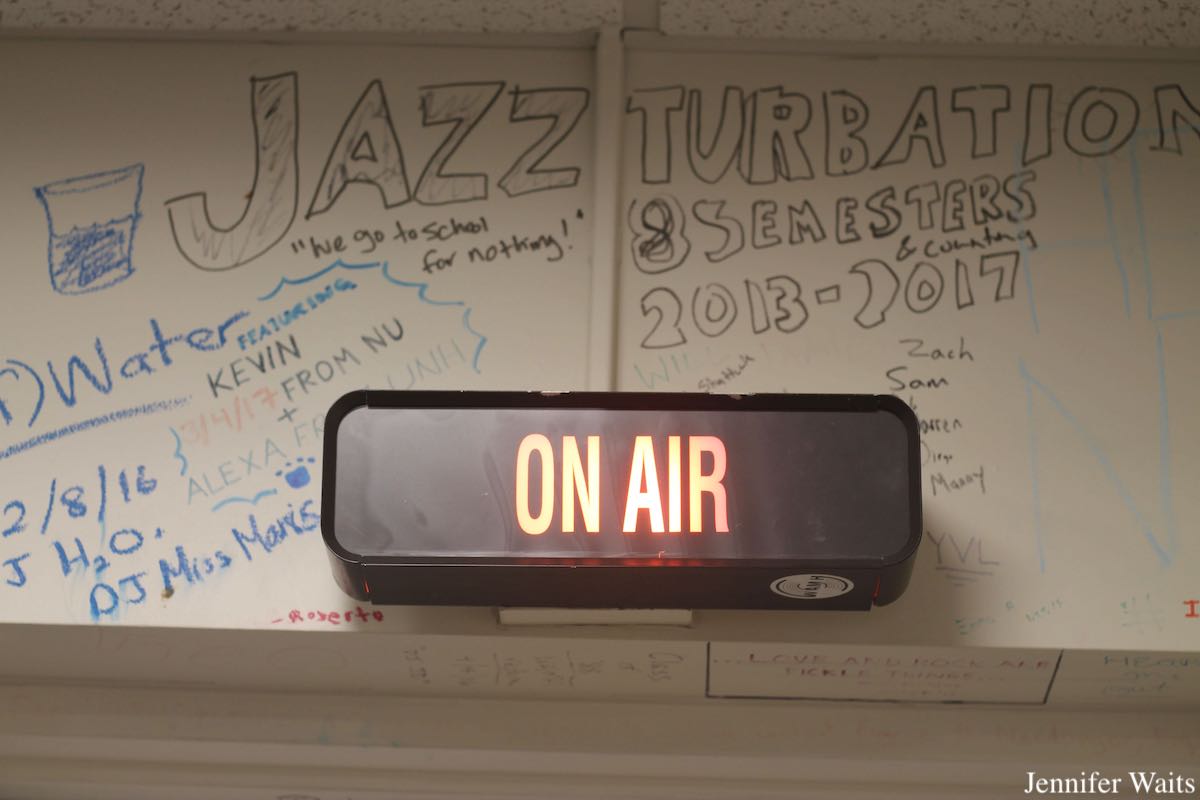
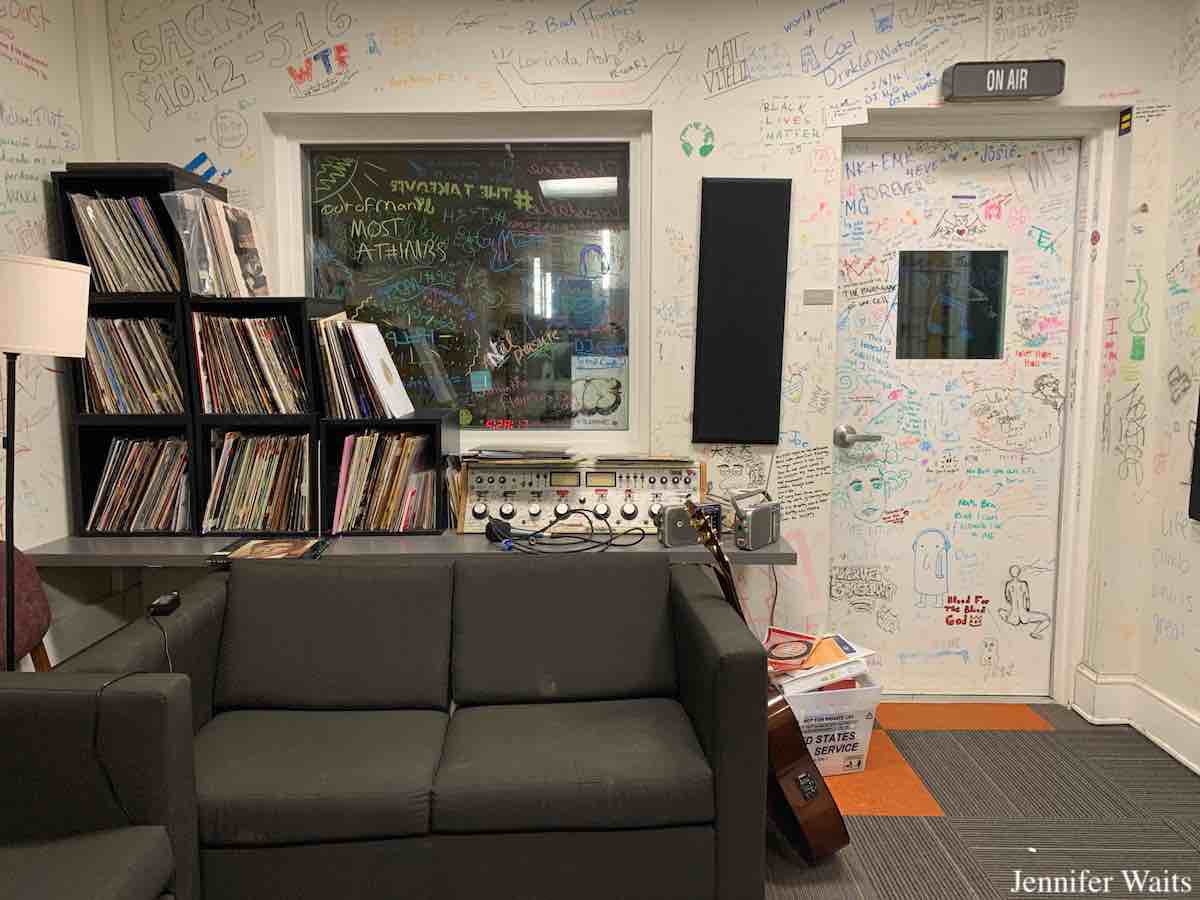
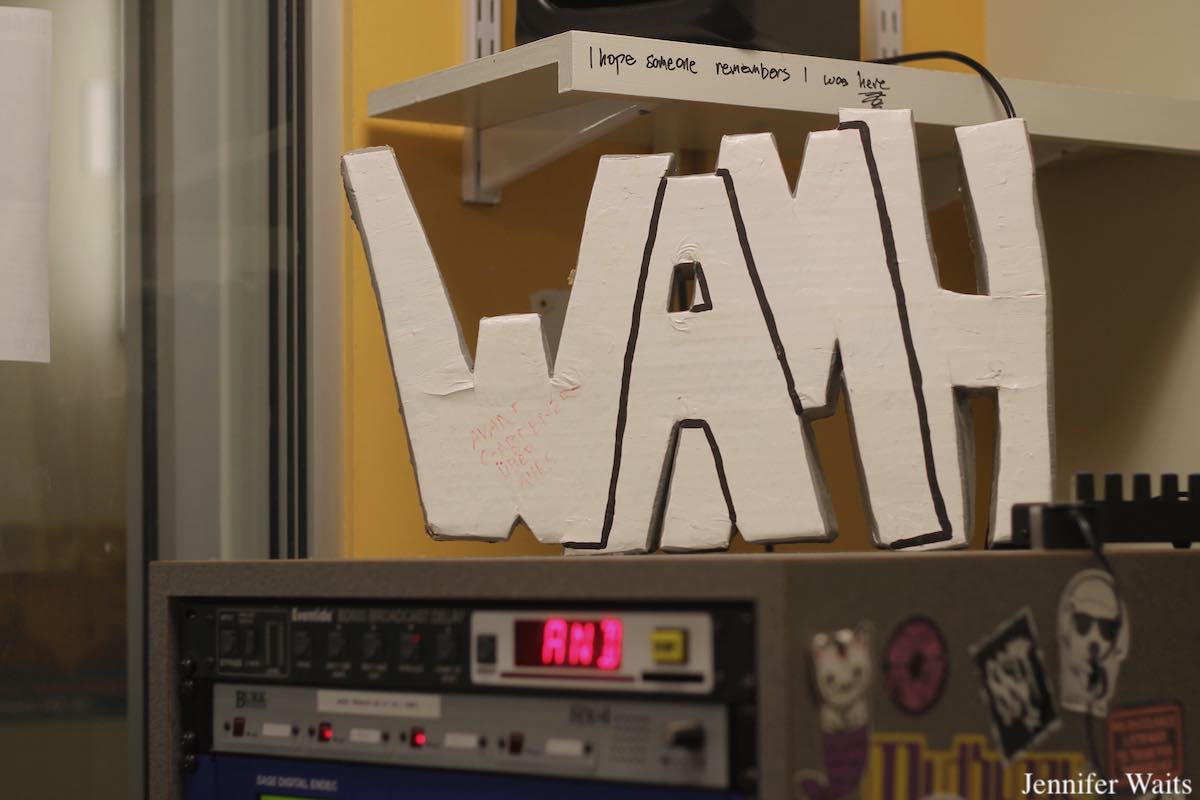
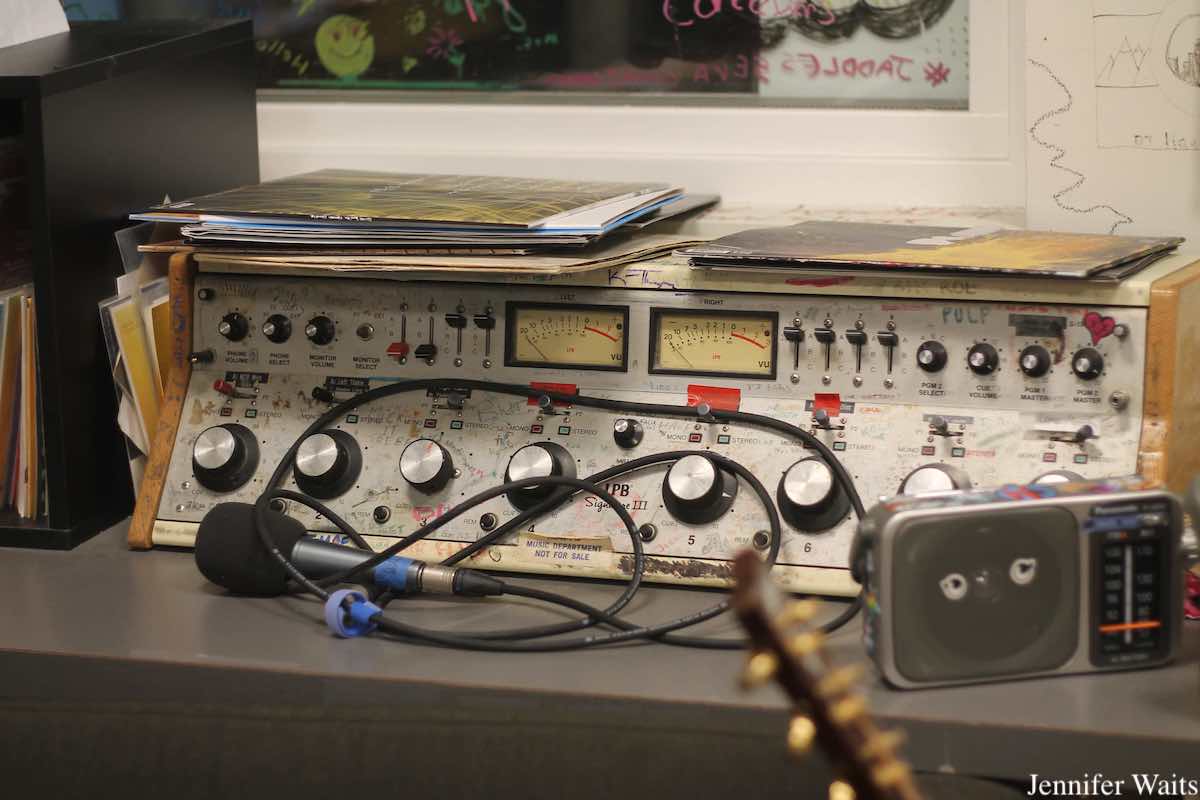
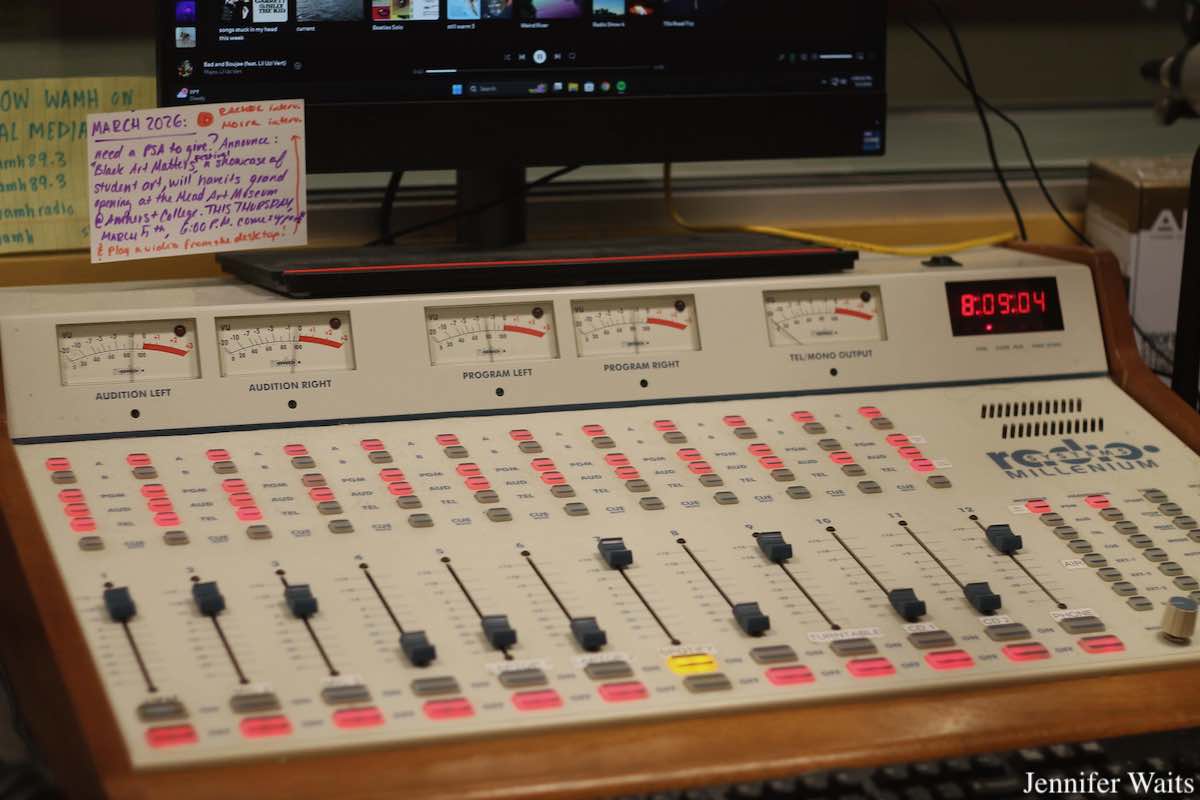
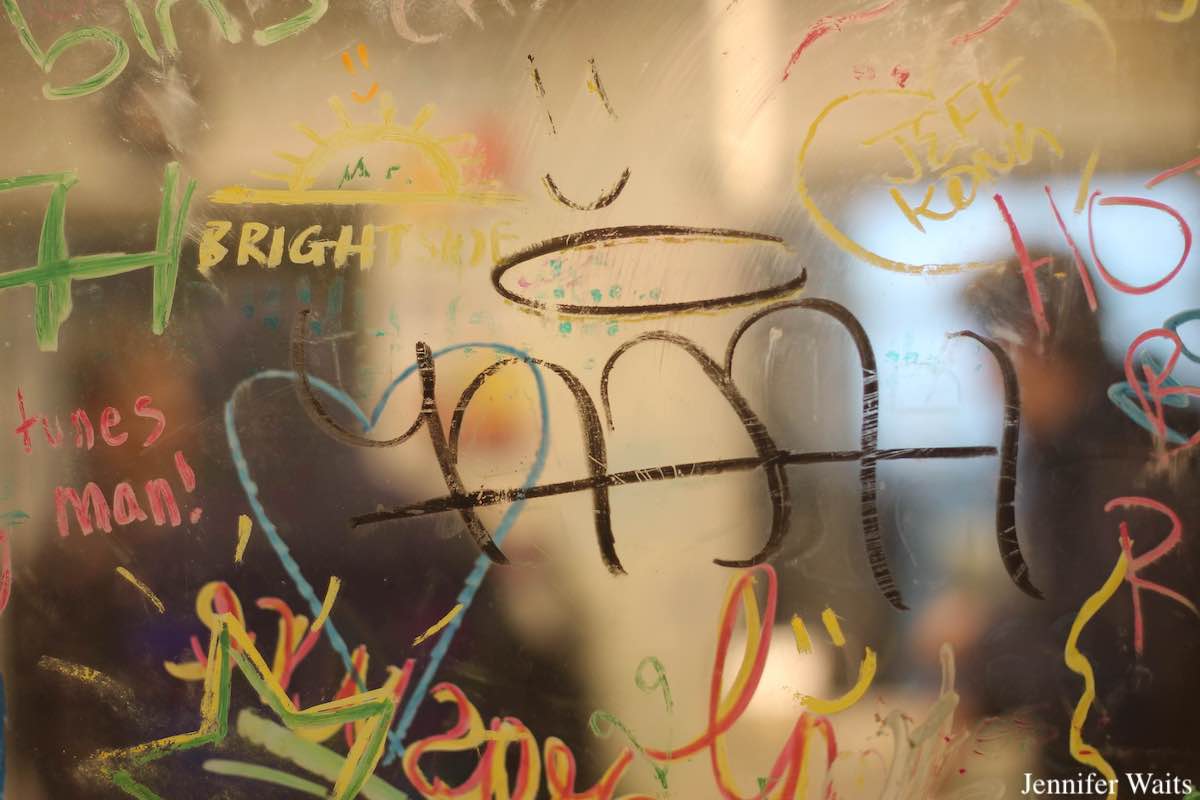
From there, a door leads to the main station space, whose white walls are covered with colorful drawings, notes, and autographs from DJs and celebrities. A cluster of grey couches provide a seating area with views of the two adjacent studios. Signs of the past are everywhere, from a 20th century audio console, to a weathered Leonard Cohen LP, to a 1993 poster for a Swirlies show, to an even older poster for a Ramones concert presented by WAMH. A Leo Blais-crafted WAMH sign (it’s always a thrill to see one of these college radio staples) sits perched over audio equipment in the studio. Hidden away in an old production studio, now used for storage, are wooden cubbies, with one cube labeled “current CMJ New Music Report,” a reminder of the days when that radio industry publication was read cover to cover by stations.
Signs of the Early Days at WAMH
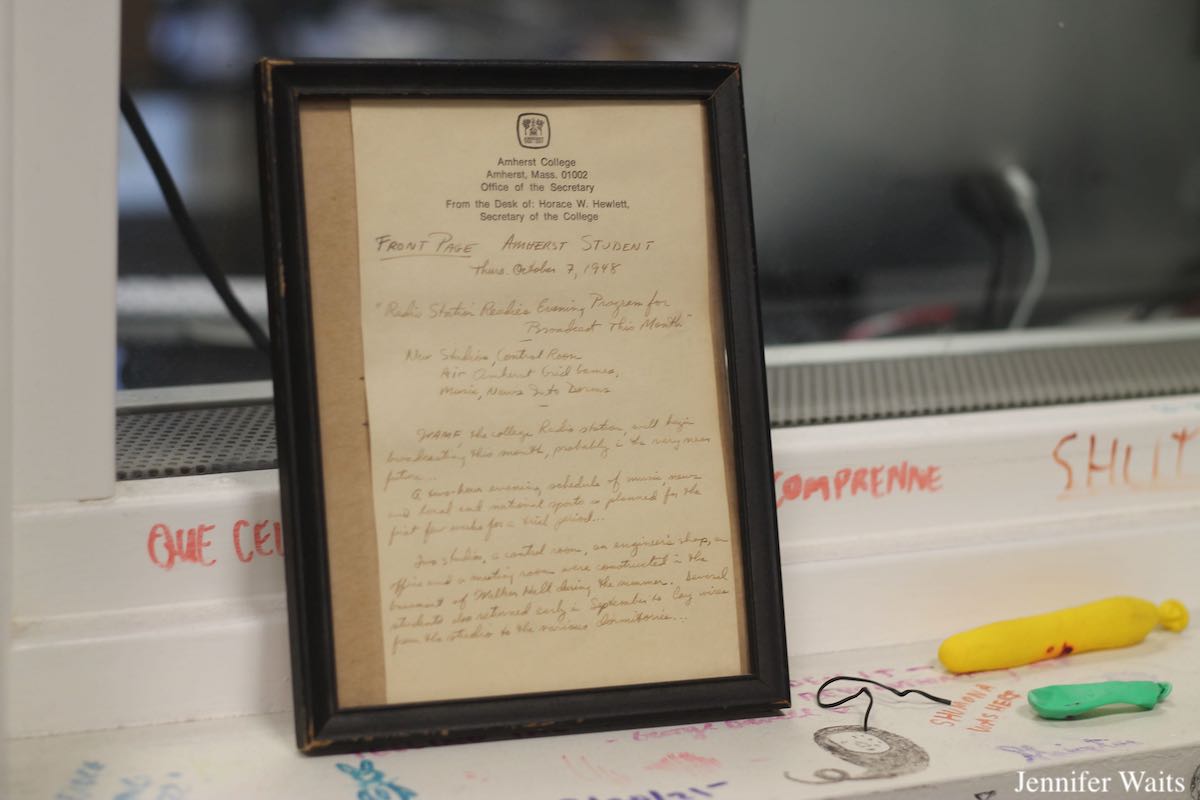
But perhaps the oldest item is a handwritten letter from 1948 detailing a front page story in the Amherst Student about the launch of the radio station. The letter describes “two studios, a control room, an engineer’s shop, an office and a meeting room” in the Walker Hall basement, with wires connecting the station (then called WAMF) to “various dormitories.” Having visiting the Amherst College Archives and Special Collections that morning, I had a bit of a preview of the rich history of WAMF-WAMH.
College Radio at Amherst: 1948 Beginnings as Campus-Only Carrier Current Station WAMF
WAMF launched as a campus-only AM carrier current station in 1948. By 1950 it was broadcasting eight hours a day, had a staff of 60 student participants and had begun collaborating with nearby campus radio stations. This work was formalized in March 1950, when the Pioneer Broadcasting System (PBS) had its official launch. The network was initially comprised of student stations at Smith College (WCSR), UMass Amherst (WMUA) and Amherst College (WAMF). The stations connected with each other using phone lines, sharing programming and thereby expanding each of their broadcast days. An interesting aspect of this partnership was that it was between stations at three distinct institutions: a private women’s college (Smith), a private men’s college (Amherst is now co-ed, but was all-male at the time), and a public university (UMass Amherst). Upon its launch, it claimed to be “the first direct line intercollegiate broadcasting network in the country.”
WAMF Launches FM in 1955; Call Letters Change to WAMH in 1971
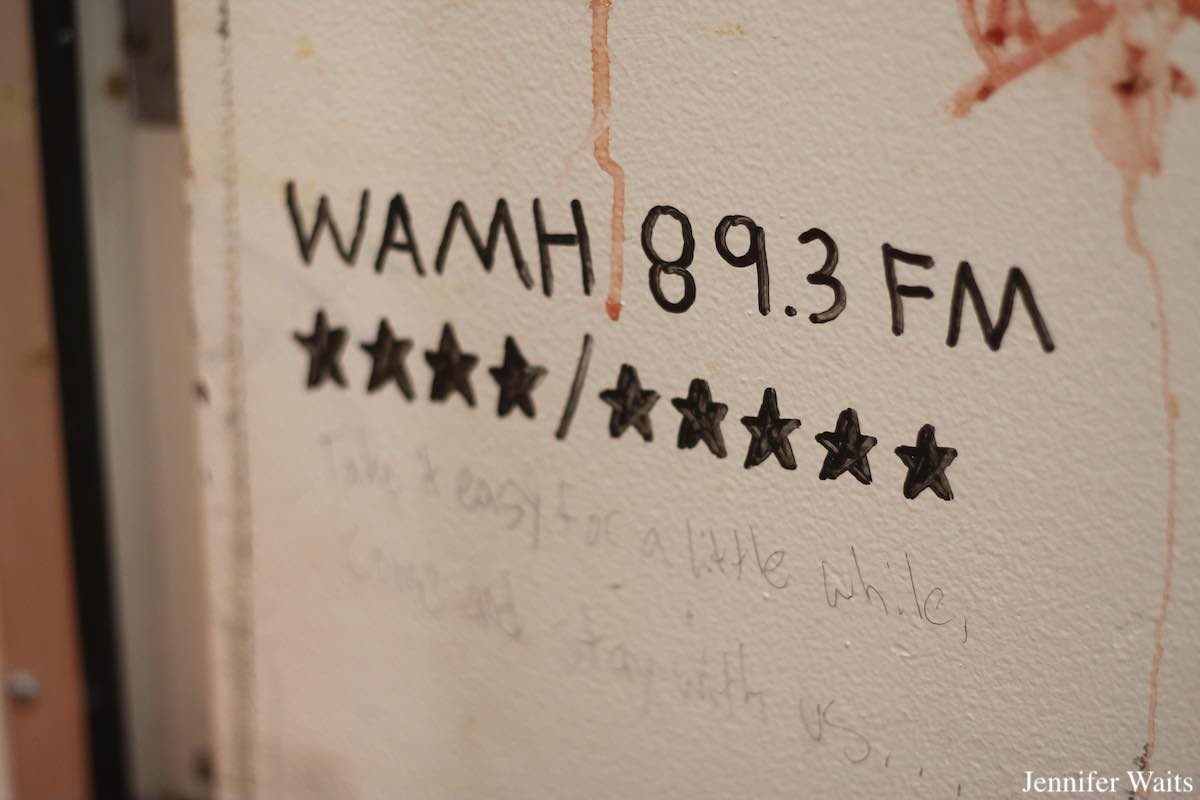
By the mid 1950s, WAMF was airing news, “music to study by,” as well as Amherst College football, basketball, and baseball games. The station hosted a regional college radio conference in 1954 and was accepting national advertising. After encountering issues with its AM carrier current, a decision was made to switch to FM. By December 1955, WAMF was broadcasting with a non-commercial educational FM license at 10 watts. The January 1956 Amherst Alumni News reported that after installing an FM transmitter, the station could be heard within a 15-mile radius. However, AM transmissions were still key for campus listeners. Therefore, “undergraduates working on the station built 20 FM-AM converter units which have been placed in dormitories and fraternity houses to enable undergraduates to hear programs on conventional AM radios,” according to the outlet. Those broadcasts could be heard at 640 AM. In 1971, WAMF changed its call letters to WAMH and received authorization to increase its power, although that expansion to 150 watts in stereo didn’t happen until 1976. At the time, WAMH moved to 89.3 FM, where it remains today.
Archival Projects in Anticipation of Station Move
With the station move to a new student center imminent, members of WAMH are reflecting back on the station’s history (a few joined me for the visit to the college archives) and are working to preserve the materials in their current space. The station invested in a scanner in order to digitize various paper items. Documenting all the scribbles on the walls is a bit more challenging, but is equally important since it’s become a tradition to leave one’s mark on the station. “As soon as you become a DJ, you can write on the wall,” Liu explained, adding that even though the length of the notes varies, “it’s cool to watch how things have kind of grown and new things keep getting added.”
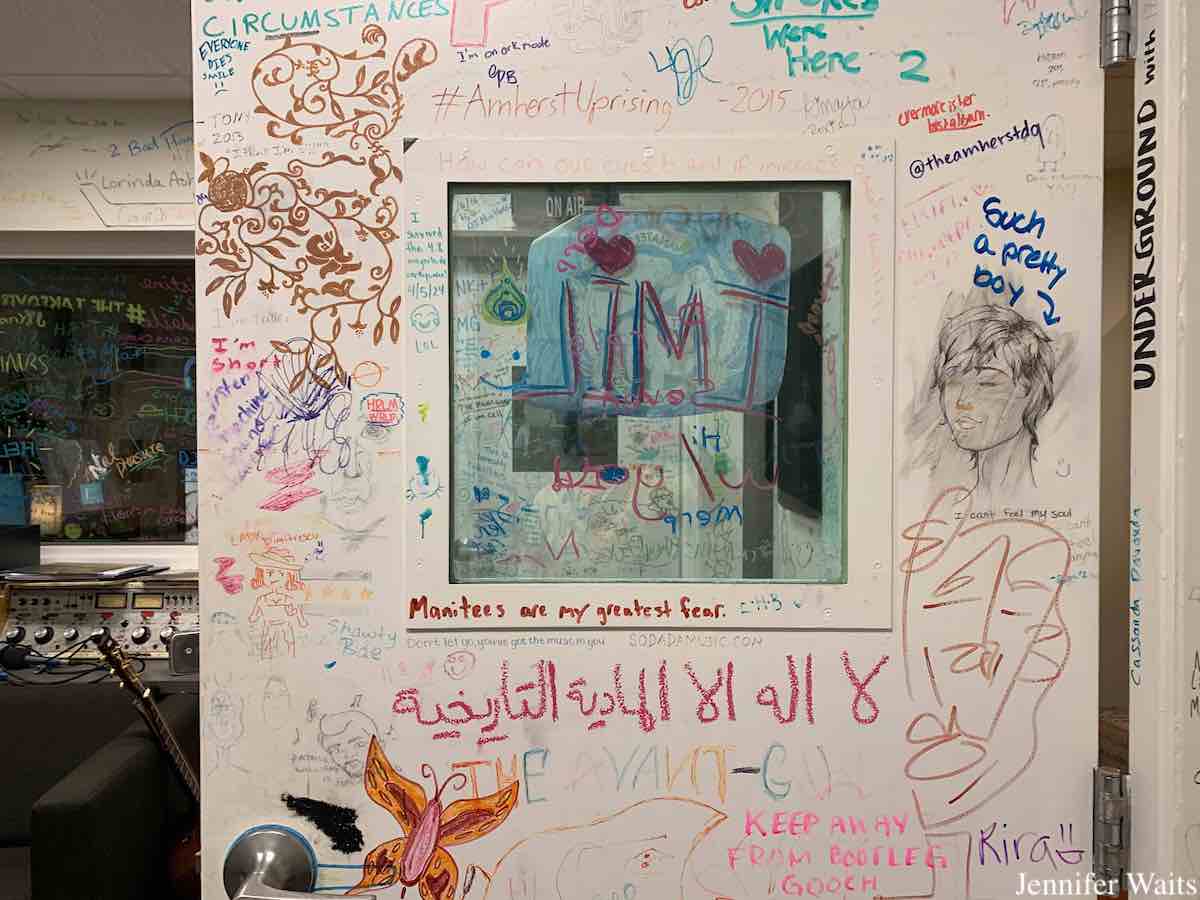
Liu told me that in an attempt to capture the varied artwork, she made a sweatshirt featuring items that she had traced from the wall. “I love the stuff here. It’s really cool reading…conversations people have had that have taken place…across the wall,” she said. Already feeling nostalgic about her time in the current WAMH space, she told me, “I’m going to miss this place a lot.” A junior, she has another full year at WAMH, although next semester the station will look entirely different.
Station Manager’s WAMH Backstory
A radio fan since she was a kid, Liu shared fond memories of listening to 1990s music in the car with her mom and told me “I knew I really wanted to do college radio.” It wasn’t a surprise that she joined up with WAMH as soon as she arrived on campus. In fact, she and her co-station manager Lila Schlissel met online just after they were both admitted early to Amherst. They discovered their shared love for music and radio and talked about doing a show together.
Liu said that she first saw the station one night during orientation week. She reminisced, telling me, “Lila asked me if I wanted to go check out the station with her.” After they peeked through the windows, the station manager invited them in and even showed them how to use the soundboard. “And I just remember it was such a cool feeling to be able to touch the soundboard and hear the music coming through,” she described. Soon after, Liu and Schlissel began doing a show together and then in sophomore year they joined the station’s executive board (e-Board), where they have been co-station managers since Spring 2025. Liu enthused, “I love doing radio.”
Membership Growing at WAMH
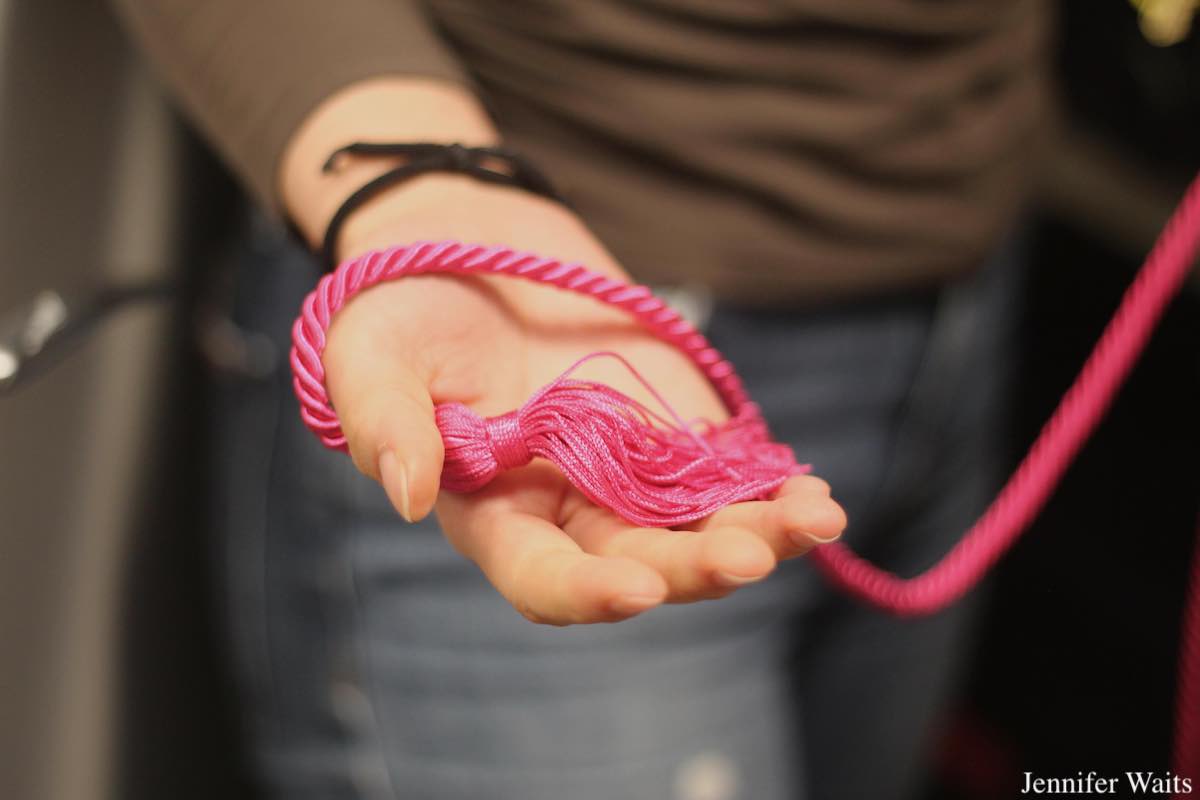
A student-run station, WAMH currently has around eight members on its e-board and Liu estimates that there are approximately 80 DJs, adding that the number might be even higher because of an uptick in participation this semester. Telling me that it’s atypical to see so many new members in the spring, she said that is was exciting to have a range of students joining, including freshmen and seniors. She speculated that part of the reason that more seniors are being drawn to WAMH is because of a new graduation tassel that she introduced last year as a perk for station members. “People love collecting little tassels to wear,” Liu explained.
WAMH shows run from around 4pm to 2am over 89.3 FM in the Amherst, Massachusetts area and stream online on Mixlr. When student programming is not airing, a feed of classical music from New England Public Media (NEPM) plays over 89.3 FM. This partnership originally began in 2015 as a collaboration with New England Public Radio (NEPR), when participation in WAMH was quite a bit lower. It was seen as a way to help fill airtime and ensure the station’s survival at the time.
Live in the Studio: Vinyl, Nostalgia and Chatty DJs
During my Thursday evening visit in early March, the studio was occupied with three live DJs playing pop and hip hop music (and vinyl!) on the show “Hall Pass.” One spoke nostalgically on-air about music they remember from their youth, including the band One Direction and songs that their babysitter used to play in the car. They closed out their show with a request for “Bad and Boujee” by hip-hop group Migos.
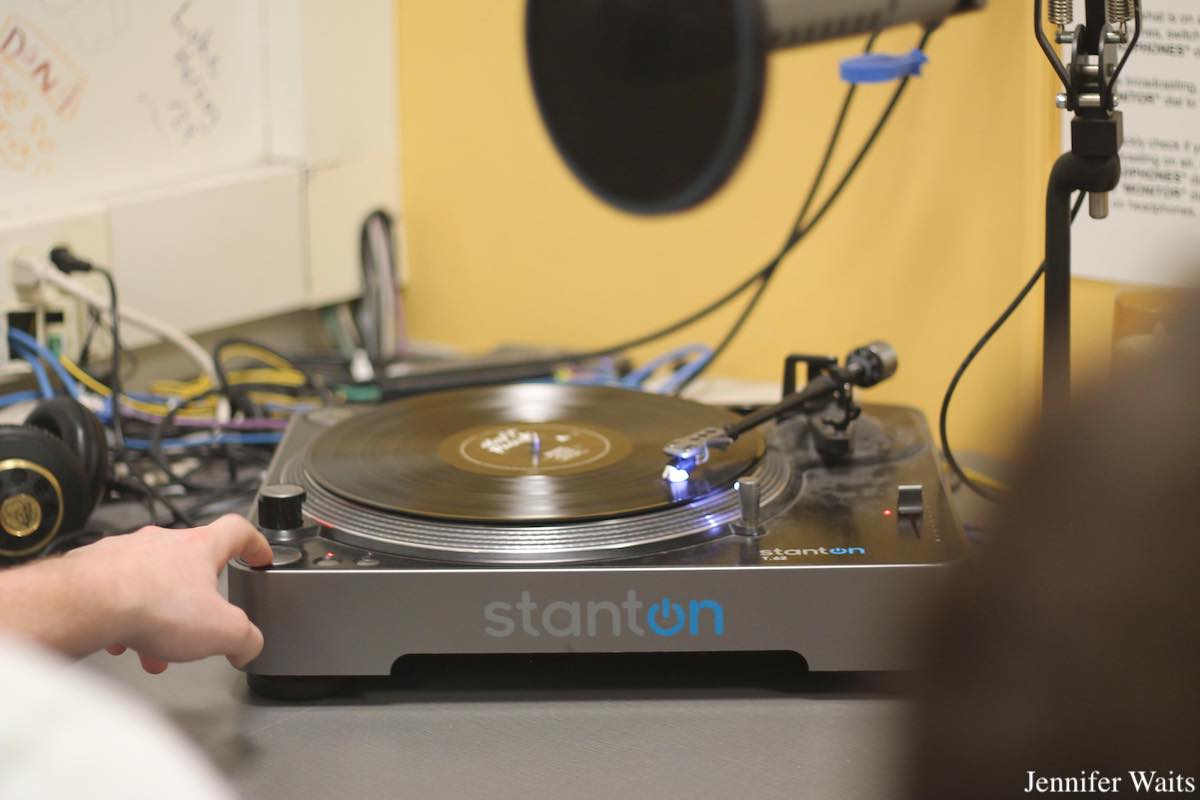
Soon after, DJ Ceci Malone arrived to host “Einstein’s Dreams,” and played songs with lyrics about the end of the world. The set included a range of genres, including the 1960s pop classic “The End of the World.” Liu said that there’s a lot of freedom on-air, telling me, “our DJs are…able to do what they want to do.” She told me that the random mix of shows covers a variety of topics. One thing that stands out to her is that many DJs are quite talkative. She explained, “I love hearing…co-hosted shows where you’ll…hear friends talking about different topics and…get a little glimpse into their life.” With that in mind, while tuning in this week, I heard a team of DJs chatting about puzzles, doing a quick restaurant review, and working out answers to the New York Times’ games Wordle and Connections while taking a mic break between playing songs from the Beatles and ZZ Top.
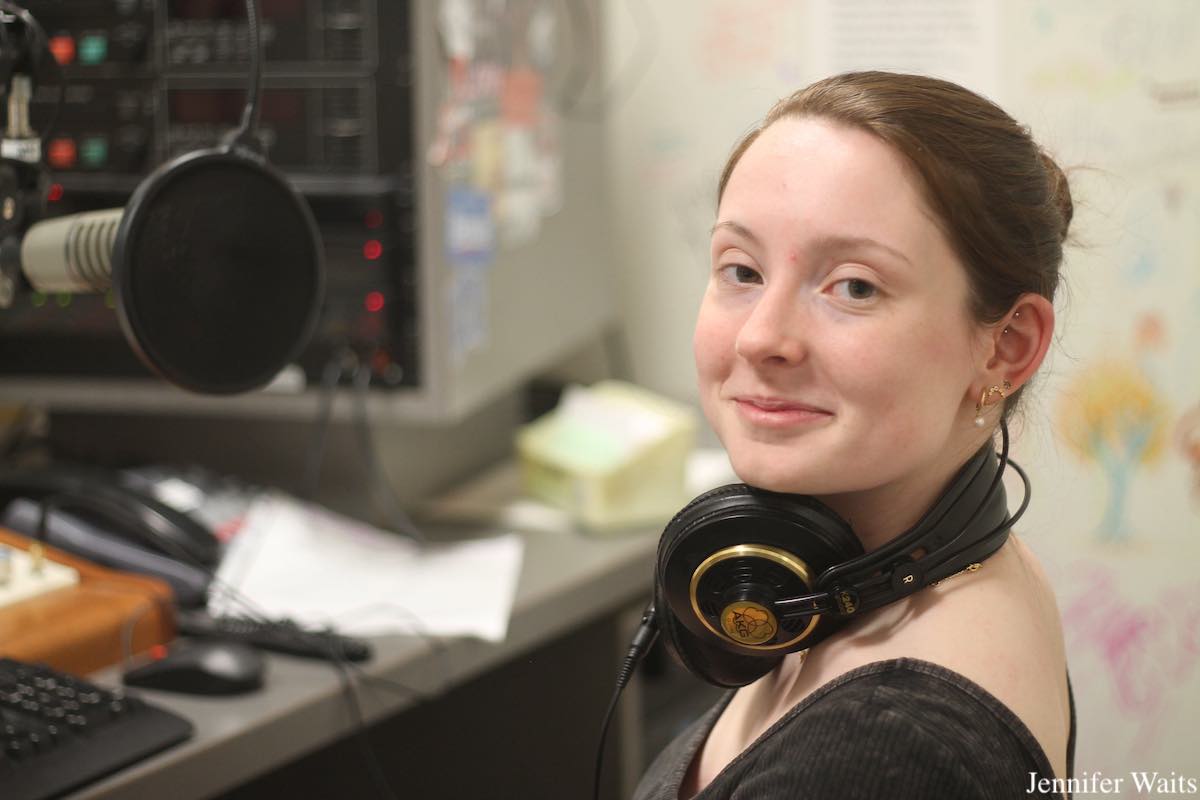
Liu also does two shows on WAMH. She co-hosts the film-focused program “B-Roll and B-sides” with her co-station manager, telling me that they talk about movies and play music. On a recent program they brought on Schlissel’s visiting brother and discussed their love for movie theaters. On her other show, “The Minor Third,” she plays hip-hop and R&B music and talks about sports and other topics with her co-host, who is also her partner.
DIY Aesthetic at WAMH: From PSAs to Posters
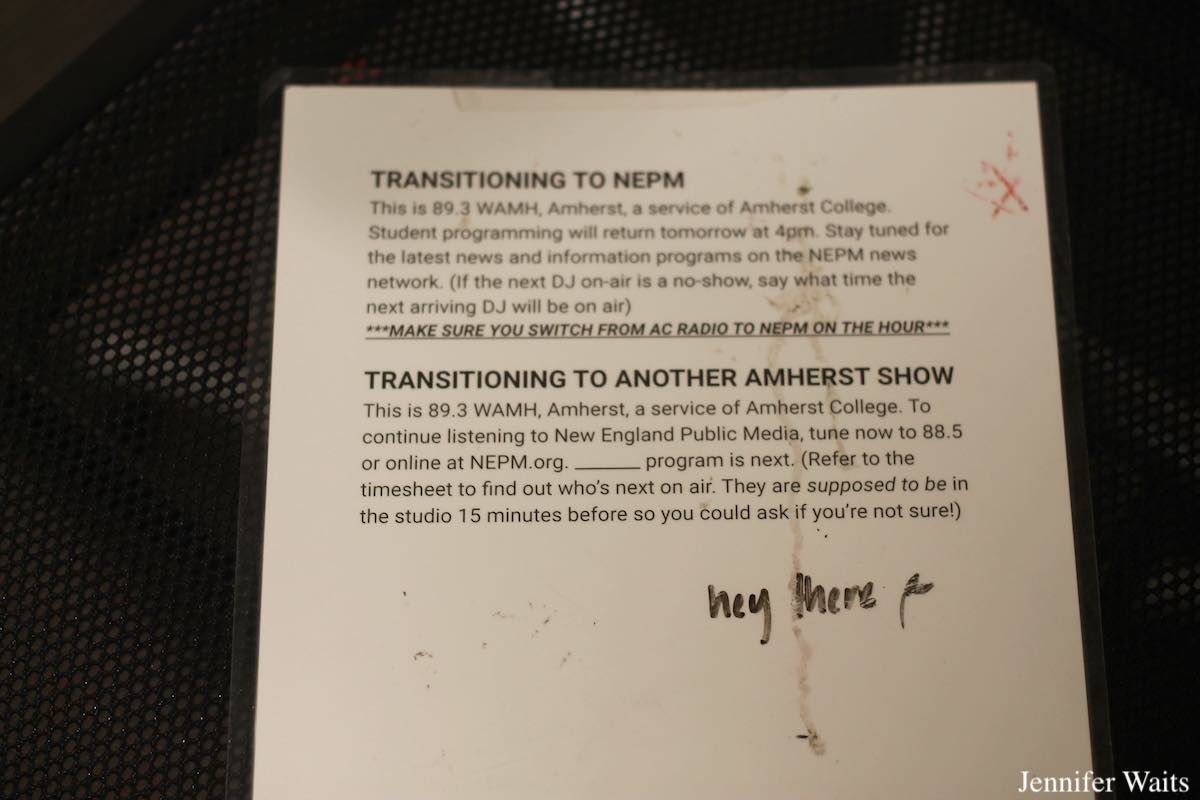
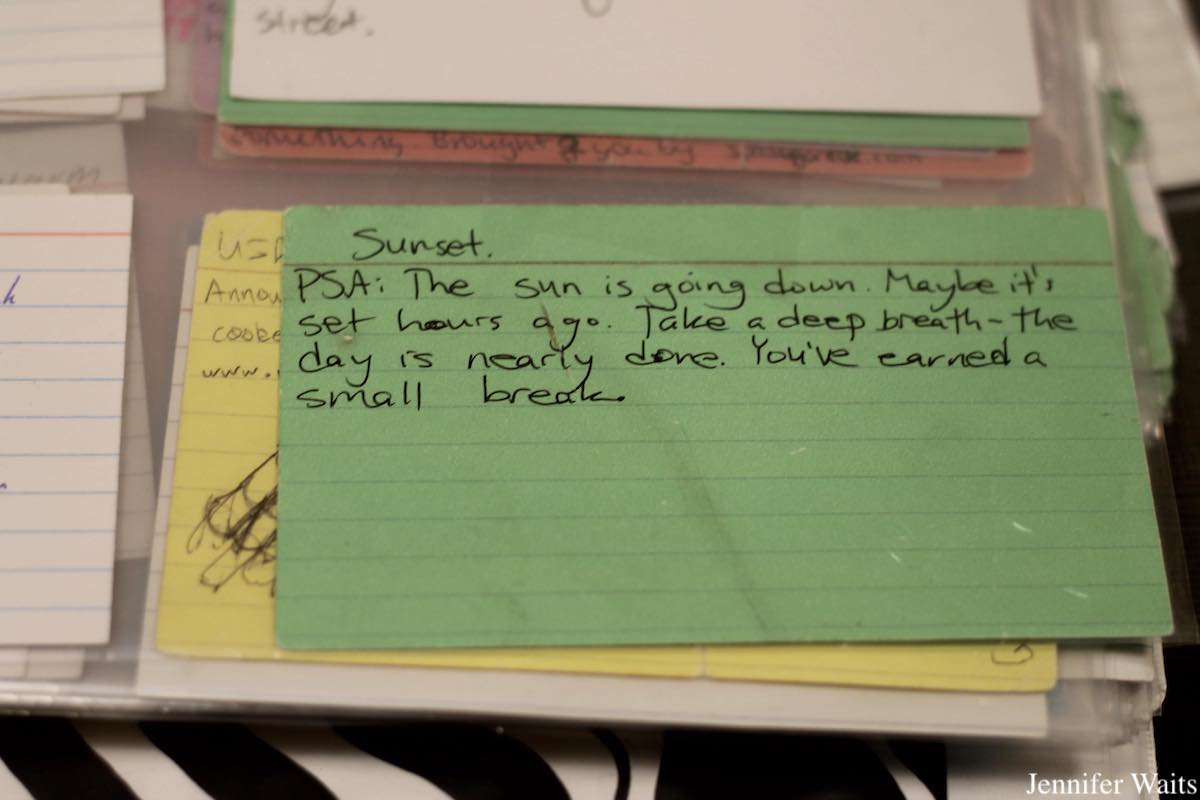
A quirky aspect of WAMH is its use of handwritten public service announcements (PSAs). Written on colorful index cards, the PSAs include expected topics like flu prevention tips from the CDC, but also include obtuse messages unrelated to a particular agency or non-profit. One example, the purple-inked “Not that Deep,” says, “it might not seem like it in the moment, but it will pass. take a deep breath. control what you can control. in the end, will it really matter tomorrow? next year? in a decade? it’s not that deep bro. let it go.” Stacks of these DIY PSAs sit in plastic sleeves in the WAMH studio, waiting to be read on the air.
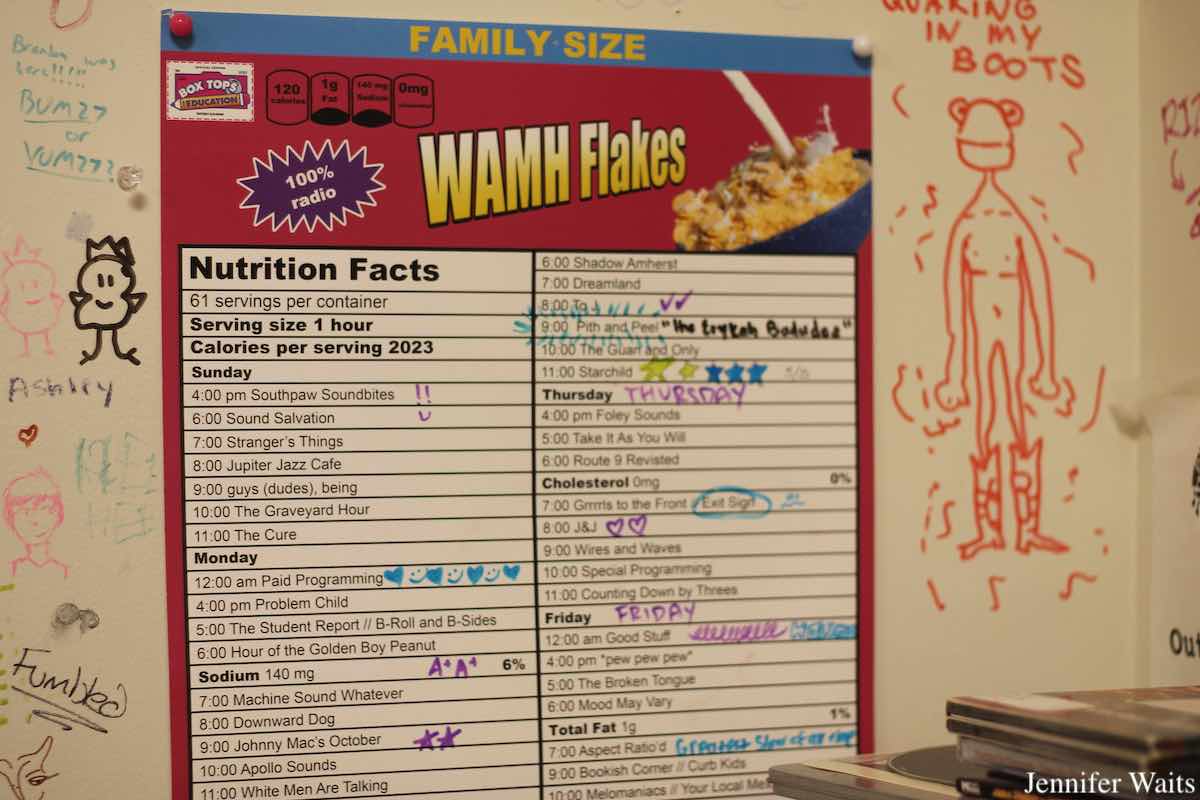
Liu was excited to show me some beautiful schedule posters for WAMH (including a few that she made), which have a different design every semester. One has a radio dial theme, another (“WAMH Flakes”) resembles the nutrition facts section on a cereal box, and the Fall 2024 schedule depicts the daily lineup in squares that look artwork within a CD case. In the archives I saw a large collection of similar posters from the past, so it was wonderful to see the tradition being maintained.
Popular DJ Events and Shows Hosted by WAMH
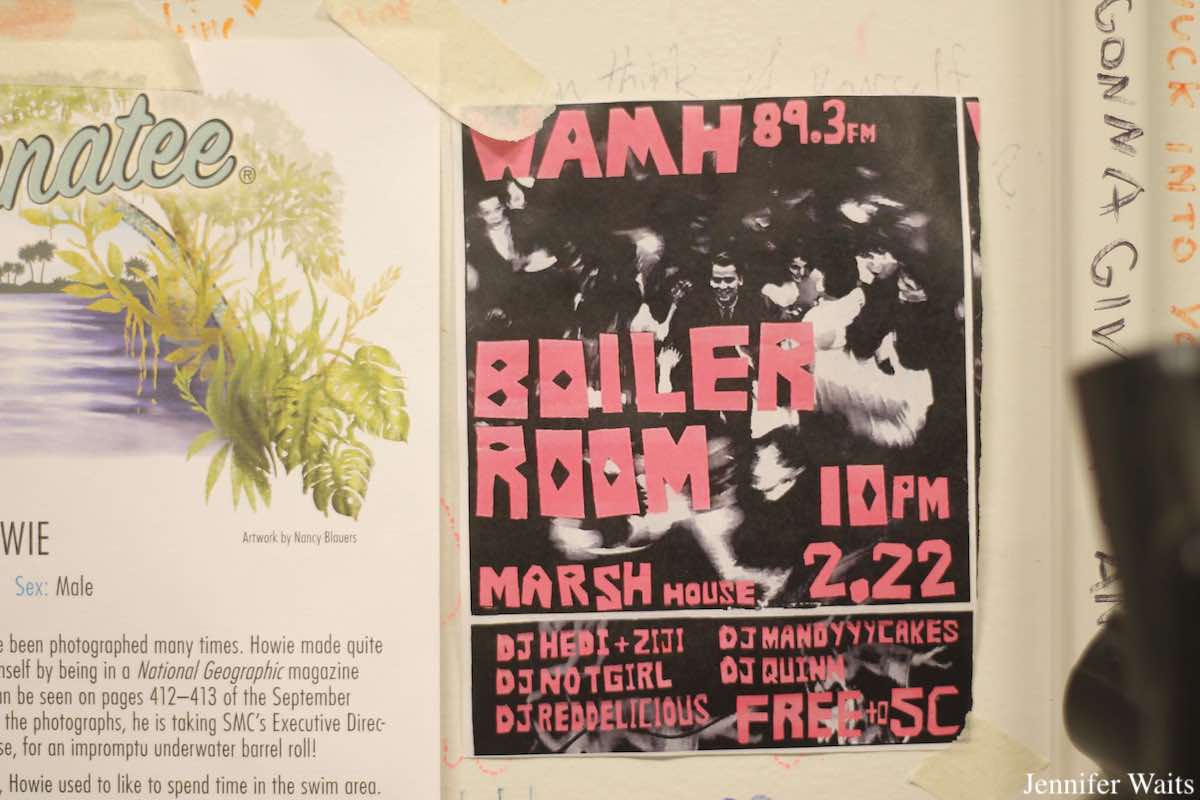
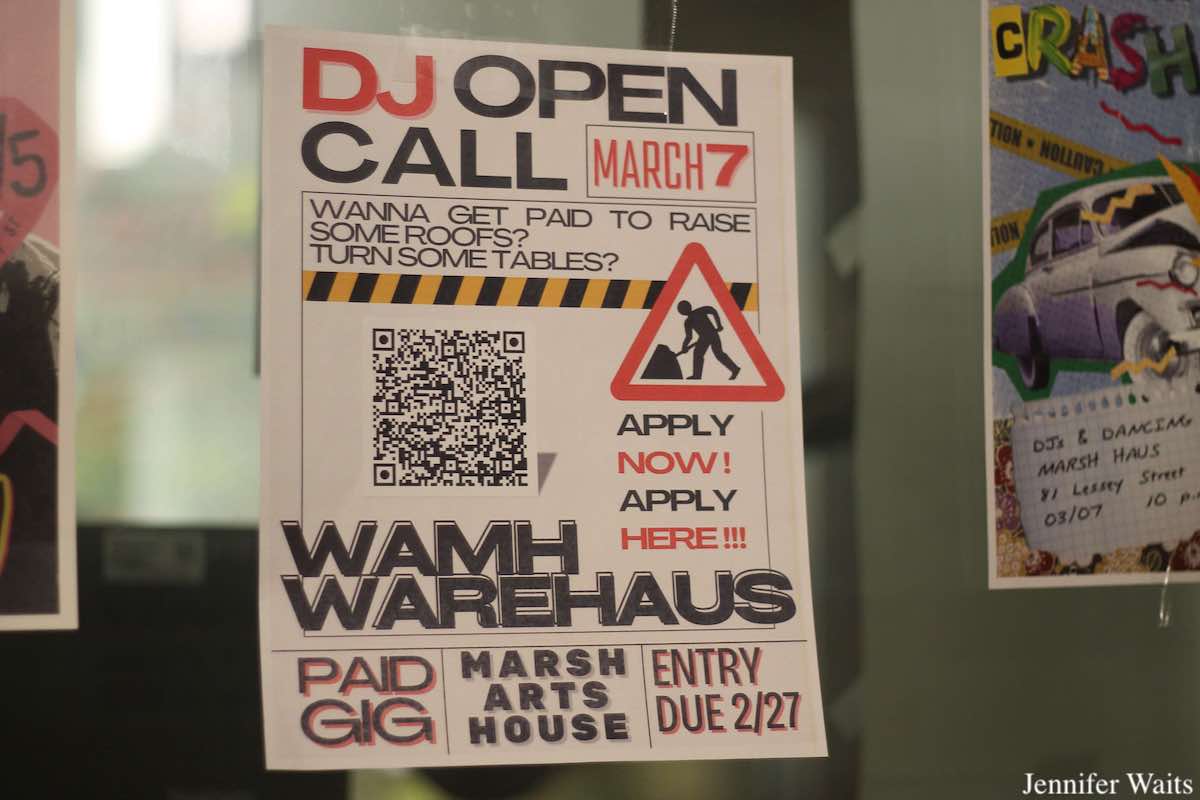
Besides the radio programming, WAMH also produces live music and DJ events. On the weekend following my visit, WAMH was hosting its third in a series of DJ events that started in 2025. Three DJs from the “Five College Consortium” (comprised of Amherst College, Smith College, Mount Holyoke College, Hampshire College and University of Massachusetts Amherst) were scheduled to play sets at Marsh House, an arts-themed community at Amherst College. Liu noted that the DJ events have been “extremely popular,” and that “DJ sets…in more of…a party format” with “cool music,” seem to be more of a draw than other types of live music events. In light of that, Liu said that WAMH hopes to continue doing more live DJ events in addition to shows and the station’s annual spring concert.
Throughout my visit, Liu radiated enthusiasm for radio and WAMH. Optimistic about the state of the station and radio in general, she is especially pleased with the increase in participation at WAMH this semester. “It’s a good sign that people are still interested in doing student radio and still wanting to engage with it,” she said.
Thanks to WAMH + Station Tour Archive
Thanks to Finley Liu for the tour of WAMH and to everyone in the Amherst College Archives and Special Collections for a fun visit and glimpse of the amazing WAMF-WAMH collections. This is my 199th radio station tour report and my 140th college radio station tour. You can view the entire collection of my radio station visits in numerical order or by station type in the Radio Survivor archives.