Archive for the ‘statistics’ Category

14,420 Radio Stations in the US

At the end of last month the FCC released its tallies for the total number of broadcast stations in the US as of Sept. 31, 2009 and Dec. 31, 2009. When you see the big number of 14,420 full-service radio stations it’s a big reminder that radio is still an enormous media presence in this country. This total represents an increase of 23 stations just from the end of September.

Here’s the breakdown for all radio types:

Full-power stations

  • AM stations – 4790
  • FM commercial stations – 6479
  • FM educational stations – 3151
    TOTAL 14,420

    FM translator and booster stations – 6155

    Low-power FM stations – 864

    Grand total: 21,439

Note that FM translators and boosters are low-power stations that may not originate their own programming. They may only retransmit the signal of a full-power station. I’m pretty sure that a very large percentage of translators are non-commercial, thought I don’t have the exact number at hand. This is because the rules for non-comm translators are much looser than for commercial ones. A non-comm translator may be located any distance away from the station it retransmits, whereas a commercial translator must be located within its mother station’s expected broadcast range.

Educational stations encompass all non-commercial stations that have NCE licenses, including college, school, religious, community and public stations. The FCC does not distinguish between them.

Even though many observers have tuned out of radio, it’s going to be a long time before 21,439 broadcast stations are going to be abandoned and forgotten.


New Pew Internet and American Life Study’s Take on Radio News Consumers

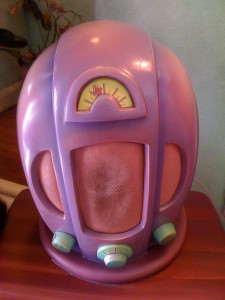
Listening to the Radio in Minnie's House at Disneyland

A study released this week from the Pew Internet and American Life Project reveals some interesting tidbits about how people in the United States are increasingly turning to the Internet as a major source for news.

However, the report, “Understanding the Participatory News Consumer” (PDF) also highlights the fact that people continue to seek information from multiple sources, including radio. According to the report, in a typical day, 54% of Americans “listen to a radio news program at home or in the car.”  The study also found that 59% of study participants reported getting news from both online and offline sources.

The report goes on to describe the demographic differences between various segments of news seekers. Here’s what they say about those who listen to radio news:

“Looking at those who are most likely to listen to radio news either at home or in the car on a typical day, several demographic groups stand out: those between ages 30-64, college graduates, and those who use the internet and cell phones.

Interestingly, those who are online are more likely to get radio news: 57% of internet users get radio news regularly, compared with 44% of non-users. Similarly, 53% of the cell-only population (those who have dropped their landline and rely exclusively on their cell phone) get radio news on a typical day, compared with 39% of those who rely exclusively on landlines.

Radio news is also a major draw for Republicans and conservatives, compared with Democrats, moderates and liberals.”

To see how those listening to radio news differ from those getting their news from TV, newspapers and other sources, take a look at the complete report. It also shares some really interesting findings about participatory news consumers, who tend to utilize multiple news sources and are more likely to interact with the stories that they consume (by blogging, commenting online, posting to Facebook, using Twitter, etc.).


Congress will hold hearing on Arbitron Portable People meter

Edolphus Towns still on the warpath over the  PPM

It looks like Arbitron’s controversial Portable People Meter is still in hot water with the government. The  device, which measures user listening habits sans a written diary,  is scheduled to be the subject of a hearing by the House  Committee on Oversight and Government Reform on Wednesday,  December 2. This is the committees’ second investigation of the controversial gadget.

“With an unprecedented decline in ratings among popular minority television and radio stations, we must explore the possibility of methodological flaws in the implementation of the PPM,” declared its Chair Edolphus Towns (D-NY, called “ET” by his staff, we’re told).  “As it stands now, the current system jeopardizes the future of minority broadcasting.”

The Portable People Meter is worn by the participant, sort of like a pager. It picks up radio signals around the user and keeps track of the stations to which he or she is listening. Critics of the PPM says its sampling methodology includes too few minority radio fans and that Arbitron recruits an insufficient number of cell phone only households for the device (which are often minority households). Arbitron responds that the  PPM is much more accurate than the old  diary system.

PPM opponents, among them many of the nation’s civil rights groups and minority broadcasting associations (and Stevie Wonder), asked the Federal Communications Commission for a formal investigation of the device, but  the agency offered only a notice of inquiry. Three states have required improvements in the PPM, among them New Jersey. New York, and Maryland. (more…)


Complete FCC indecency/obscenity stats since 2002 now posted on Radiosurvivor.com

Lovers of the truly bizarre process by which the Federal Communications Commission receives indecency complaints from the public will enjoy our comprehensive table of all indecency, obscenity, and profanity complaints logged by the agency since 2002.

Here’s a sample of the last line of the chart:

2008 Jan. Feb. Mar.
“Indecency/Obscenity 578 505 179,997
“General Criticism” 83 148 234
“Other programming issues” 510 248 676

Notice that huge jump in indecency / obscenity numbers in March from 505 to 179,997 (while the other categories remained stable)? That’s typical of the roller coaster pattern that is the monthly fluctuation of government indecency complaints. Chances are good that most of these gripes are generated by decency group auto-forms. Anyway, enjoy!


Clear Channel unloading four silent radio stations to minority non-profit; 846 to go

What does Kingsford the Pig have to do with any of this? Read on.

What does Kingsford the Pig have to do with any of this? Read on.

It was definitely a feel good moment last week when Clear Channel announced that it plans to donate four radio stations to the Minority Media Telecommunications Council. The MMTC says it will work with the National Association of Broadcaster’s Leadership Training Program to “use the stations for training and to incubate new minority and women broadcast owners.”

If Clear Channel were giving these stations to me, I’d be, like, “THANK YOU CLEAR CHANNEL. DUDE. WOW. THANKS.” David Honig, President and Executive Director of MMTC, did the formalities with a lot more class. “Clear Channel Radio’s generosity and support creates an enormous opportunity not only for our own training programs, but for minority and women broadcasters who would not otherwise have the means to operate their own stations,” he said. Very well put.

(more…)


Radio factoid: educational broadcasting is pulling the weight when it comes to full power station growth

source: USAID

source: USAID

A look at radio licensing trends in the United States over the last five years shows an interesting pattern. While the number of commercial AM and FM full power licenses has declined or remained flat, there’s been a big expansion in educational FM stations. Lets’ review the stats in QA form.

Q. How many Federal Communications Commission licensed full power radio stations are there United States?

A. As of December 31, 2008 the FCC counted 14,253. These break down to 4786 AM stations and 9467 FM stations.

Q. How many of those FM stations were commercial versus educational?

A. 6427 were commercial. 3040 were educational (“educational,” of course, includes public radio stations).

Q. How many FM translators and boosters are there?

A. 6120.

Q. How many Low Power FM stations are there?

A. 859. There could be a lot more if the FCC made it easier to get licenses.

Q. Are these license numbers growing?

A. Yes, and no. There were 13,383 full power radio stations at the end of March 2003, so the aggregate is going up. But the number of AM stations has declined by 18 and the number of FM commercial stations has remained nearly the same (up 248 from 2003—a 4 percent increase). Meanwhile the number of FM educational stations has grown by 640—a 25 percent boost in that sector’s growth. So basically educational FM is pulling most of the weight when it comes to conventional radio license expansion. Were it not for that sectors’ strength, the total number of licenses would have increased by 230, a 1.5 increase in growth.

Sources:
BROADCAST STATION TOTALS AS OF DECEMBER 31, 2008,
FCC, February 27, 2009.
BROADCAST STATION TOTALS AS OF March 31, 2003
, FCC, May 5, 2003