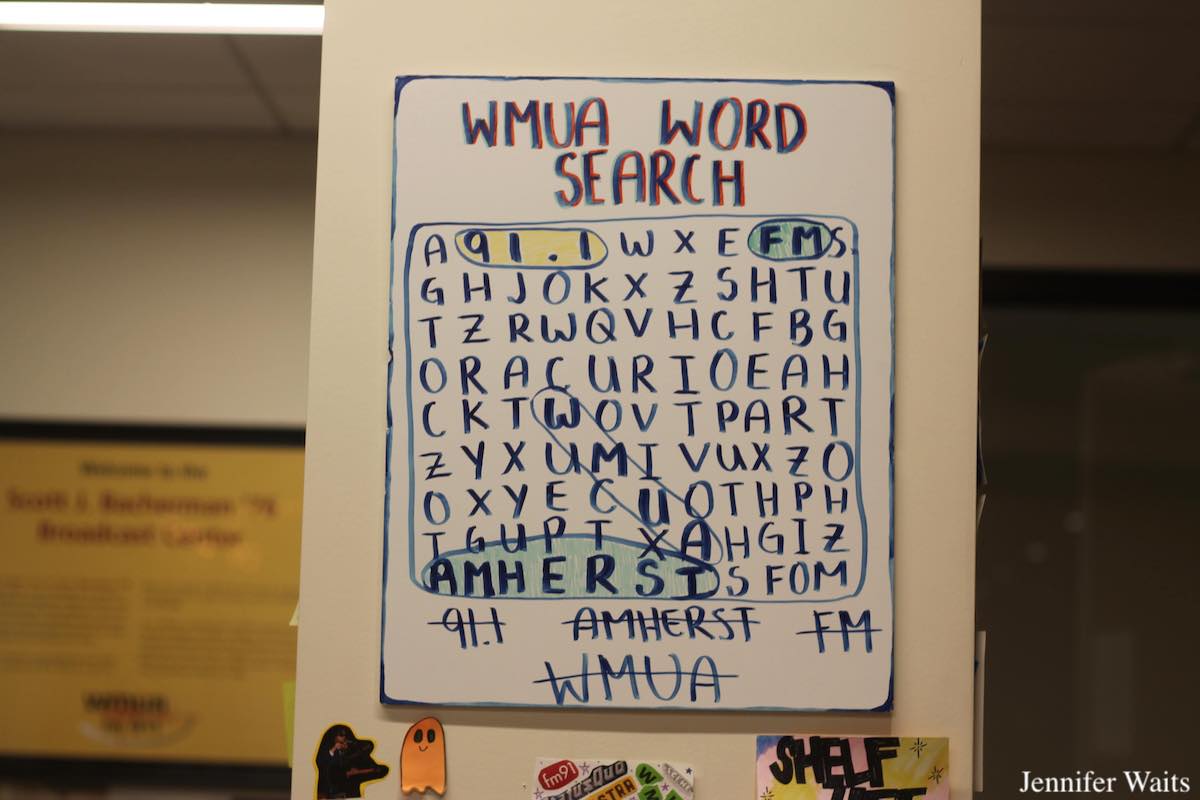
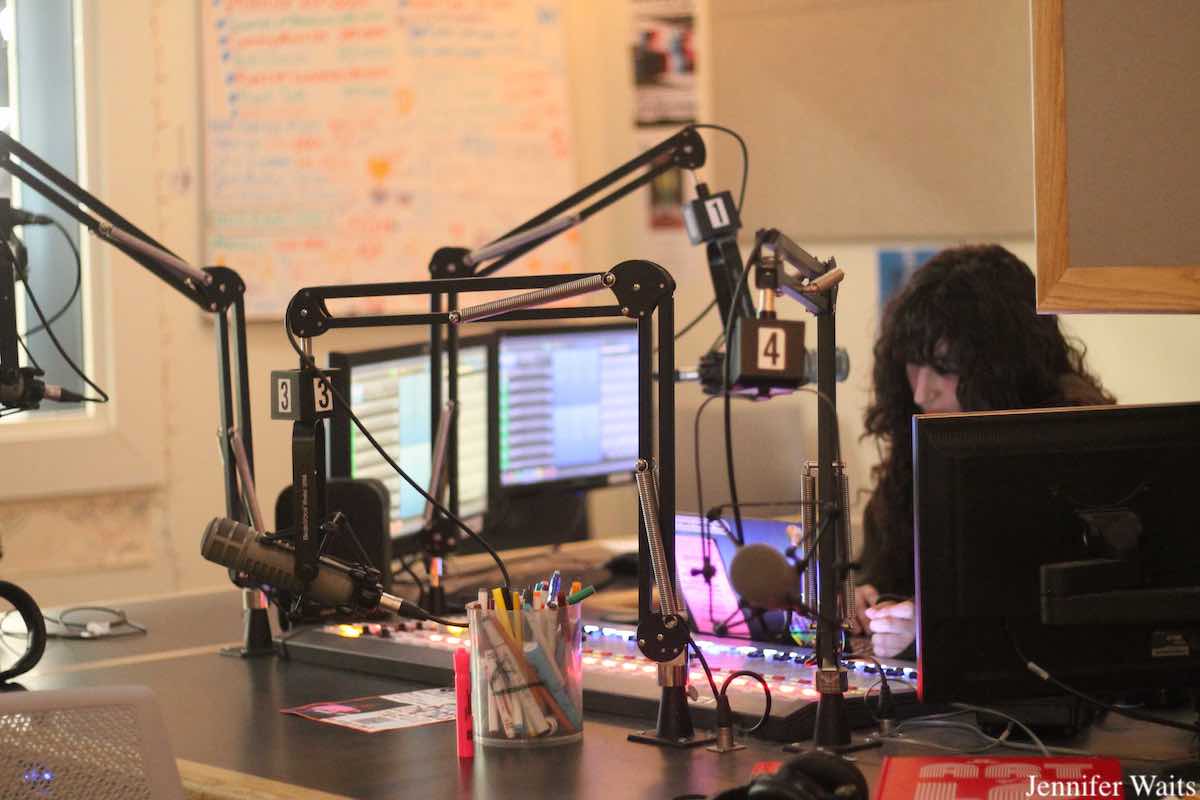
During lunchtime on a Thursday in early March, University of Massachusetts Amherst’s college radio station WMUA was buzzing with activity. Tables in the lobby were full of students working on laptops, eating and socializing, while the station’s two main studios (one for the 91.1 FM signal and another for streaming station WMUAx) were occupied by DJs doing live programs.
Touring WMUA in 2026
Located in the Student Union building, the station is highly visible, especially with its FM studio’s wall of windows facing a high traffic area where people can be seen walking and congregating. WMUA General Manager Lyvia Migliaccio greeted me and took me on a quick tour of the station. Blessed with an amazing amount of space, WMUA’s large lobby opens into the main control room (MCR) and production room (for DJ training and live broadcasts on the second stream). Off a hallway are the advisor’s office, engineering office, news and sports room, and a podcasting/editing studio.
Appreciation for Physical Media and Human Music Recommendations
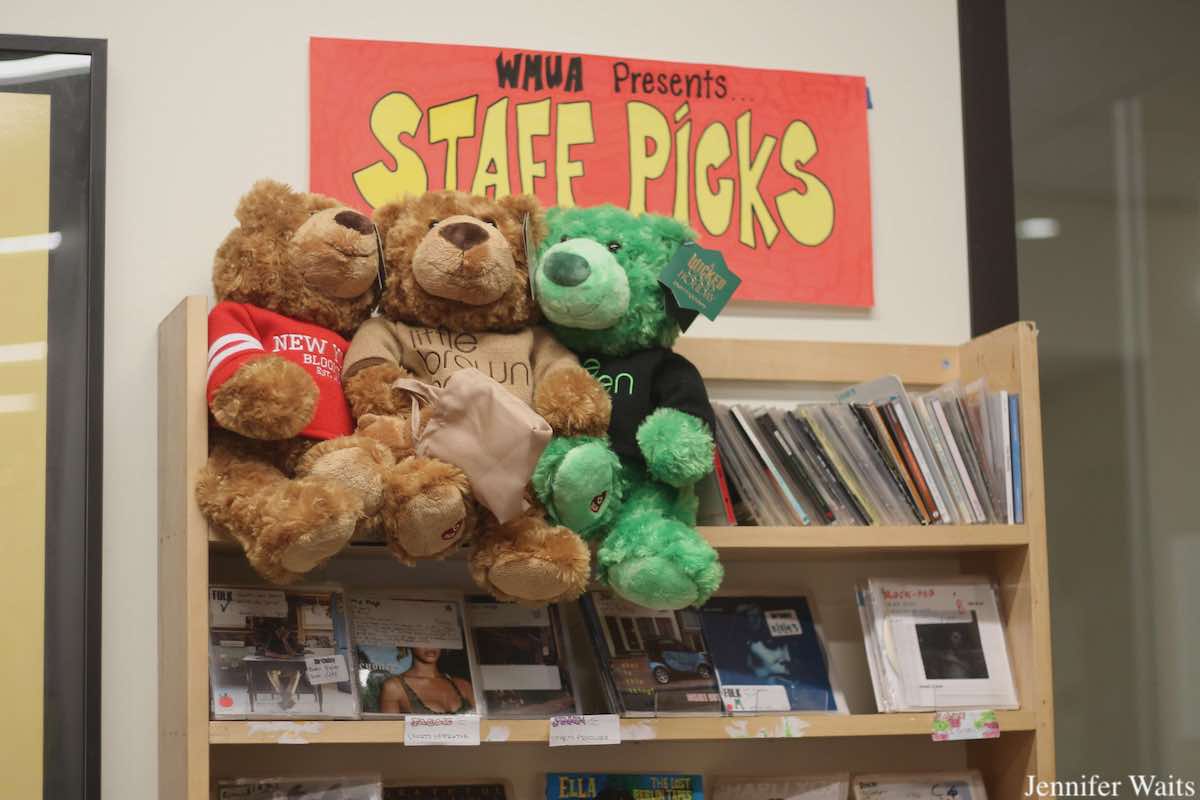
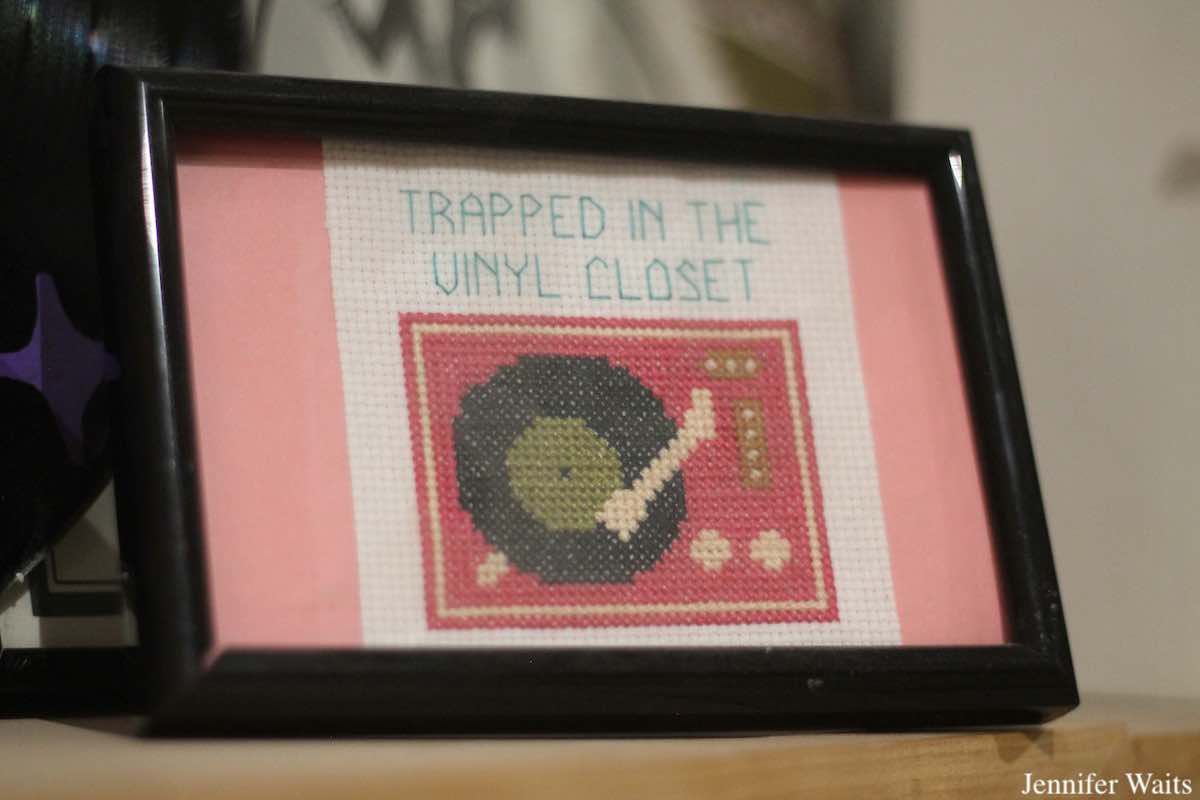
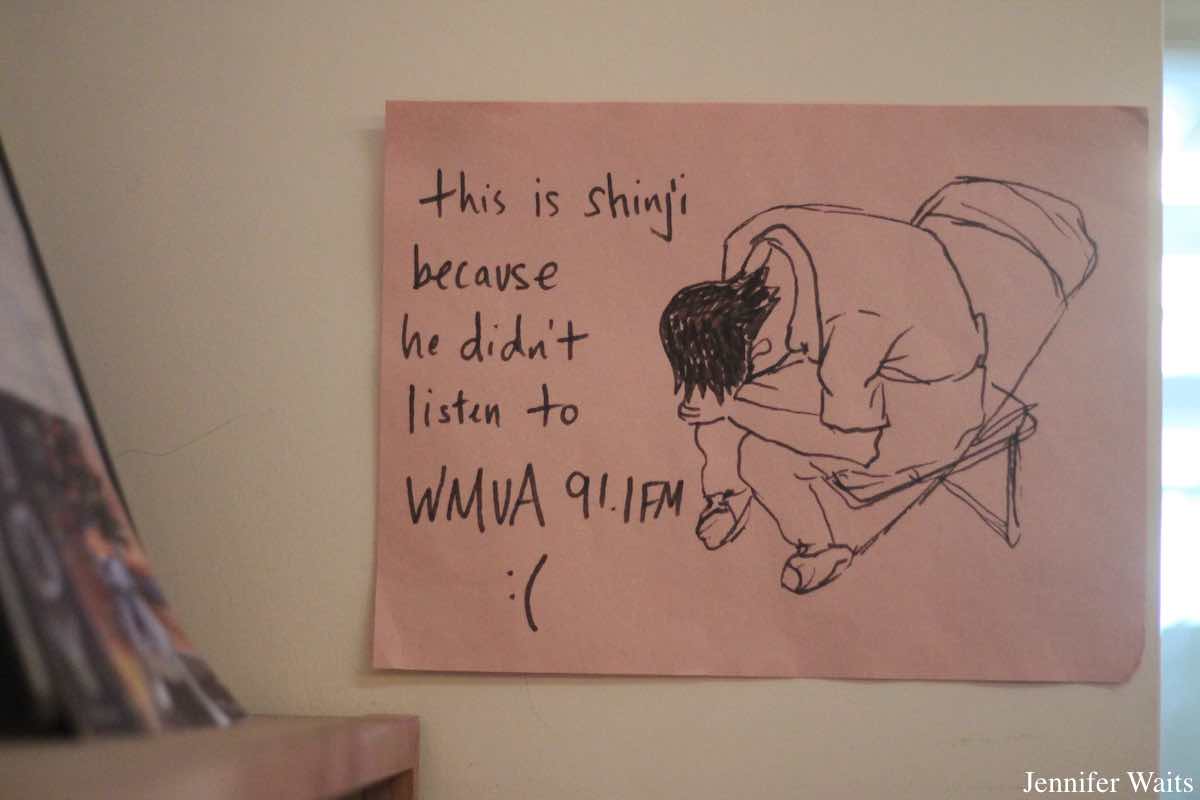
Physical media is dispersed throughout the station and can be seen in pretty much every room and studio as well as in the lobby and hallways. Just inside the station entrance is a shelving unit labeled “Staff Picks,” featuring some of the favorite CDs of WMUA participants. The selections run the gamut and include Ella Fitzgerald, 1990s classics from the Cardigans and Cocteau Twins, and newer releases from Brandi Carlile, Beyonce and Charli XCX. An open question, “What are you listening to?,” is written on a wall nearby, with post-it notes underneath the sign providing clues to the music taste of WMUA participants. Both displays are indications of the vibrant station community and its enjoyment of physical music.
Packed WMUA Schedule Includes Two Streams and an Increasing Number of Students
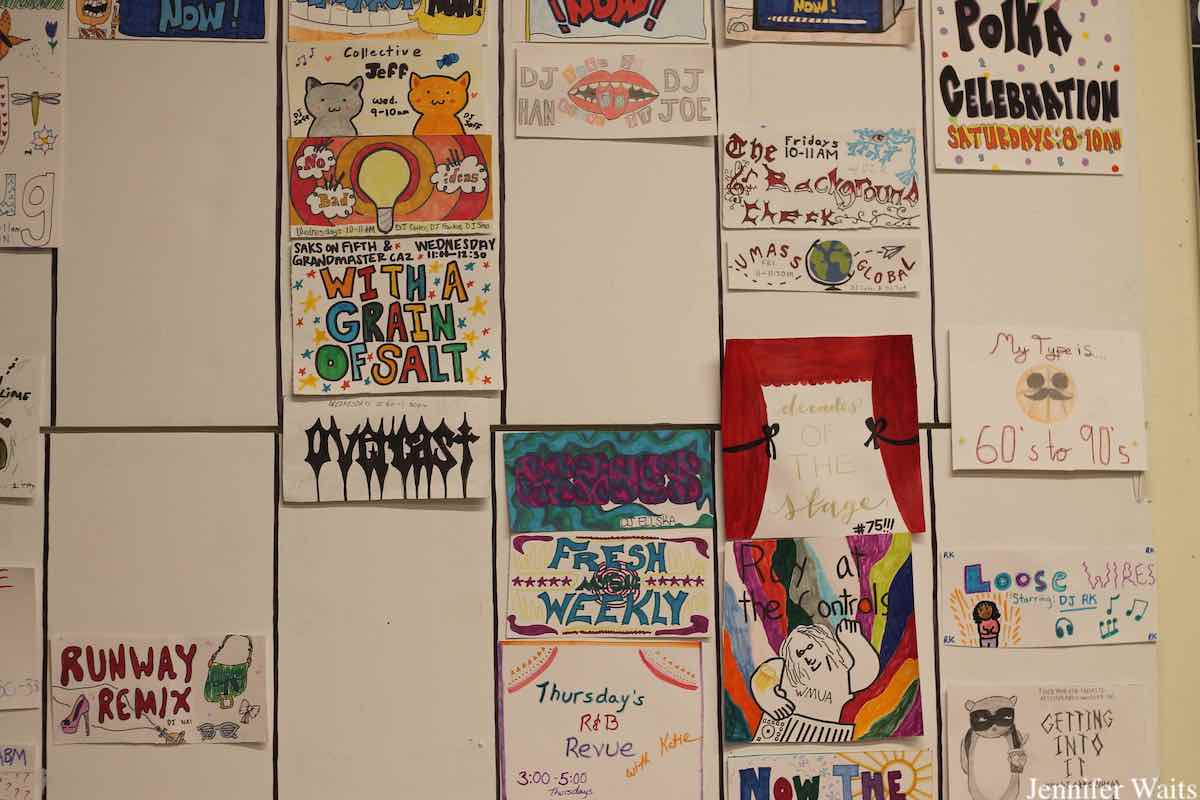
On the other side of the station lobby a large wall is covered with a grid of the WMUA schedule. Hand-drawn cards serve as promotion for various shows on the calendar, with hosts creating the design for their time slot’s card. With over 100 shows this semester, the schedule is packed. Having both an FM stream and a second internet-only stream helps with getting all interested folks on the radio, especially since there’s a large sports department and athletic events can lead to the preemption of programs.
Approaching the end of her senior year, Migliaccio told me that WMUA has grown tremendously since her first year on campus. In addition to increasing participation, she thinks the station is “a lot more DIY” than in the past and is more connected with the school and the community. As we chatted about that, another student, sophomore Seamus Kelley, chimed in with an observation about how welcoming the station is, saying that he regularly comes by to study or hang out, saying, “And even though I don’t have a show, I feel really like a part of a broader community of music heads.”
Vibrant and Welcoming Culture at WMUA
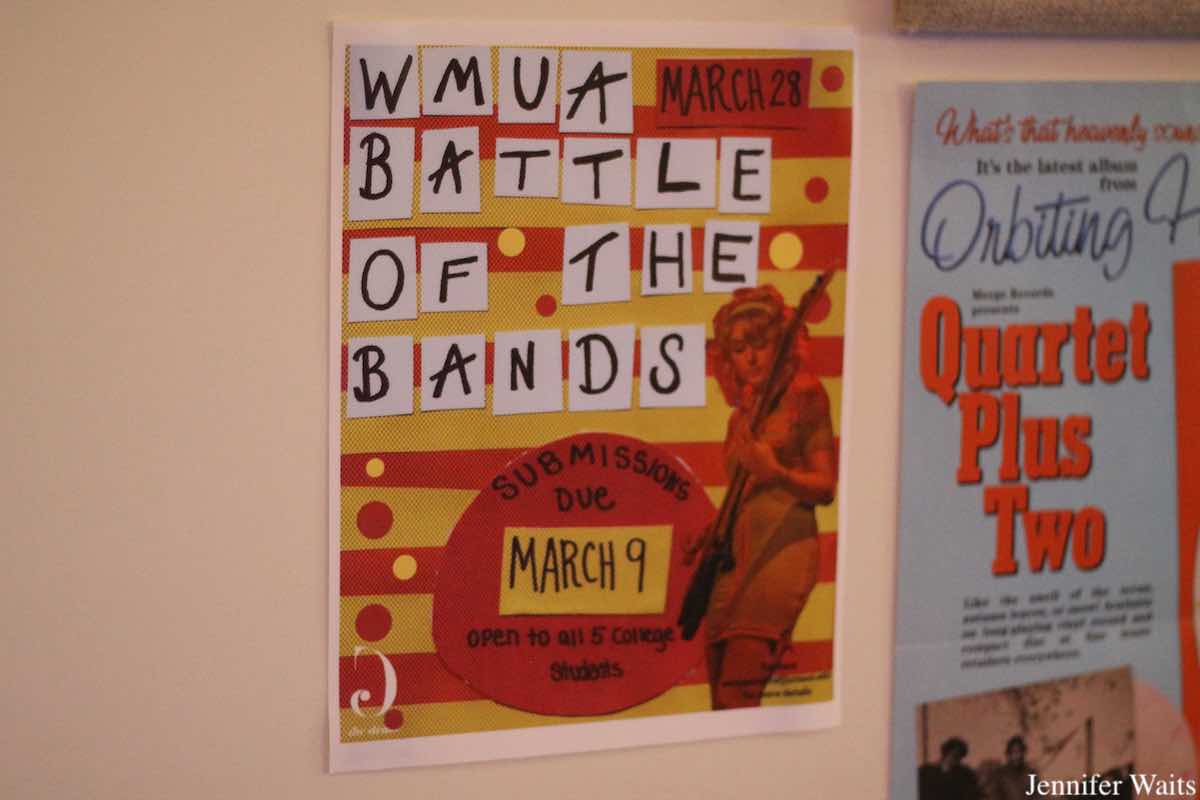
In speaking to that sense of community, Migliaccio confirmed that “people just pop in and hang out,” adding that WMUA does a variety of things beyond radio, which bring in new folks. In particular, shows and concerts on and off campus help to get the station’s name out there. WMUA also regularly hosts a “Battle of the Bands,” which is open to students from their fellow nearby schools in the “Five College Consortium,” including Amherst College, Hampshire College, Mount Holyoke College and Smith College. The most recent battle just took place in late March. Migliaccio reminisced about producing that event several years ago and how it turned into a costumed event at the last minute since the timing coincided with Halloween weekend.
Mix Tape Nights at WMUA
A newer event, Mix Tape Night, happens pretty frequently. One was coming up the night of my visit, in fact. During Mix Tape Night, people are invited to come to WMUA and burn a mix CD for themselves or as a gift to a friend. As part of the fun, they are also encouraged to design their own cover for the CD. Additionally, station members get credit for participation if they make a mix and leave it for others to enjoy. According to Migliaccio, “the Mix Tape Night has brought in a lot of people who I think otherwise would not been involved” with WMUA.
DIY Vibe at WMUA
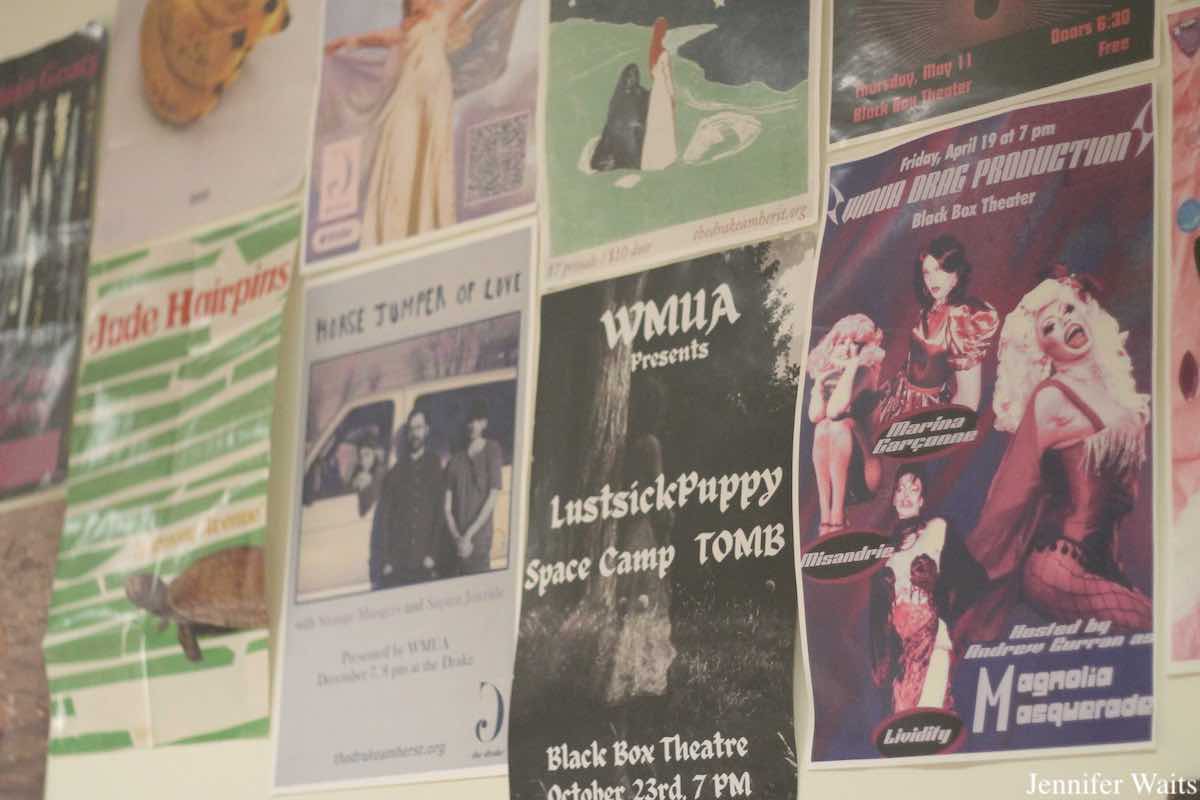
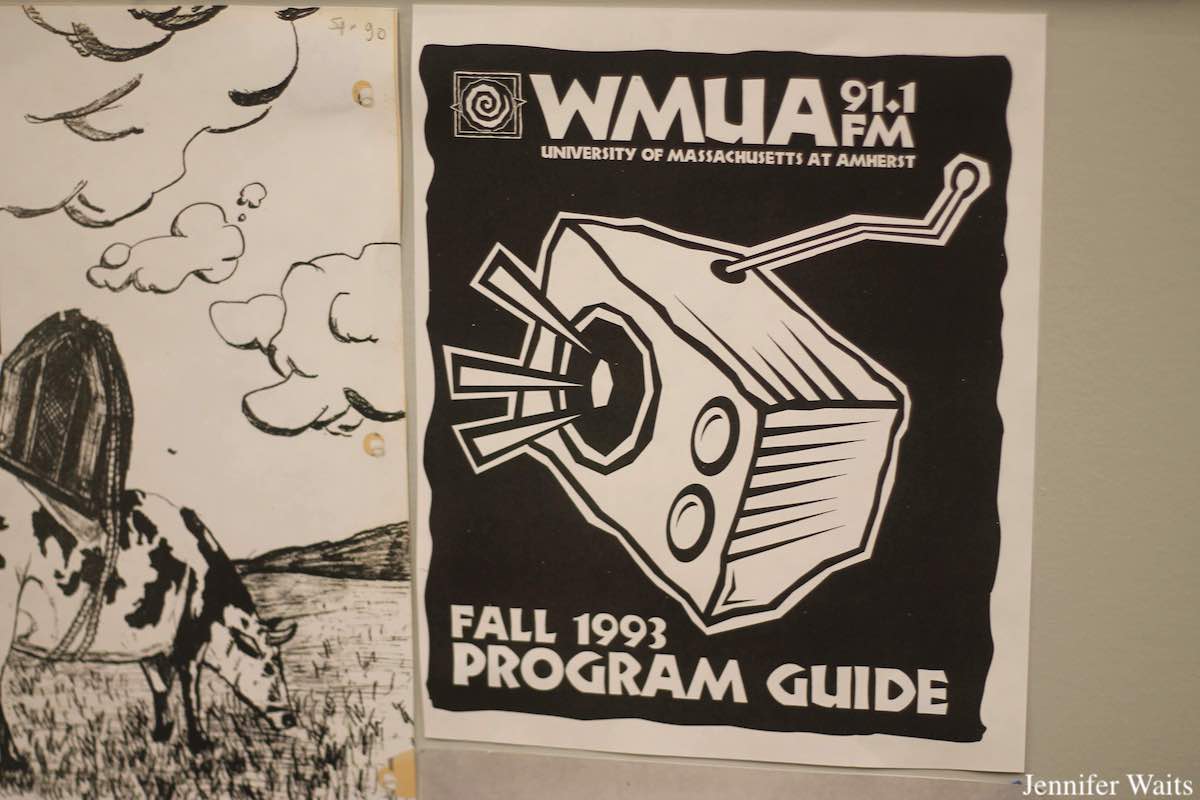
The hands-on, DIY craft aesthetic not only infuses Mix Tape Night, but can also can be seen on the walls of the station. Looking around WMUA some of these creations include a fabric stitched and painted WMUA banner, an artist’s sketch of the studio, show flyers drawn with colorful markers, and even a scrapbooky collage-style poster promoting a Friday radio show (“Public Disservice”) that incorporates doilies and magazine cut-outs. As I marveled at the work, Migliaccio agreed, saying, “We try to be as crafty as we can,” noting that there is interest in moving away from a reliance on technology to create flyers. “As much as it’s nice that certain things like Canva are super accessible, I think people generally love… [that] they’ve made it with their own hands,” she explained.
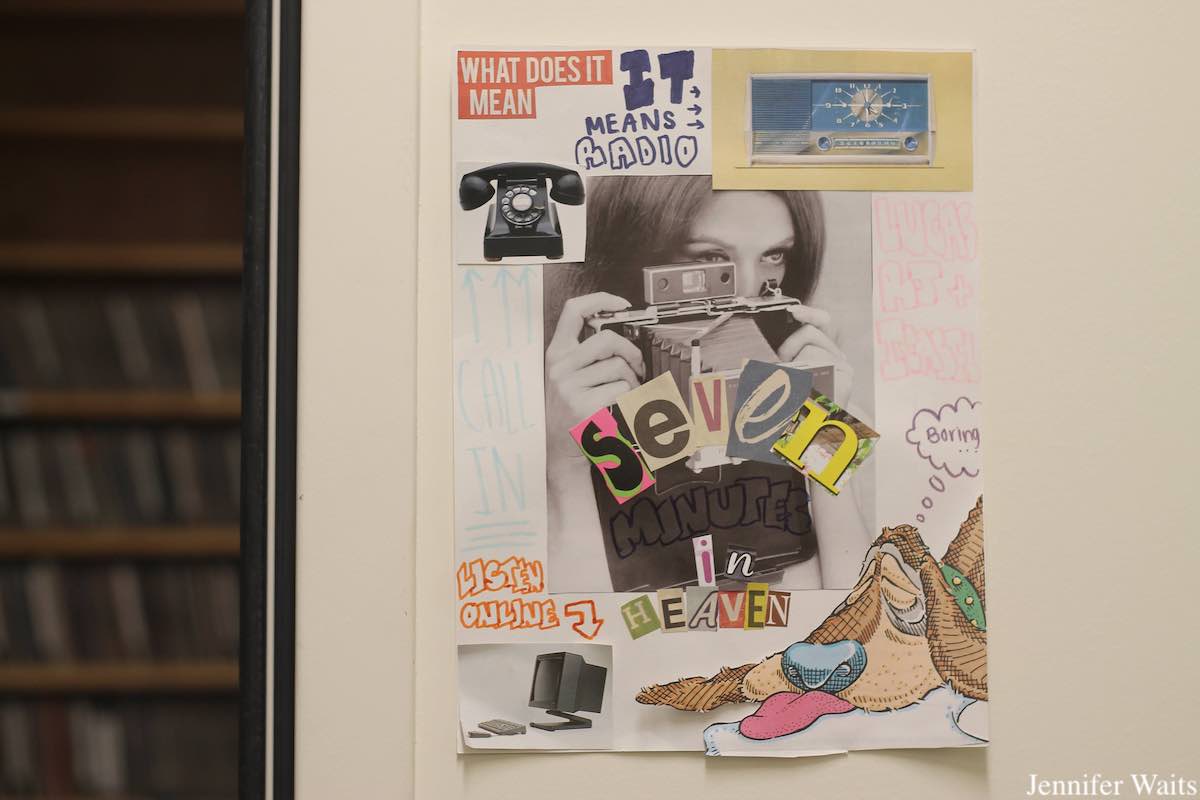
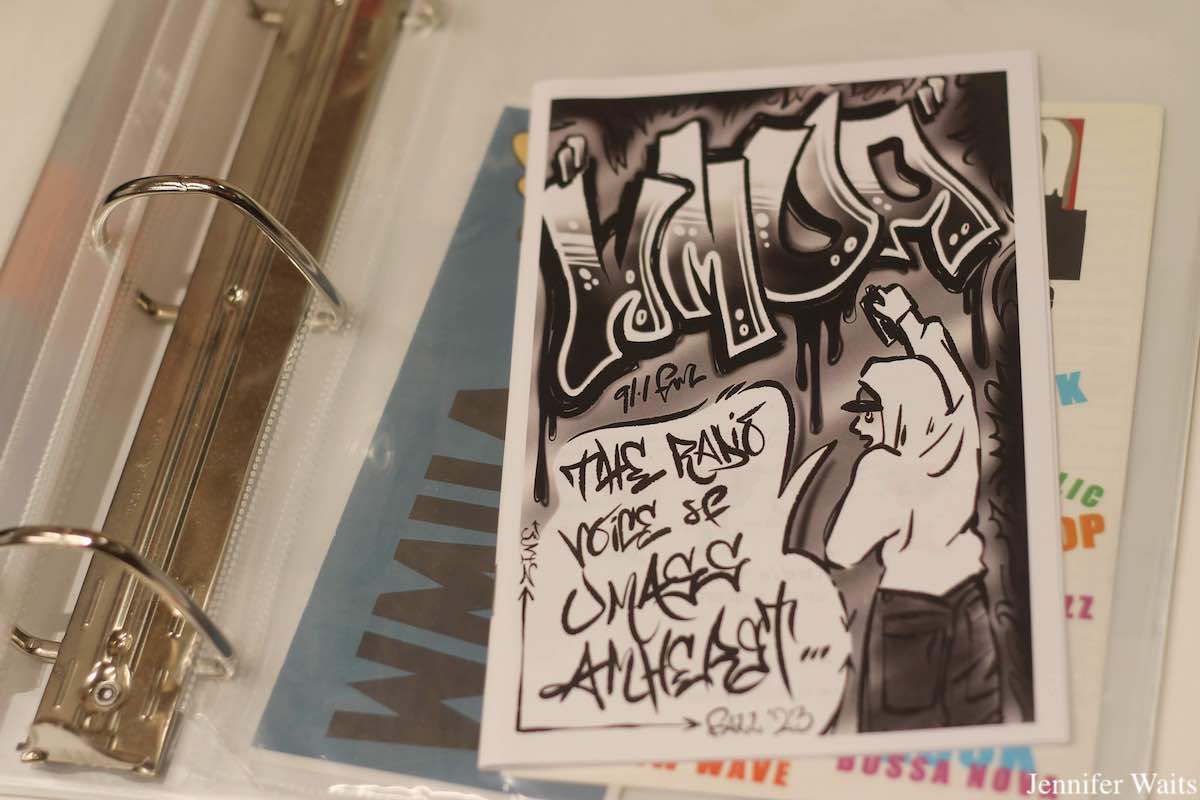
Another promotional item regularly created by WMUA is its annual zine, which is generally released in the spring. For Migliaccio, it’s one example of what makes college radio special. She explained that she relishes the opportunity to “show that we’re still using the CDs…still using the vinyl…still making the zines” and “still…designing our posters.” She counts herself among the DJs playing physical music and said that she’s seen an increase over her four years at WMUA. “I see people all the time…bringing in CDs and being super excited about what we have here” and “uncovering something and being super proud to show everyone what they found in our collection,” she noted.
Physical Music is Cherished and Used at WMUA
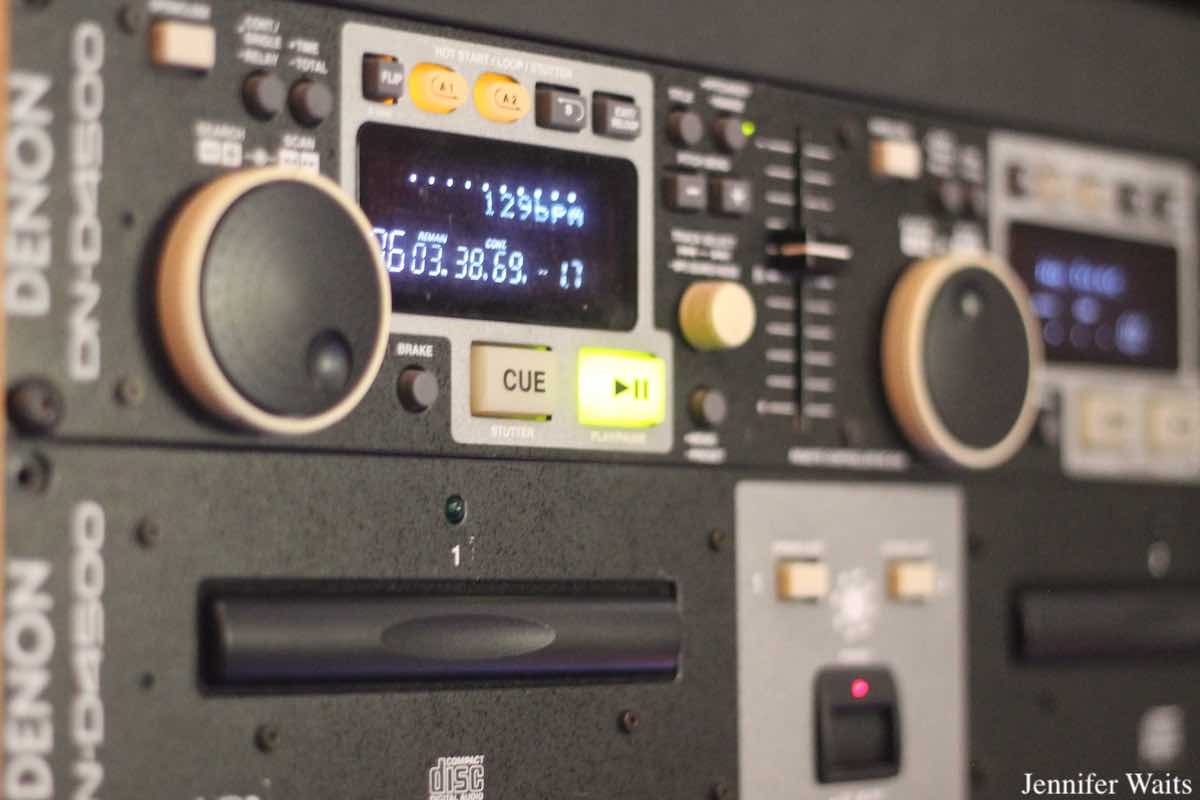
WMUA’s production director Owen Ray is also a fan of physical music and described doing a show using CDs and vinyl as an addictive and more personal experience when compared with playing music off a computer. He explained that, “when you’re switching between CDs and vinyl on air, you have the tactile feedback” from “hitting the buttons to play and stop” and “transitioning between faders.” As a result, “the actual auditory experience for the listener is much more specific to you” compared with a show in which one is “taking a break every three songs and hitting pause.”
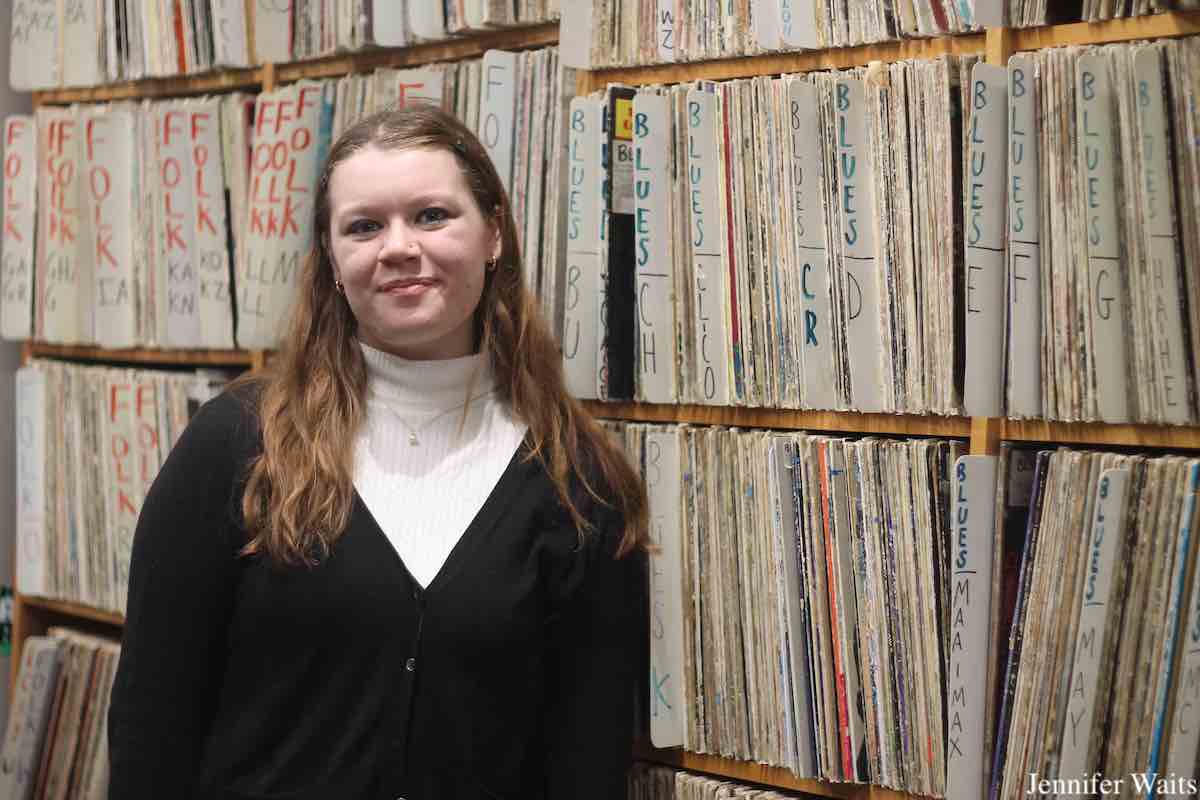
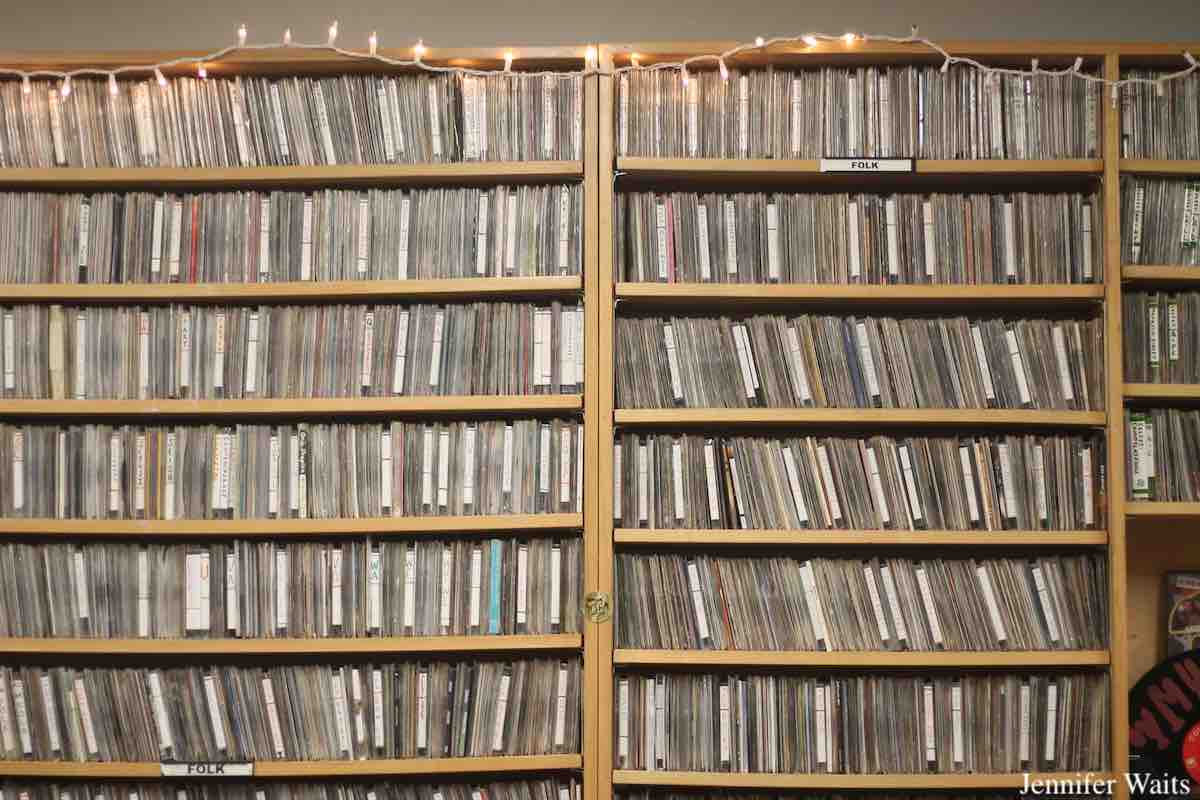
Ray also made sure to point out a unique characteristic of WMUA’s international music library. Arranged by part of the world and countries, the CD library was meticulously organized years ago by someone at the station. As we scanned the shelves, labels indicated music from Africa, Western Europe, The Middle East, The Americas, etc, with even more narrow categories for Madagascar, Bulgarian music, Tex Mex, reggae, etc. He said that he appreciates that this style of organization emphasizes “the actual diversity across countries, regions and artists,” adding that it’s “a really special part of what we have here because I like digging into this stuff too for my show.”
Mix of Shows Includes Variety of Genres, News & Sports
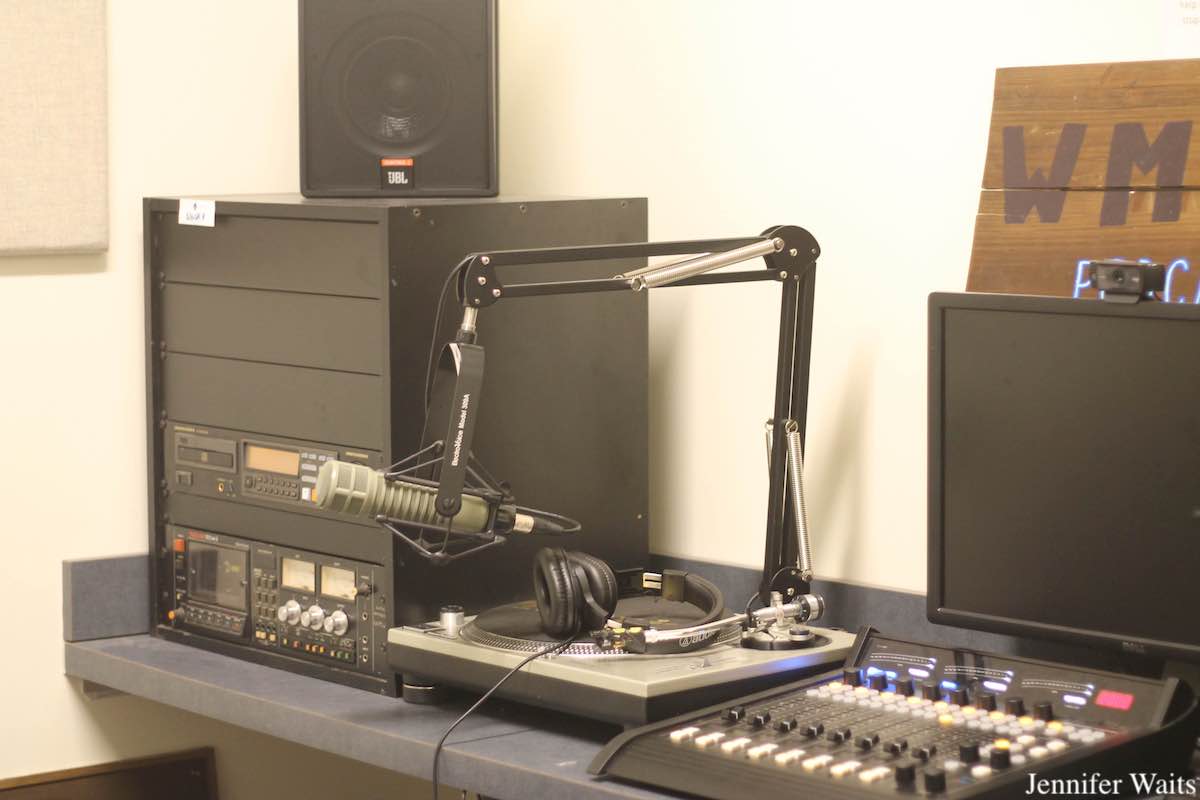
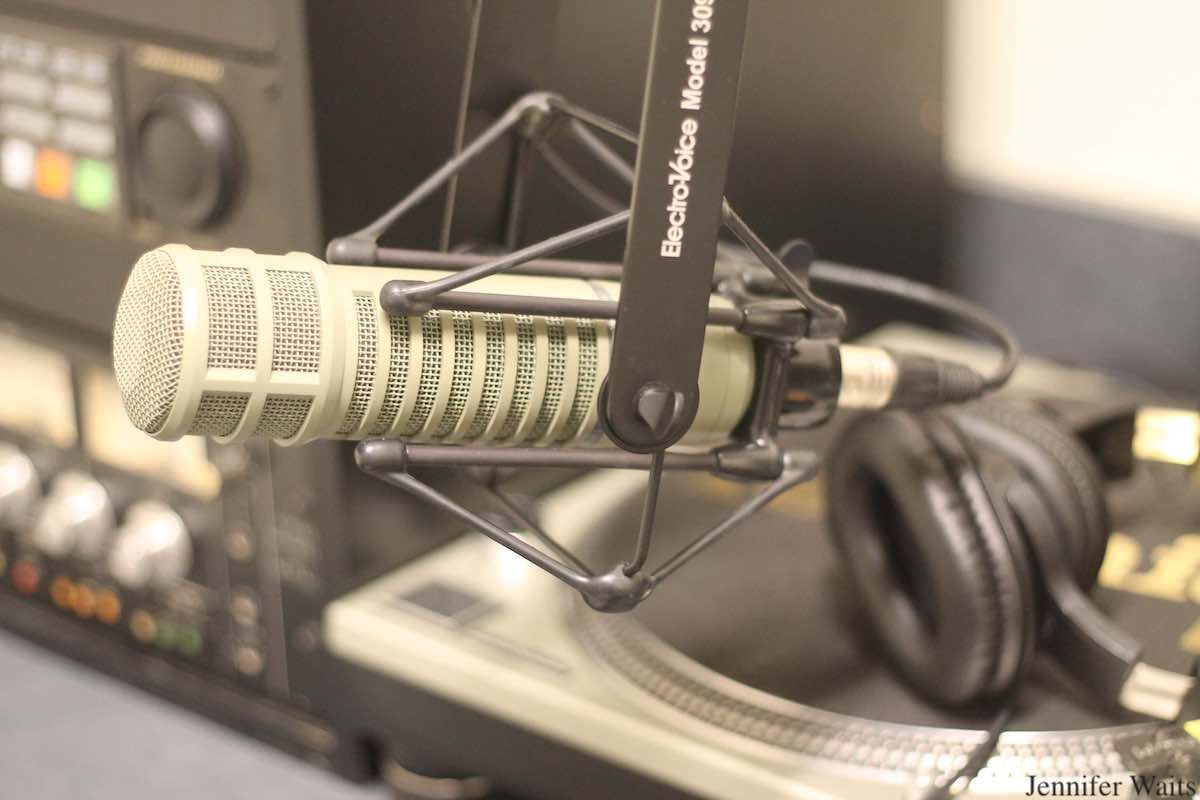
Not surprisingly considering its large music library, the studios at WMUA easily allow for the use of physical media. I spotted CD players and turntables throughout the station, with the main control room set up with an enviable five CD players, three turntables, and cassette decks. The range of programs include music shows that play punk, country, R&B, polka, jazz, goth and “dark music,” talk shows, news, sports, and more. Off the air, WMUA also runs a news and music blog, Off the Airwaves, which includes features as well as archives of programming.
A student-managed station, WMUA also welcomes non-student participants, which make up around 10 to 15 percent of the membership. Migliaccio said that many of the community DJs have been with the station for years and are a vital part of the fabric of WMUA. She shared that during DJ training each new broadcaster shadows an existing host, and noted that the long-time community DJs are especially welcoming. Some also have regular student co-hosts, including on the “Poet Talk” program.
WMUA History Snapshot
Since I’m always eager to learn more about a radio station’s backstory, it was exciting to see that WMUA works to preserve historic materials. Advisor Carson Cornelius brought binders full of vintage clippings and correspondence from the 1940s to the 1970s out of his office to share with me and also pointed out the WMUA Charter certificate on the wall, noting that it the station existed earlier than the charter would suggest.
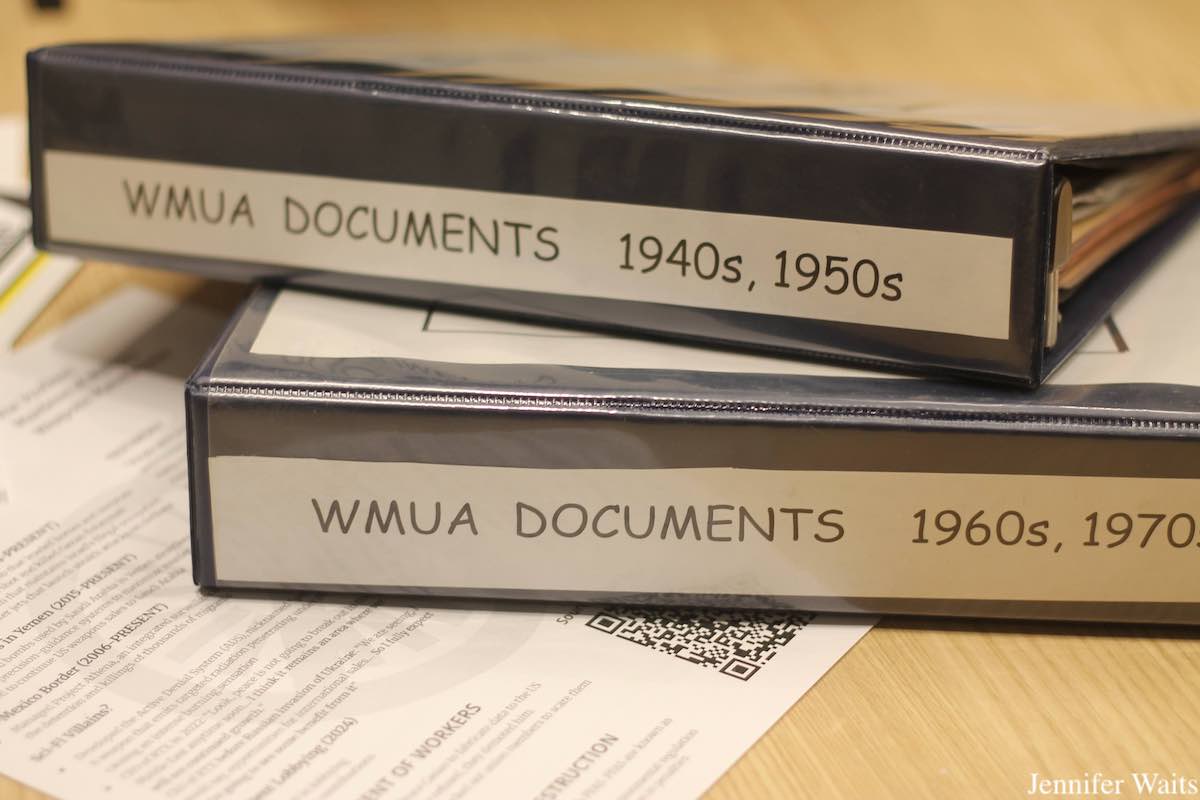
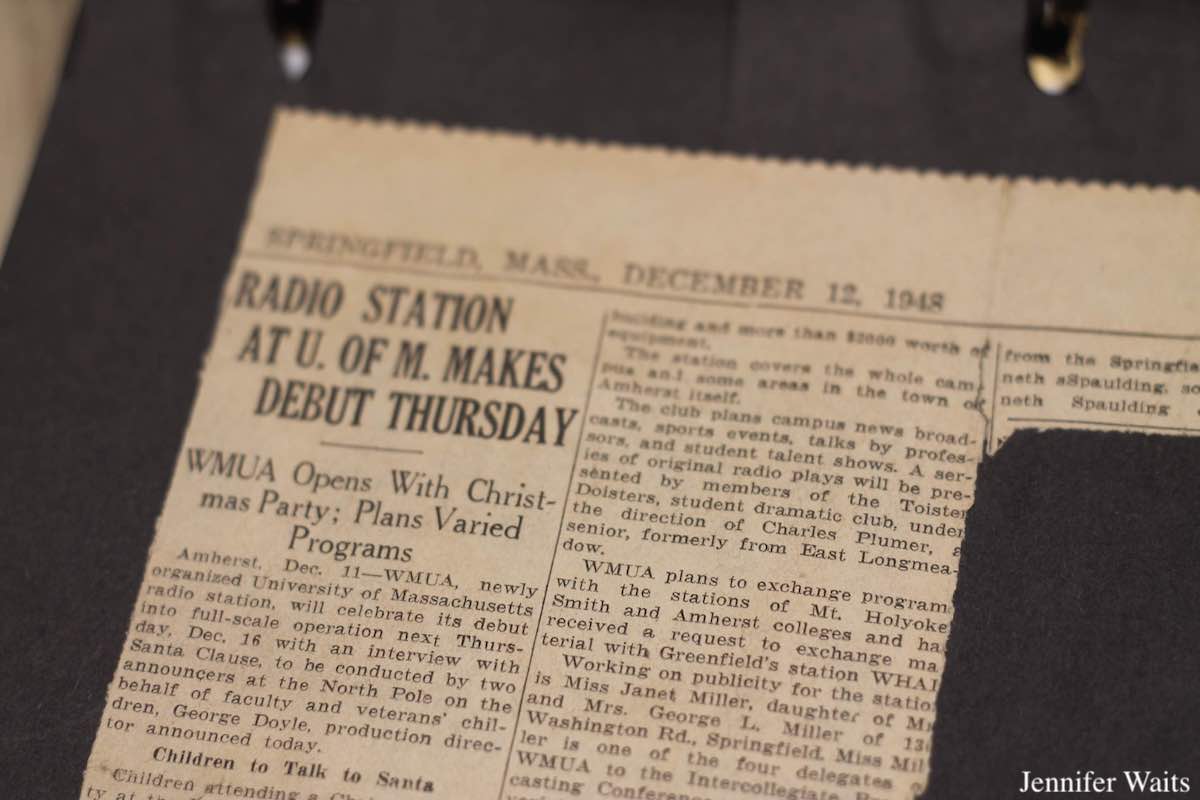
Flipping through the binders, one can trace the trajectory of the station. Newspaper clippings and documents describe WMUA’s debut over AM carrier current in late 1948 (including special Christmas programming that featured an interview with Santa Claus), its collaboration with local stations at Smith College and Amherst College to form a regional college radio network (the Pioneer Broadcasting System), and its move to FM in the early 1950s.
WMUA’s Radio Predecessors at Massachusetts State College
More than a decade before WMUA’s 1948 launch, radio programming was being created on campus. In June 1936, Massachusetts State College (the school’s name at the time) produced material for broadcast on the National Farm and Home Hour sponsored by the Federal Department of Agriculture. Transmission took place from the Farley 4-H club house (The Massachusetts Collegian, 6-6-1936) and garnered fan mail from alumni and other interested listeners from across the country. Other radio efforts during this time included shows broadcast from the studios of local stations.
In its January 5, 1939 issue, The Massachusetts Collegian reported that an $800 grant had been received by the college for the creation of a radio studio. By 1940, radio programming was being produced from the new Tower Room studio in the South College building for broadcast on local stations. Initial shows included “extension service programs” that were transmitted to WHAI, WSPR and WSYB as well as more student-oriented broadcasts that began in February 1940 featuring skits, music, sports reports, music and interviews (Index, 1940).
Student Radio Begins on Campus with WMSC and WUMM
As the fall semester began in 1946, student radio station WMSC was in the works and debuted in April 1947 over 915 K.C. However, those broadcasts were short-lived after reception reports from the 10 watt station were received from nearby towns, indicating that it had exceeded its permitted campus-only range. After exploring “power current” methods, the club was given call letters WUMM (pronounced “woom”) by the Intercollegiate Broadcasting System (IBS) in December 1947 and launched carrier current transmissions in spring semester 1948 (The Massachusetts Collegian, December 4, 1947). During that term, the station “presented the campus with a program of world, local, and sports news; disc jockey shows, and forums on current events” according to the student yearbook (Index, 1948). The Radio Club had over 100 members at the time.
WMUA Debuts Campus-Only Broadcasts in 1948
The next semester, in fall 1948, radio revamped again at UMass. Participants from University of Massachusetts at Fort Devens’ station WFDM joined forces with WMSC/WUMM, contributing equipment as their campus prepared for its closure in 1949. After the two stations merged, WMUA was formed, launching in December 1948. According to “History of WMUA 1948-1963,” the call letters were selected as a reference to “Massachusetts University in Amherst” (at this point the school was called University of Massachusetts Amherst), but the station was also jokingly called “Western Massachusetts Undertaking Association.” Within a few years, in 1952, WMUA was granted its FM license and continues over FM today.
Thanks to WMUA + Station Tour Archive
Thanks to Lyvia Migliaccio for the tour of WMUA and to everyone else at the station for being so helpful and welcoming. This is my 198th radio station tour report and my 139th college radio station tour. You can view the entire collection of my radio station visits in numerical order or by station type in our archives.