

On Friday, October 3, as World College Radio Day was being celebrated across the country and around the globe, students were locked out of their long-time home at college radio station WCSB 89.3 FM at Cleveland State University. Word soon spread that a deal had been struck between university leadership and local public radio organization Ideastream, allowing the group to utilize the WCSB frequency in order to broadcast jazz music programming from its JazzNEO service, which had previously been online and on 90.3 HD2.
Student leaders at WCSB were not informed of this plan until the day that it was announced to the public. Soon after, the WCSB website (see the last capture of their former website on Archive.org) was taken down and WCSB leaders and participants were escorted out of their station by the police (see video of police arriving at WCSB from News 5 Cleveland). Unaware of what was about to transpire, WCSB staff had been excitedly planning for their Halloween bash and for their upcoming 50th anniversary.
WCSB Supporters Voice Disappointment with the Deal
In the ensuing weeks, WCSB supporters have been voicing their disappointment in this deal by holding protests, writing letters, initiating petitions, speaking to the media, participating in panel discussions, and engaging with local politicians. They have also built a new website, XCSB – WCSB Reborn. As a result of these efforts, on October 20, the Cleveland City Council adopted an emergency resolution “supporting the students and station members working to regain access to the 89.3 FM radio frequency and urging Cleveland State University to fully restore WCSB radio to its students.” The resolution reads in part that, “…this Council unequivocally supports the students and community members who continue to organize to reclaim their station and the culture of student-run WCSB 89.3 FM.” In response, there have been more than 250 public comments in support of the resolution.
Panel Discussion on Cleveland Radio Show Includes CSU and Former WCSB Leadership
Local media outlets in Cleveland have been reporting on the WCSB shut-down and Ideastream even hosted a panel discussion on its editorially-independent public affairs program, The Sound of Ideas, on October 14. During that live radio show, the most recent WCSB General Manager Alison Bomgardner, former WCSB General Manager Lawrence Daniel Caswell, and numerous callers articulated what the loss of the FM signal means to students and the community. Cleveland State University President Dr. Laura Bloomberg and Ideastream President and CEO Kevin Martin spoke about their rationale for launching this “strategic partnership,” which took student radio off the local airwaves.
During the show on Sound of Ideas, Caswell spoke of his experience at WCSB as being “one of the most foundational things that I’ve ever done in my life.” He added that, “WCSB’s mission was always to provide programming and music to communities that were not otherwise served by radio in Northeast Ohio. It was the first really collaborative community that I was part of.” Bomgardner added that “89.3 was a laboratory of the cool,” explaining that the station pushed boundaries. While not offering a plan forward, Bloomberg complimented the former WCSB, saying “it’s a well-run student organization” and “should continue.”
Additionally, former WCSB advisor Daniel Lenhart joined the show by phone to express his concerns about the current situation at the radio station and the factors leading up to it. He also pointed out that the station “was started by students, not by the university” and that WCSB was “student-driven from the get-go.” After a flurry of calls against the deal, Bloomberg jumped in to say that “those are not the only voices we’re hearing” and suggested that “the pushback has a silencing effect on other people.” To counter the dissent, she argued that there was positive buzz for the deal during a fall visit day with prospective students and families that took place one day after the announcement. She stated that on that day future students were “excited about the possibilities.”
Details of Partnership Outlined in Signed Agreements Between CSU and Ideastream
According to a Program Service and Operating Agreement (obtained by Signal Cleveland) signed by Cleveland State University and Ideastream on October 3, 2025, Ideastream will “provide noncommercial jazz music programming, educational news, and information programming” using the call sign WCSB. While there is no promised payment for this service, Ideastream will reimburse Cleveland State for “FCC-allowable operating expenses.” The agreement also allows Ideastream the “right to purchase the Station, including all assets used or useful in the operation thereof, by matching any bona fide offer received by Licensee…”
Additionally, a Memorandum of Understanding (also obtained by Signal Cleveland) outlines further details of the deal between Cleveland State University and Ideastream. Notably, the MOU states that on the effective date of the agreement, “Ideastream will assume day to day operation of the Station’s digital platforms and products, including but not limited to the Station’s website, live streams, mobile applications, on-demand platforms, social media accounts, e-newsletters, and audience performance data systems” and “the WCSB.org URL shall be redirected to Ideastream’s website…”
Further, the MOU states that Cleveland State “covenants and agrees that during the term of the PSOA, the Station will be its sole radio station,” which calls into question whether or not the university has plans to allow student radio to continue in any form. Additionally, the MOU prohibits Cleveland State from soliciting “donations for JazzNEO programming and services or any services that compete for listeners or financial support with JazzNEO.”
CSU President Bloomberg to Receive Spot on Ideastream Board of Trustees and Students to Receive Internships
Perhaps the most surprising element of the agreement is that Ideastream is granting a seat on their Board of Trustees to the President of Cleveland State University during the term of the partnership. This includes voting rights. Ironically, during the radio interview on The Sound of Ideas, President Bloomberg acknowledged, “I’m not a media person,” when asked about details of the operating agreement.
The most-touted aspect of the deal for Cleveland State is that the partnership will offer “learning opportunities and talent development” according to the MOU. This includes “paid and for-credit internships, classroom-level projects and other opportunities” for CSU students in the fields of “journalism, television, and radio production, marketing and graphic design.” Another perk for CSU is that Ideastream will air underwriting announcements across its services.
Meanwhile, many questions have been circulating about what sparked this partnership. When asked, Bloomberg said, “I didn’t specifically set out and say ‘let’s end student radio’.” In response, Caswell held her to task for not including students in the conversation. He pointed out that WCSB was “funded primarily with student tuition fees and community support.” Bomgardner added, “If students had their way, if I had my way…we would have an FM signal and that would be our preference.”
Student Leaders from WCSB Address College Radio Convention
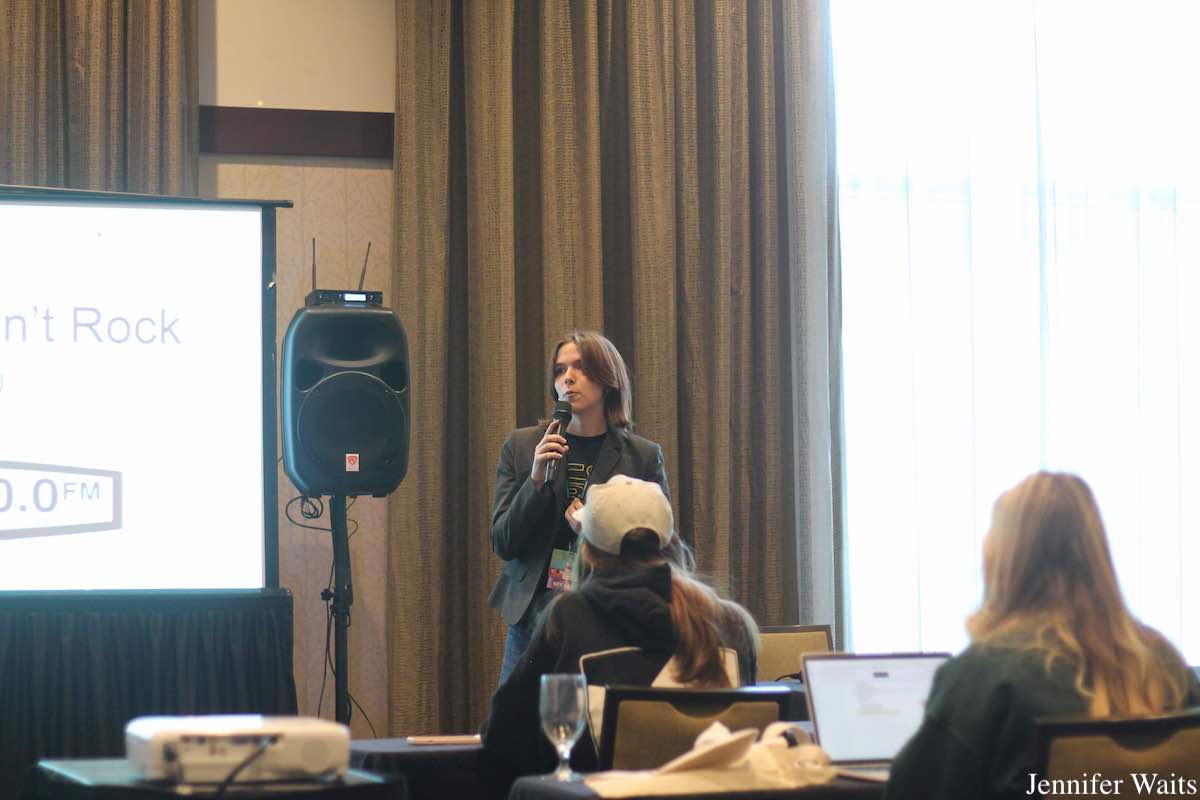
On Friday October 24, Bomgardner and former WCSB Business Manager Liam Main (who are both seniors at Cleveland State University) addressed a packed audience at a student media conference in Denver, Colorado. During their session, Cleveland Doesn’t Rock: WSCB vs CSU, at College Broadcasters Inc.‘s National Student Electronic Media Convention, they not only shared the story of what transpired with the station shutdown, but also offered tips and examples of warning signs that other college radio stations should watch out for. Main said that by speaking out and taking action this could be a way to show organizations that “we won’t allow you to replace college radio.”
While at the CBI convention, I sat down with Bomgardner to learn more about this fight. Despite all the challenges, she started the conversation by saying, “We’re in this really hopeful place now.” Taking a very direct, strategic stance, she and many others are working hard to try to get the FM signal returned for student use. She was excited by all the community support, telling me that she had just learned that a private individual had flown a plane over Cleveland State University that day with a message reading “CSU-Ideastream Sold ‘Em Out: Restore WCSB 89.3.” Bomgardner argued that in fighting this deal, “we have a chance to set a new precedent.”