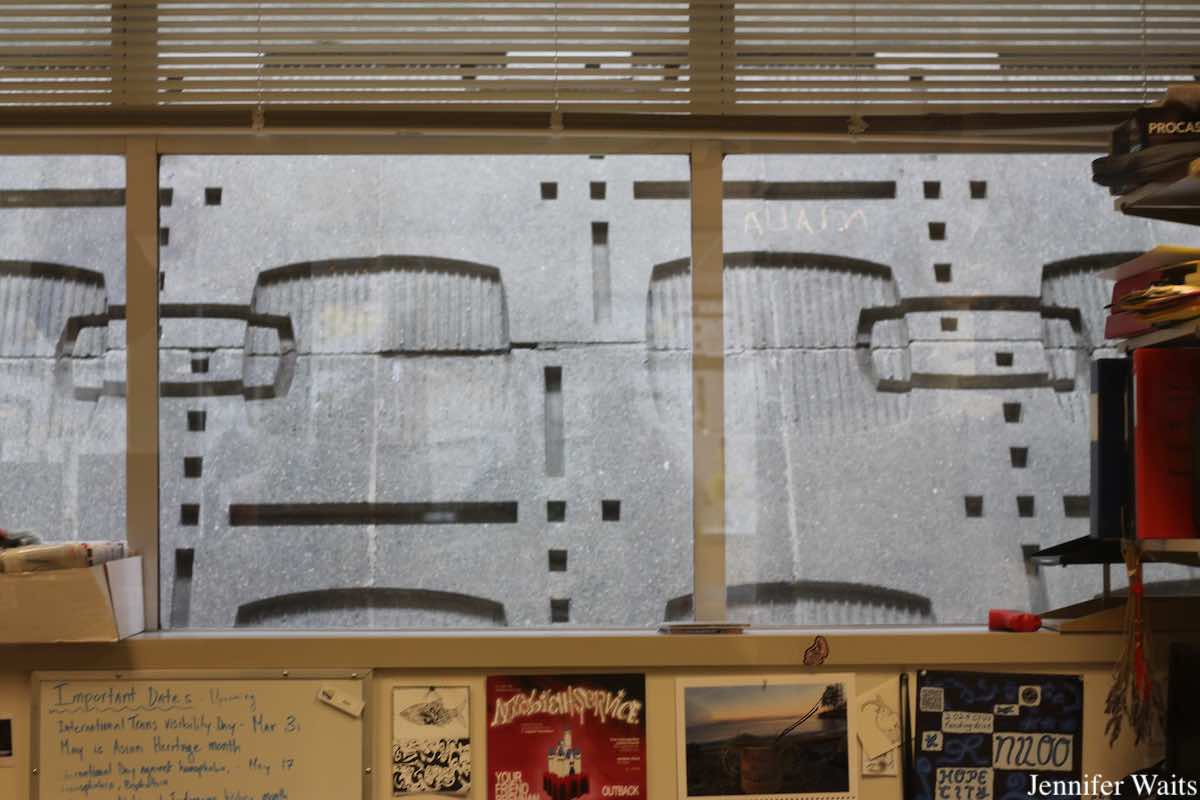
Underground is more than a metaphor for countless college radio stations which may play edgier music but are also housed beneath the earth. I’ve seen many basement digs in my travels, but none quite like the subterranean space occupied by University of Victoria’s campus and community radio station CFUV 101.9 FM in Victoria, British Columbia in Canada. Located on the lower level of the school’s modernist-brutalist Student Union Building (the SUB), the station’s windows face an angled concrete wall. When looking out of the CFUV offices and studio, it feels a bit like you are observing the world from the bottom of a fish bowl. This is heightened by the presence of tables and chairs up above the moat-like well outside of the station windows. Although faces are hard to detect, dangling legs are visible from below. CFUV Station Manager Rowan Grice told me that this odd architecture has led to some atypical interactions with listeners, with some people climbing down the wall to deliver music requests to the on-air DJs.
Welcoming Community at CFUV
Promoting itself as “offbeat community-led radio since 1984,” CFUV is made up of both student and non-student participants who work “to provide an alternative to commercial radio” and “to uplift marginalized and underrepresented voices.” Volunteers are invited to not only host radio shows and podcasts, but are also provided training in audio and video production.
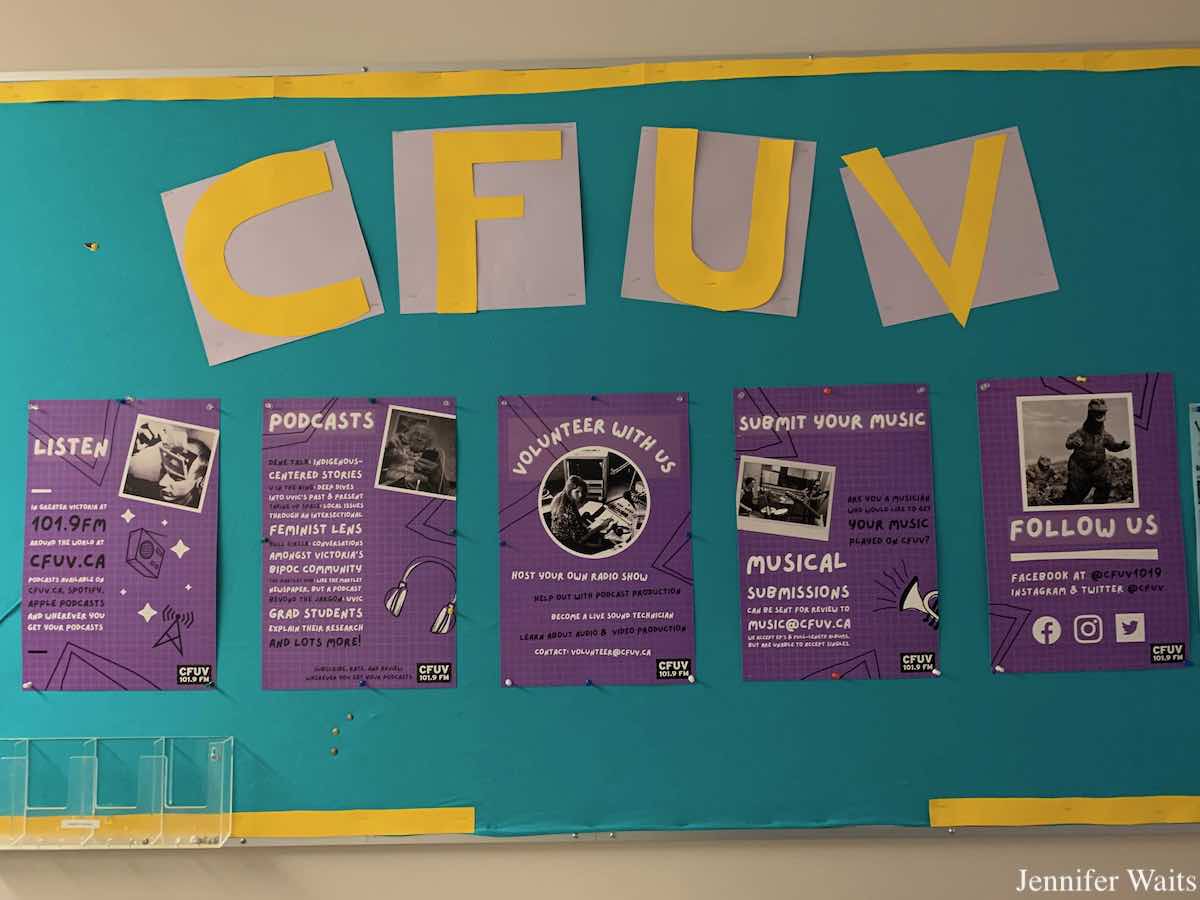
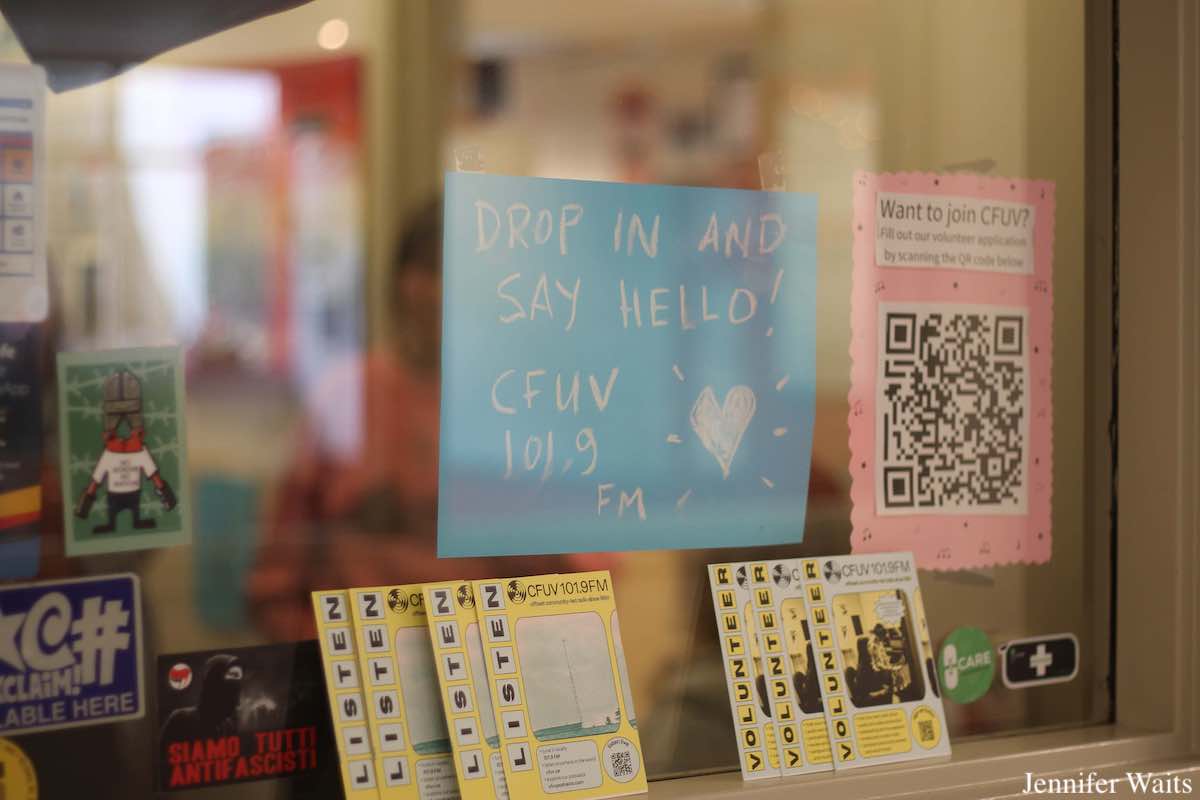
Before even stepping into the station’s lobby, it was clear to me that CFUV was a welcoming space. A bulletin board in the hallway is decorated with five purple posters, each outlining different ways that one can participate at CFUV. The posters promote listening to the station, tuning in to podcasts, volunteering, submitting music, and following CFUV on social media. Additionally, hand-drawn speech bubbles reading “learn new skills,” “build community,” “play local,” and “collaborate” are affixed to the CFUV window, touting the benefits of joining the station. Just below the paper signs is a melted vinyl Ashlee Simpson record, a sign that says “Drop in and Say Hello!” and a QR code that links to a volunteer application.
CFUV Open House for NCRC Attendees
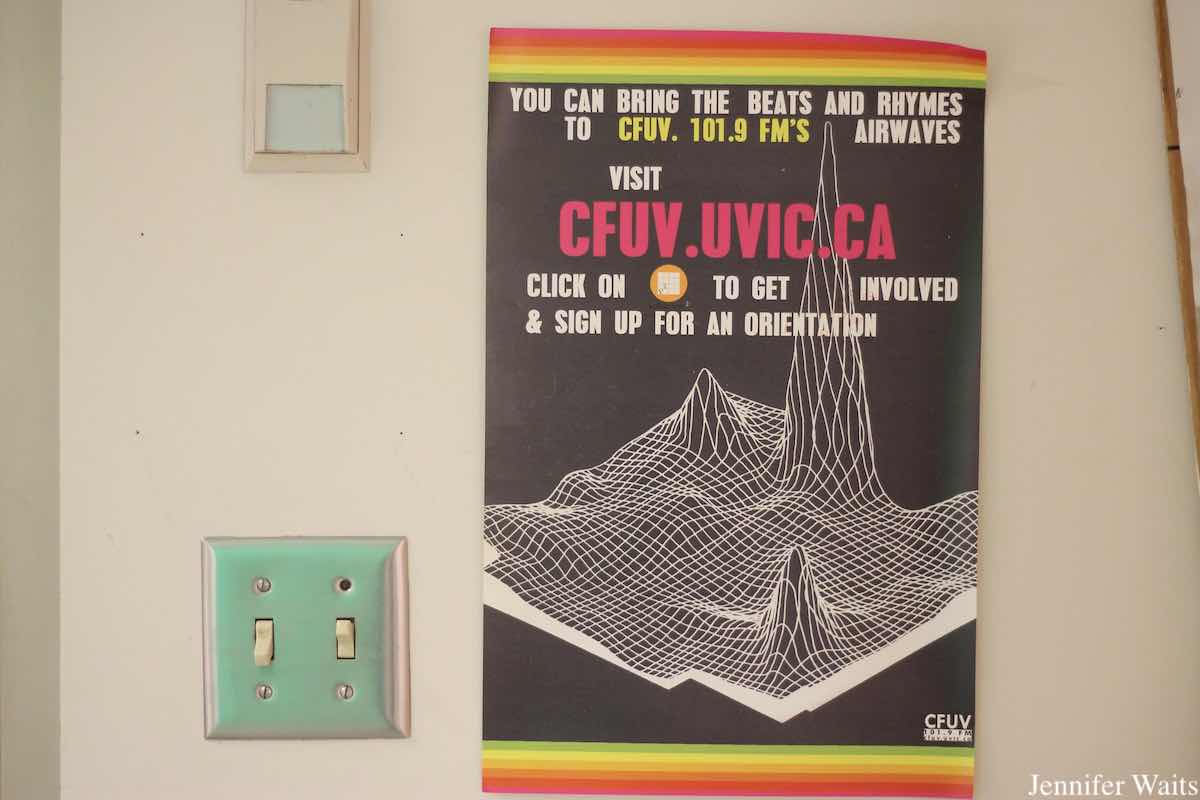
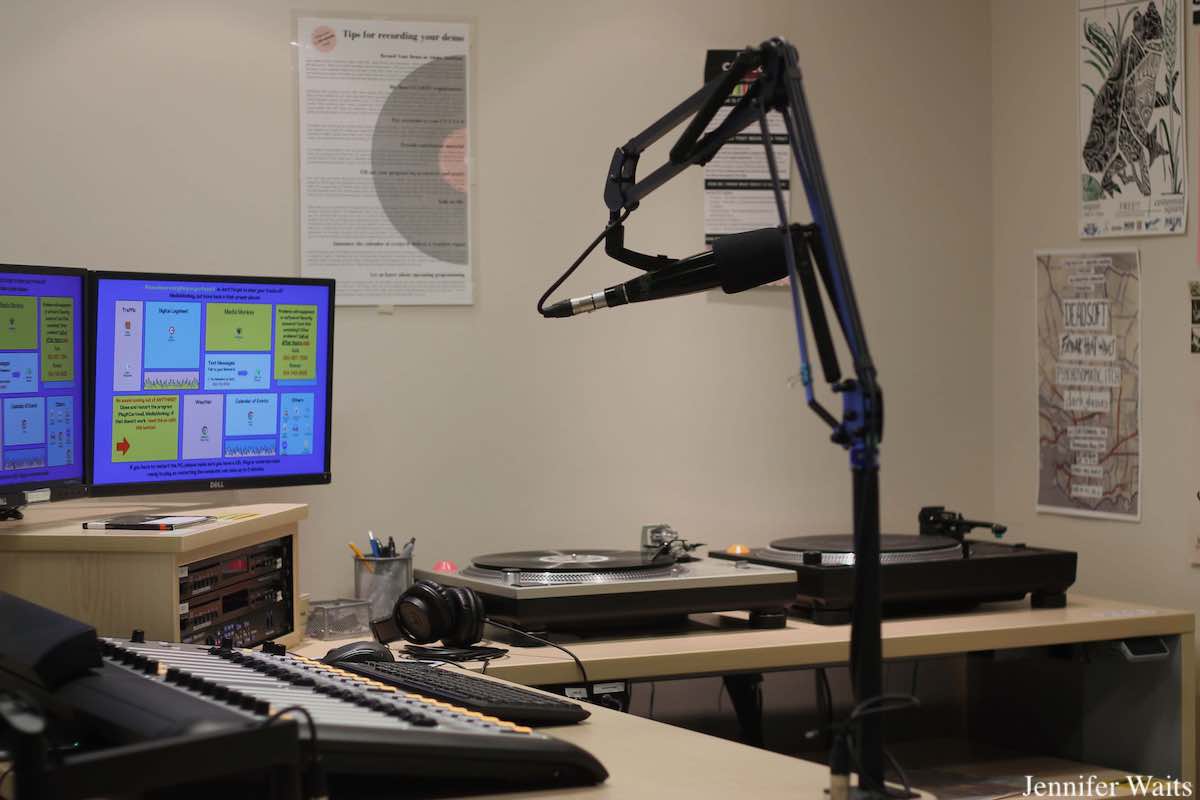
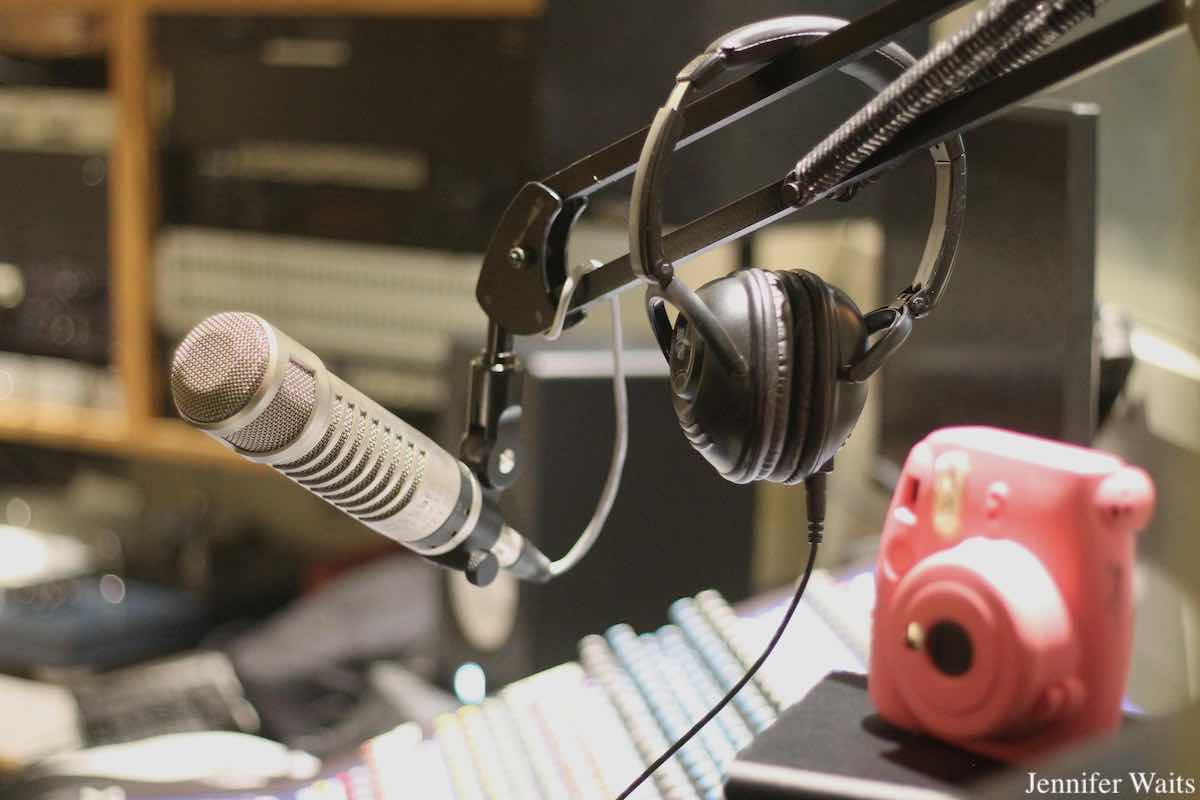
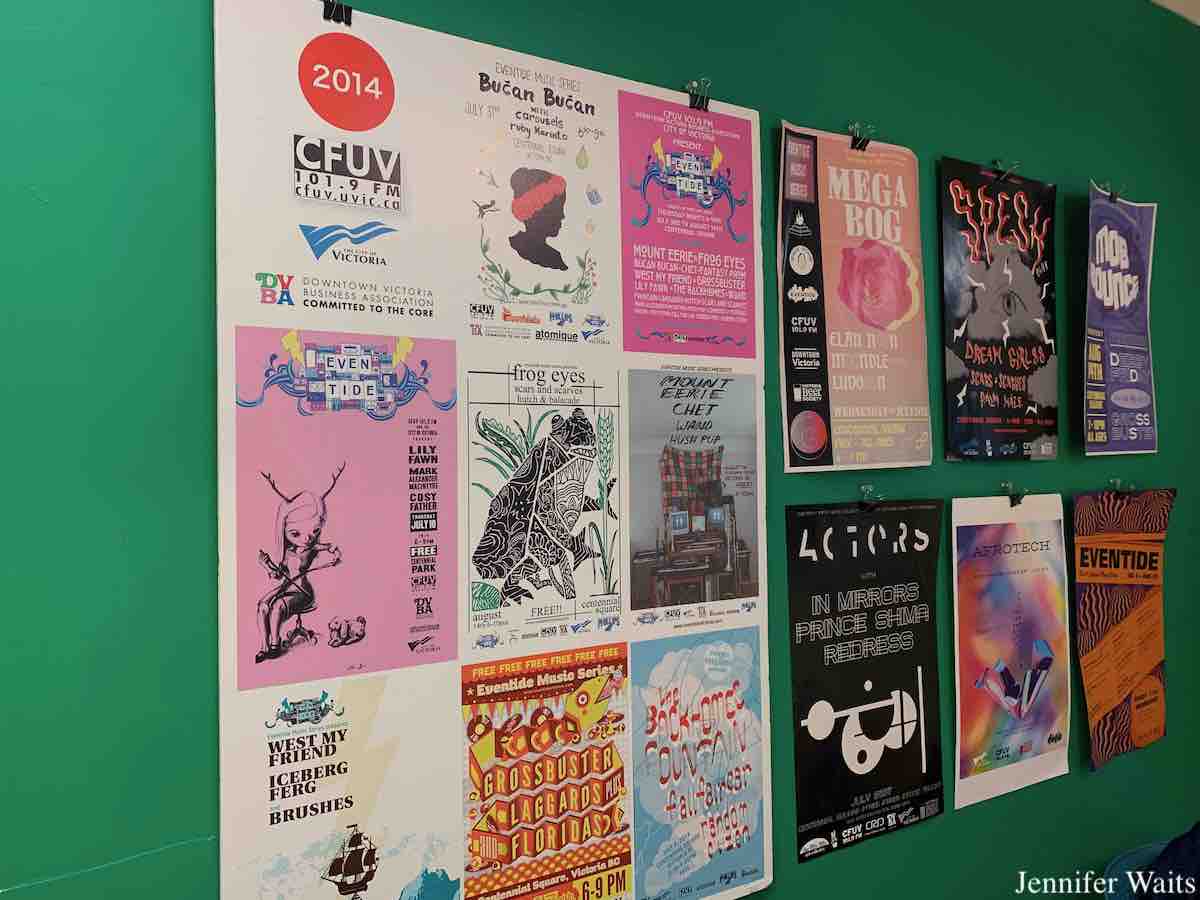
During my June 2025 visit to CFUV, the station was buzzing with activity. I was amongst a large contingent of radio people who were in BC for the National Campus and Community Radio Conference (NCRC). As we all crammed into the station and chatted about radio, folks from CFUV led tours and answered questions about their lively station. Posters for past and future events blanket the studio walls, a well-organized record library is full of music, and a performance studio is set up for local and visiting musicians. Live performances take place every Friday afternoon during the “Basement Closet Sessions” show and archived episodes can be heard on the CFUV Bandcamp page and viewed on CFUV’s YouTube page. An arrangement of Polaroid photos on the studio wall documents recent guest musicians and bands, including Bongwitch, Molly Pocket, Cistern, Stax, Steel Cut Oats and Ghost Darling.
Emphasis on Local Music, Curated Record Library
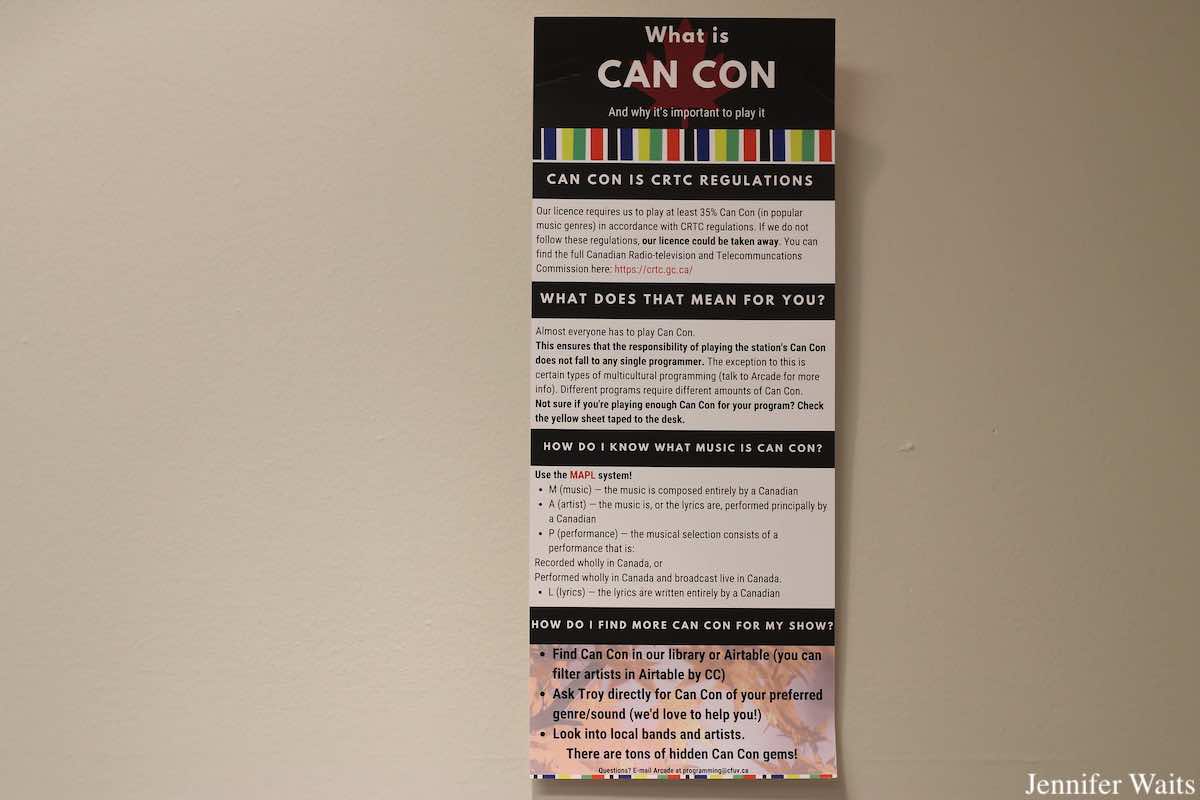
Local material is emphasized at CFUV, which also must abide by Canadian Content (CanCon) regulations set by the Canadian Radio-television Telecommunications Commission (CRTC). According to the CRTC, “English-language and French-language stations must ensure that at least 35% of the Popular Music they broadcast each week is Canadian content.” Additional rules apply for “special interest music,” for which 12% of these selections on campus and community radio stations must be Canadian.
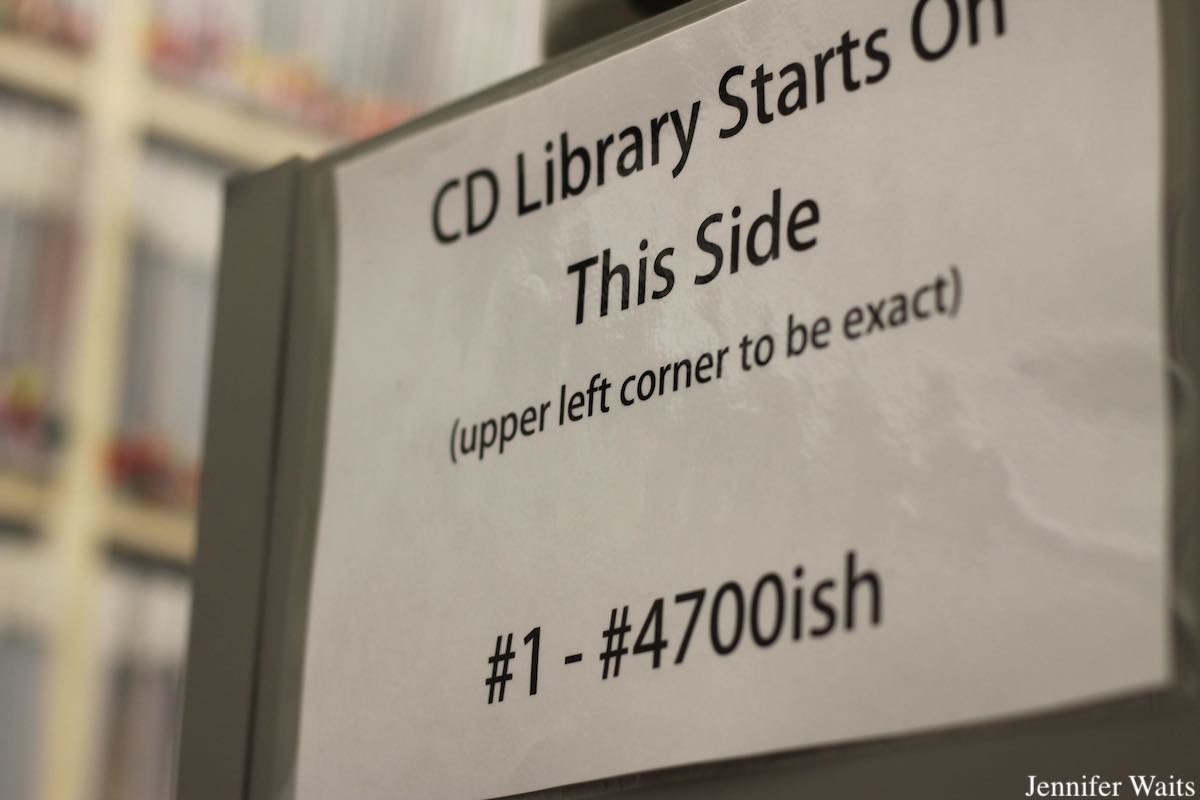
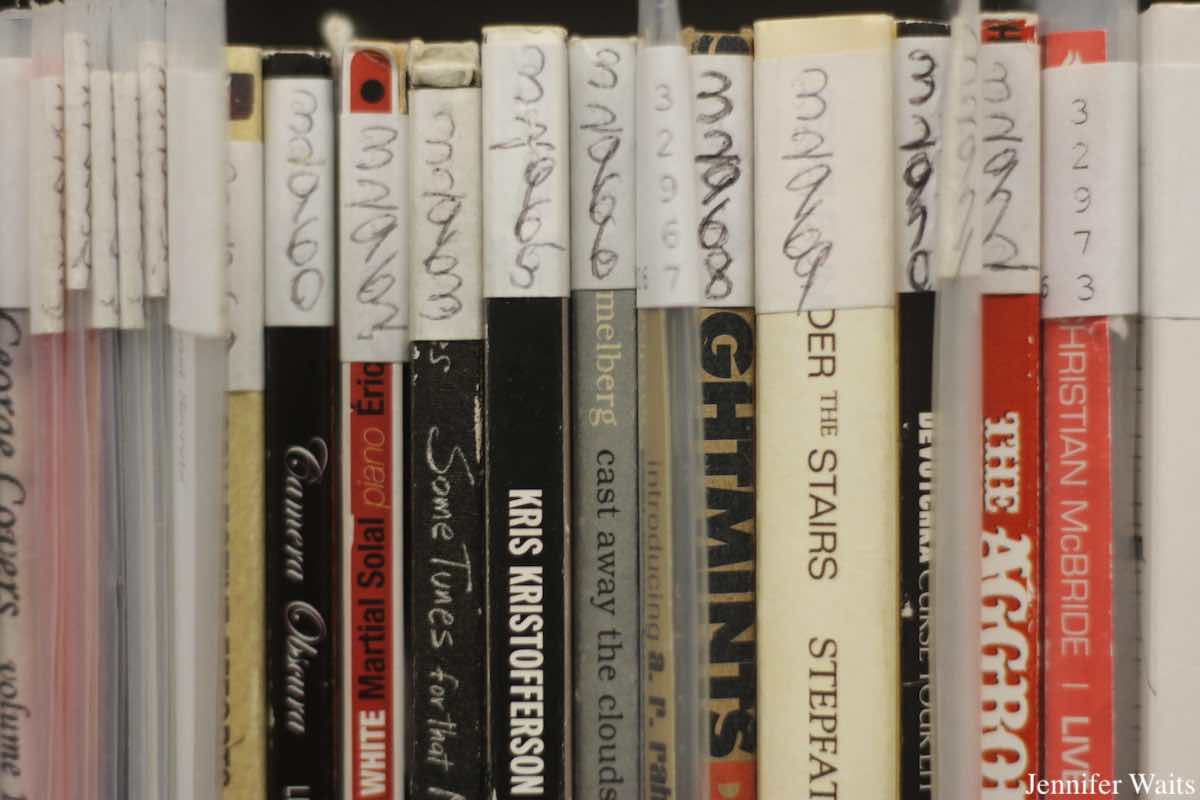
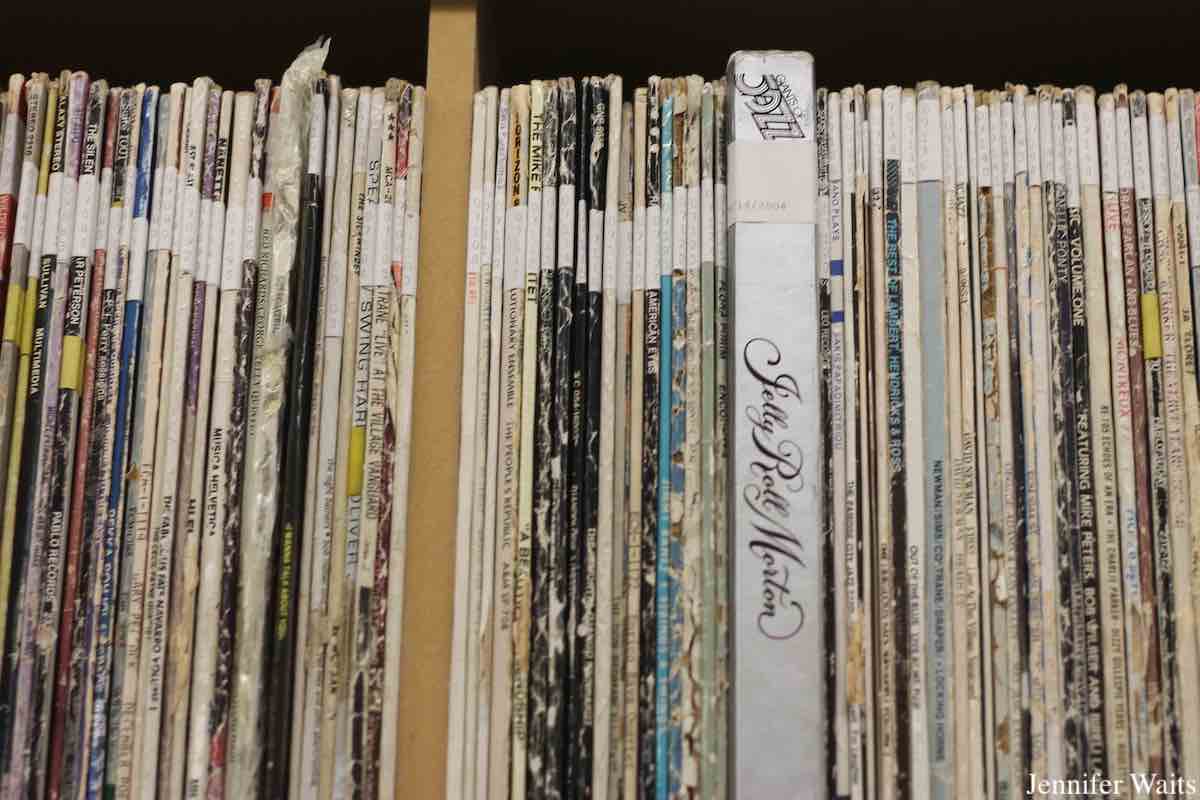
For CFUV, with an ever-expanding record library, the decision was made to be more selective about adding physical music. Whereas the station is mostly adding digital releases, exceptions are made for local music and hard-to-find items. The physical library is organized in chronological order, based on when materials were added to the collection. In the past, the coding system was written down in books, so that DJs could search for a particular album’s designated number, but today the items are listed in a database accessed via a tablet. In addition to catalog numbers on the records and CDs, color codes indicate genres and CanCon selections. For CFUV, experimental music gets marked with a silver label and hip hop is marked with an orange label, for example. Additional two-letter codes are applied to genres and Canadian content as well as releases produced by women (Wm), local artists (Lc), Indigenous artists (In), French materials (Fr) and soundtracks (Sk).
Diverse Programming Schedule
As a result of this wide variety of music, the CFUV schedule is quite diverse and includes local and syndicated music and spoken word programming. Music shows encompass classical, jazz, blues, experimental, multicultural, metal, punk, folk, country, roots and electronic genres. Additionally, CFUV has a number of podcasts, including several focusing on topics related to indigenous peoples and culture, one created by incarcerated artists (“Dark Traveller”), one presented by the independent student newspaper The Martlet (“The Nest”), a few hosted by classes (“Gender 305: Gender and International Human Rights”) and some by student groups (“Pulse Zine” podcast from the Students of Colour Collective).
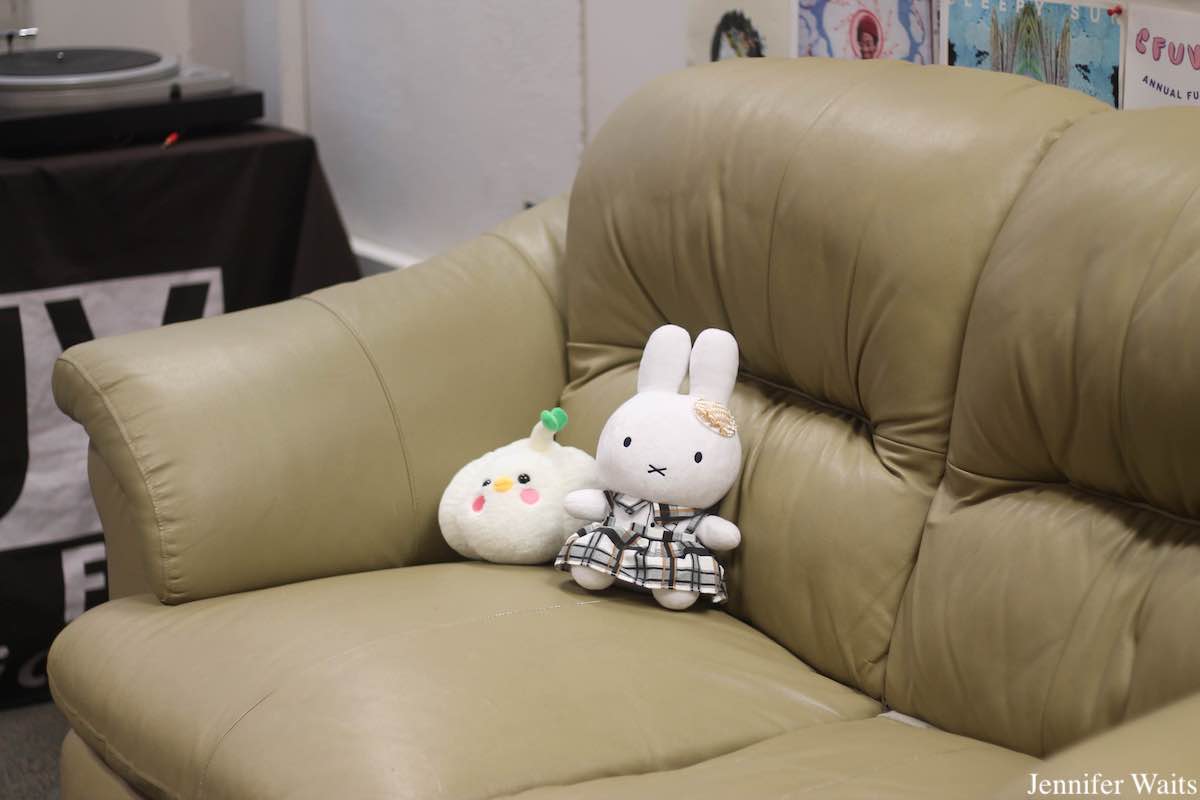
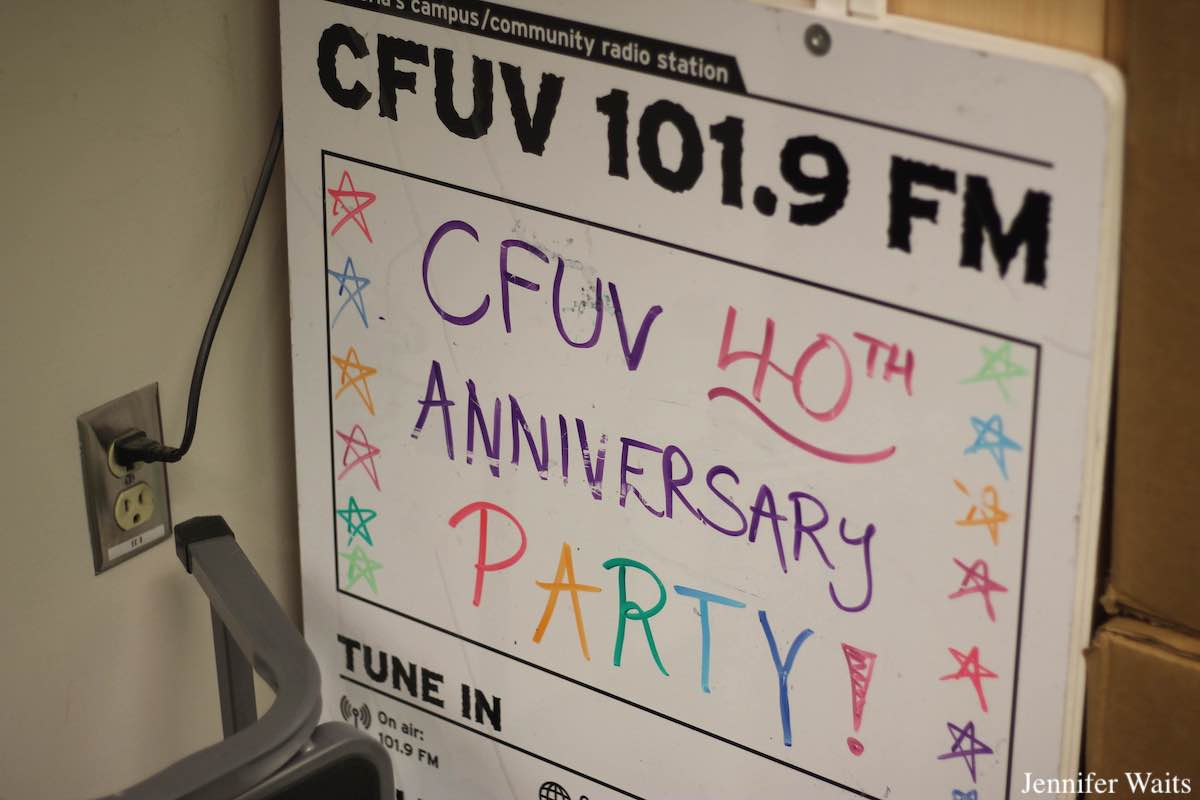
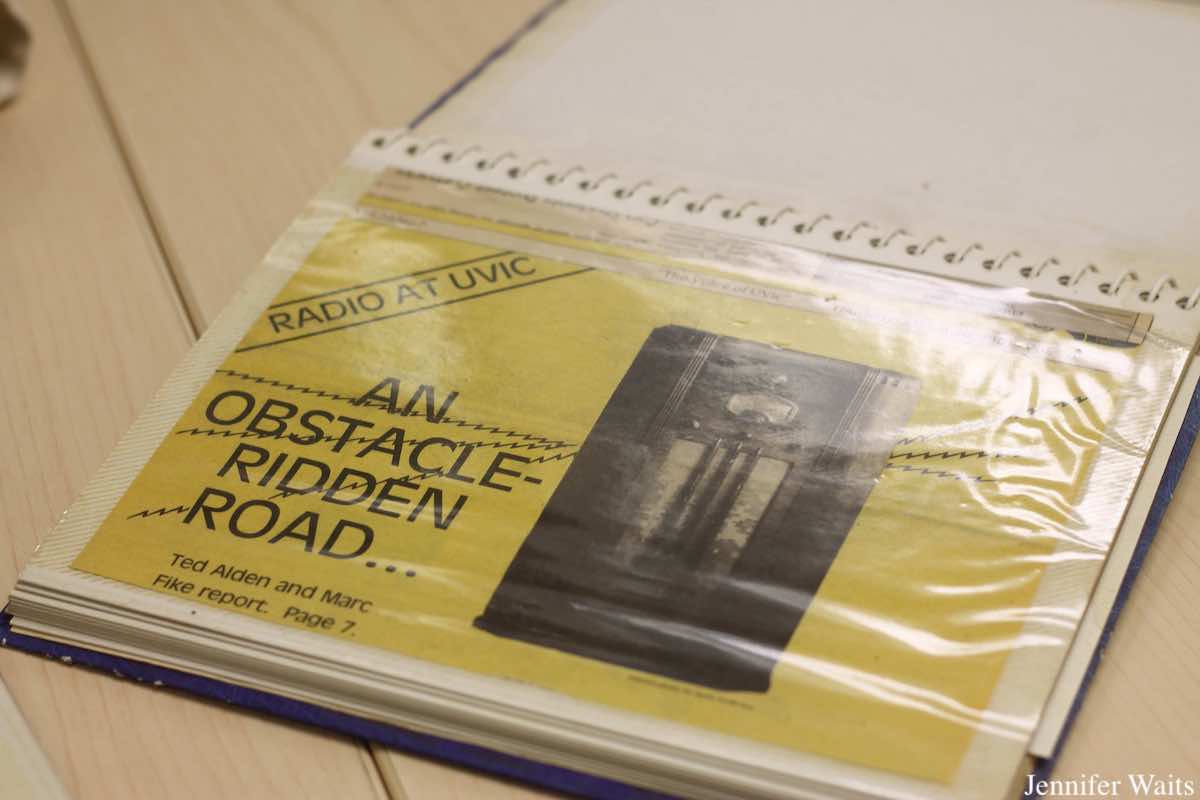
Off the air, CFUV hosts campus and community events and shares charts and music reviews in its Offbeat column in student newspaper The Martlet (whose offices are conveniently across the hall). The column is a nod to Offbeat Magazine, a print publication produced by CFUV from 1986 to 2003. While glancing through a few issues from the 1980s, I was taken back to the early days of the station. The nostalgia was appropriate, as CFUV recently celebrated its 40th year on FM. Signage and decorations from the anniversary bash add a festive touch to the CFUV volunteer office. Near a cozy couch and a space-age turntable, a binder of vintage clippings brings the station’s history to life. Although CFUV’s recent anniversary celebrated 40 years on FM, student radio activities at University of Victoria (and its predecessor institutions) stretch back even further.
Radio at Victoria College in the 1940s and 1950s
Back in 1949, an early radio group on campus, The University Radio Society, was presenting a program called “University Round Table” on Saturday nights, with dreams of eventually airing the show on downtown stations. By 1950, the Radio Club had met that goal and was planning for its first broadcast over CKDA, an AM station in Victoria. Its initial plans were for a program featuring music from the Glee and Jazz clubs and discussions about China, the Bible and psychology. The resulting broadcast on March 20, 1950 included music and an overview of the governance and history of Victoria College. The following week’s episode showcased music and a performance of a Dickens play. Student newspaper The Martlet reported that, “It is hoped that the programs will continue until the end of April with the main features being the spotlighting of the various College Clubs and student activities such as the Students’ Council, athletics, and publications.”
Campus-Only Station CJVC Begins Cafeteria Broadcasts in 1955
By 1955, the Radio Club of Victoria College was spinning records during lunchtime broadcasts that were piped in to the school cafeteria. Shows included “Make Believe Ballroom,” “Rendezvous with Records,” “Personalities in Sound,” “Foods Platter Parade,” and “The Progressive Hour.” Calling itself CJVC, “the Voice of College Radio,” this campus-only station launched on November 21, 1955. Utilizing a “amplifier system with direct wire to the cafeteria” the radio club hoped to eventually add speakers to other parts of campus, according to an entry the 1955-1956 Tower yearbook. By the following year, the station’s schedule had expanded to three hours of programming, five days a week. Shows included progressive jazz, classical, folk, news, weather, and more. Some of the records played at the station were on loan from a local music store.
During the 1957-1958 school year, “individual booth speakers” were installed in the cafeteria and shows were heard for four hours a day, six days a week. By 1958, CJVC’s schedule had grown to 27 hours a week, with news airing at 10am and 1pm. Between 1958 and 1960, additional speakers were added to a new part of the cafeteria, to the men’s and women’s commons, and to the activity hut. The station also regularly hosted dances.
Radio Club Becomes a Society in 1961; Operates from Shack
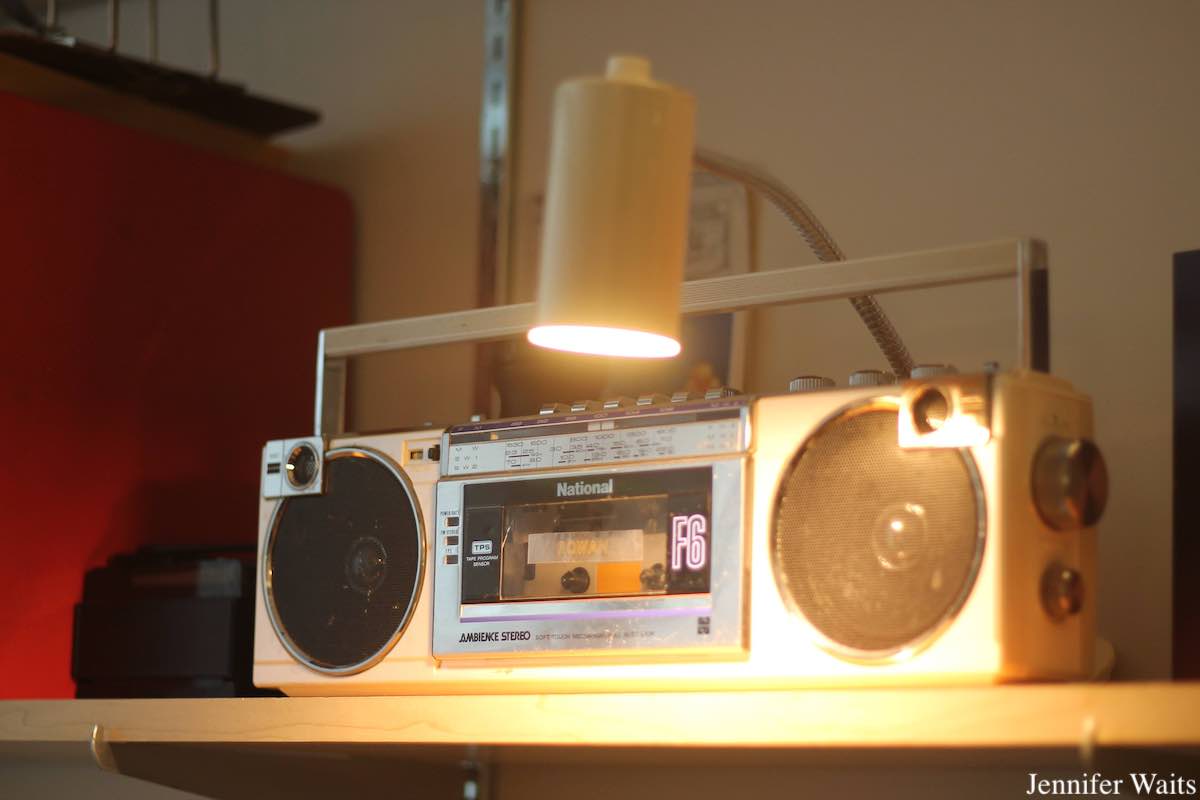
In September 1961, the club became a society within the Department of Publications and Publicity and was broadcasting on the Lansdowne campus via a closed circuit system that they had “extended to the cafeteria, the common rooms and the Services room on Argyle Street.” In addition to the campus broadcasts, Radio Victoria College also began hosting “Campus Showcase” every Sunday afternoon over local station CFAX. After the success of these broadcasts, the club was given the opportunity to control an entire day of programming over CFAX on January 19, 1962. During this time, the radio club operated out of a “8’x16’ shack down the garden path from the caf,” as described in a February 1963 piece in the Martlet, which added that, “In their confined area they have managed to crowd a broadcasting room, one studio, and a very narrow alcove which doubles as a studio.”
U.V. Radio Scores Seven-Room Space in New SUB in 1963
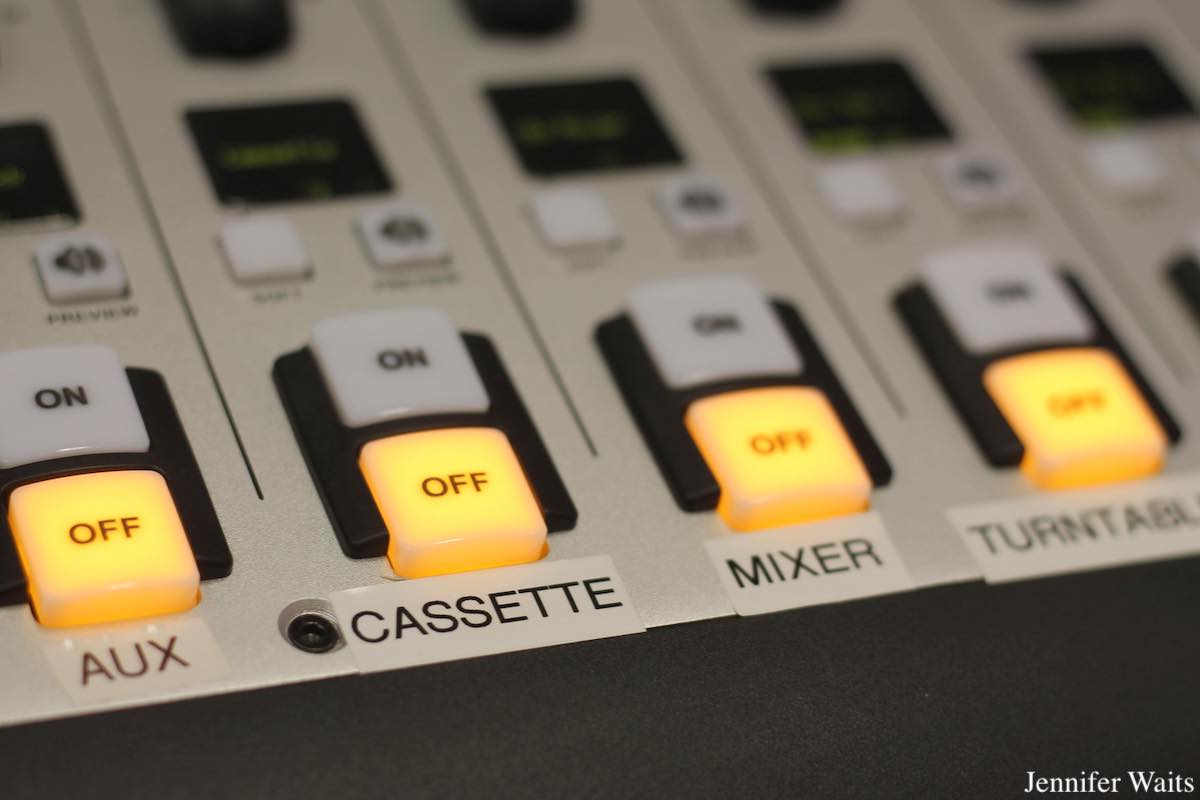
Considering the modest size of its original space, the radio station experienced a major upgrade later in 1963, when it moved operations to a custom-built headquarters in the basement of the new Student Union Building (SUB) on the Gordon Head campus. The station broadcast “music, campus news and occasional live events to the SUB lounge, and through telephone lines to the Lansdowne caf and commons,” wrote the Martlet on September 18, 1963. Now calling itself U.V. Radio, the campus radio station had seven rooms to itself, including three studios, a record library, office, entrance hall, and broom closet. It also began hosting the Playboy Bunny Bash, a semi-formal dance, which became an annual event. The 1964 dance featured live music from the Blue Tones, free cigarettes and bunnies “supplied by University and the Colony Motor Hotel.”

A few years later, the station had to move again — this time to the old health services building while the SUB basement was remodeled. Despite the disruption, UVic Radio expanded its broadcasts to 70 hours a week by the 1966-1967 school year. During fall 1967, it dug into the “medical shack” crawl space in order to carve out another studio and by fall 1968 the station was on the air for 16 hours a day, with transmissions to the SUB and to 180 rooms in the dorms. Interestingly, these broadcasts could not be heard on the radio, but instead were still piped in to individual speakers that had volume control, but that could not be turned off completely. This led to debates over the years about the type of music being broadcast, especially since the station had a “captive” audience.
UVic Radio aka CKVC Dies in 1970
Despite its accomplishments, the station (which was using call letters CKVC in the late 1960s and early 1970s) began facing numerous challenges and ceased broadcasts in March 1970. The final blow came in October 1970 after a major theft of station equipment. Other clubs began using its space in the shack and there were attempts to resurrect the station beginning in 1973. By this point, the hut housing the old station was slated to be demolished. In a weird twist, approval was received for a radio license but there was no available space and minimal student interest despite additional meetings in 1975.
Radio Returns with Campus-Only Broadcasts in 1983, followed by CFUV-FM in 1985
It was another few years before a group of students made an even more concerted effort to bring radio to campus, this time focusing on the ultimate goal of launching an FM station. A new radio club was formed and began closed circuit broadcasts by April 1983 using call letters CKLR. The call letters were changed to CFUV by September 1983 and after receiving an FM license, CFUV-FM launched in 1985. At this point CFUV had access to the entire 2nd floor of the SUB. A decade later, in 1996, it moved to a new studio in the lower SUB, where it remains today.
CFUV-FM Continues to Thrive in 2025
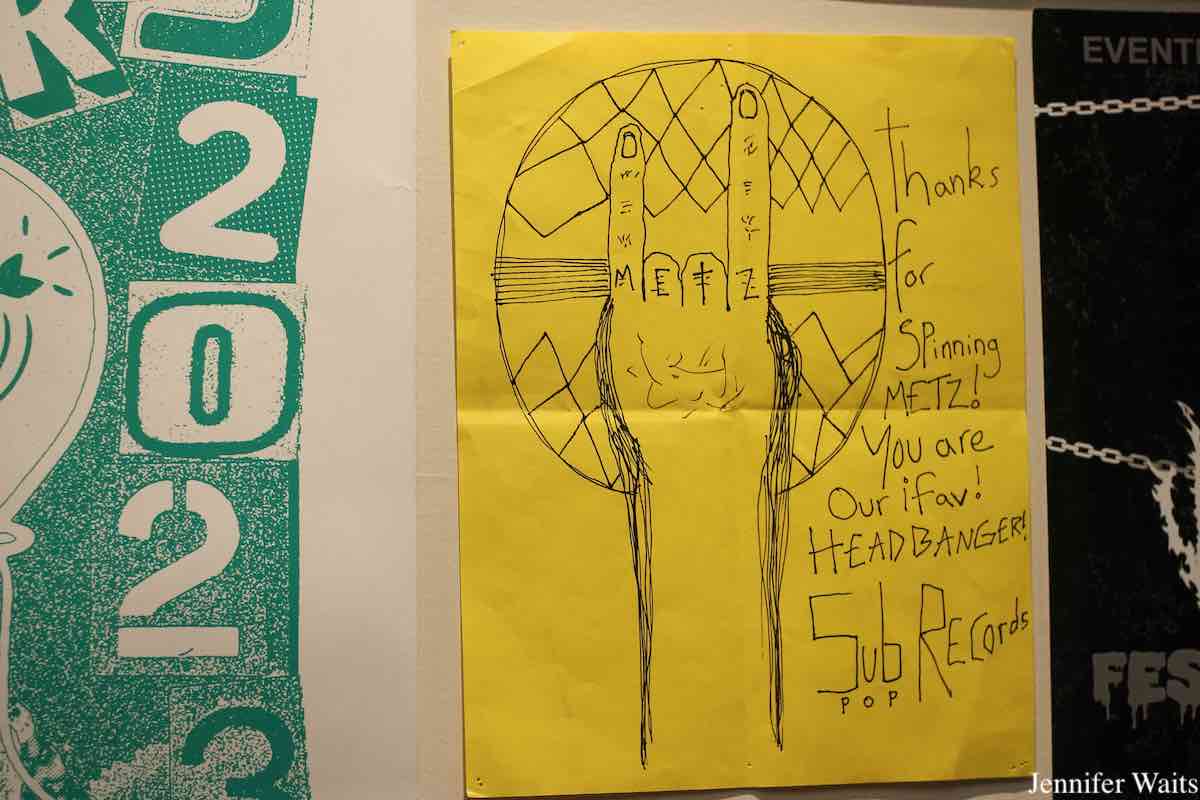
With all the ups and downs faced by the various iterations of campus radio at University of Victoria, the past 40 years represent a period of amazing growth and stability for the more public-facing CFUV-FM. Certificates from the National Campus and Community Radio Association commending various music shows as well as “Excellence in Student Programming” dot the station’s walls. The music industry has also taken note of CFUV’s support. As we chatted in his office, CFUV Station Manager Rowan Grice pointed to a 1994 gift from the Beastie Boys. Three golf balls emblazoned with the band member faces sit under a triangular plastic dome. “To CFUV-Radio. Thanks for Teeing Up The Beastie Boys October, 1994” reads a small plaque inside.
As I wrapped up my visit, Grice talked about his appreciation for the broader world of community radio, with the club-like feel and energy of stations like NTS attracting the attention of global listeners. In a strange way, the allure of these high profile stations can provide a gateway to local campus and community stations like CFUV. With that in mind, Grice said that he tries to incorporate the inspiring qualities of their online radio peers into the culture of CFUV. Much of that lies with the music, with Grice adding, “I’m always here for music discovery.”
Thanks to CFUV + Station Tour Archive
Thanks to everyone at CFUV for opening your doors to NCRC attendees. It was wonderful to be back in Canada checking out stations again! This is my 191st radio station tour report and my 132nd college radio station tour. You can view the entire collection of my radio station visits in numerical order or by station type in our archives.