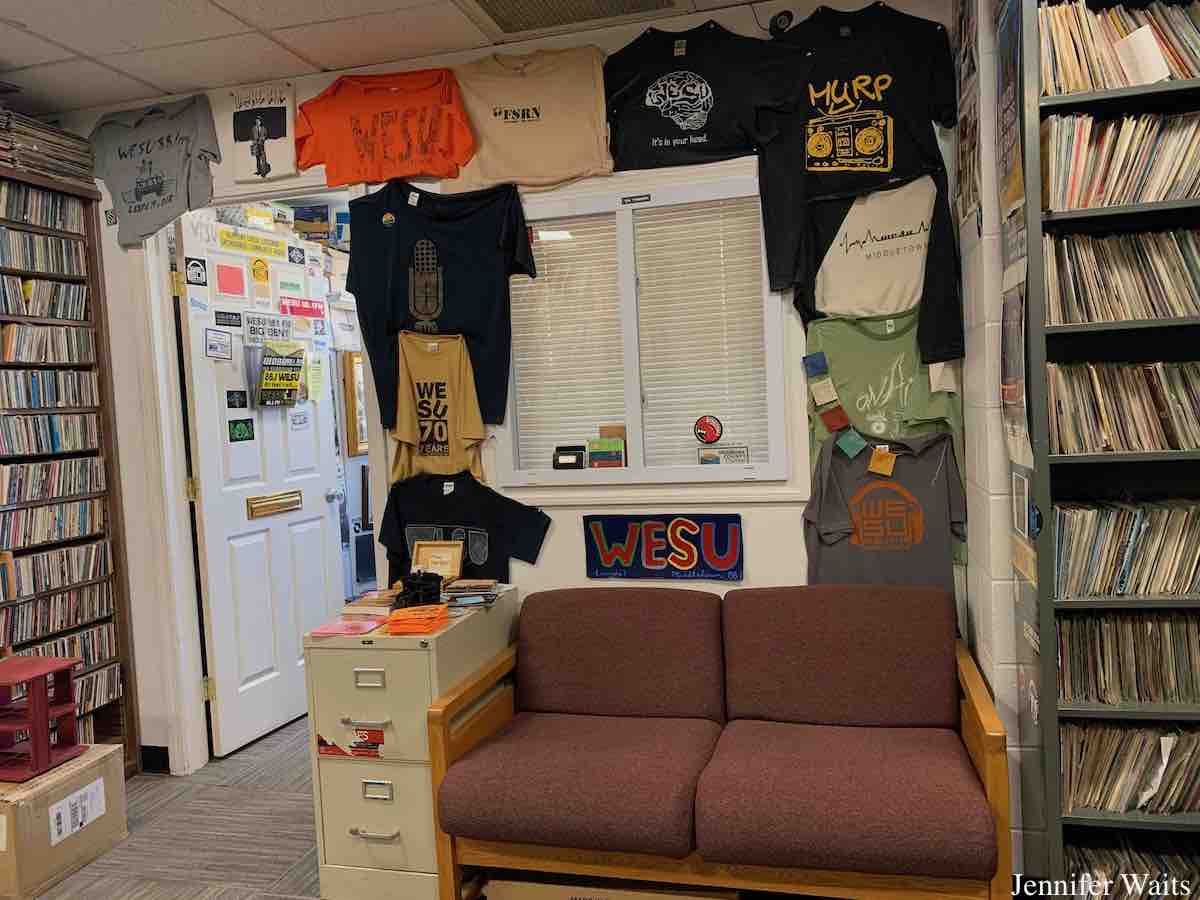
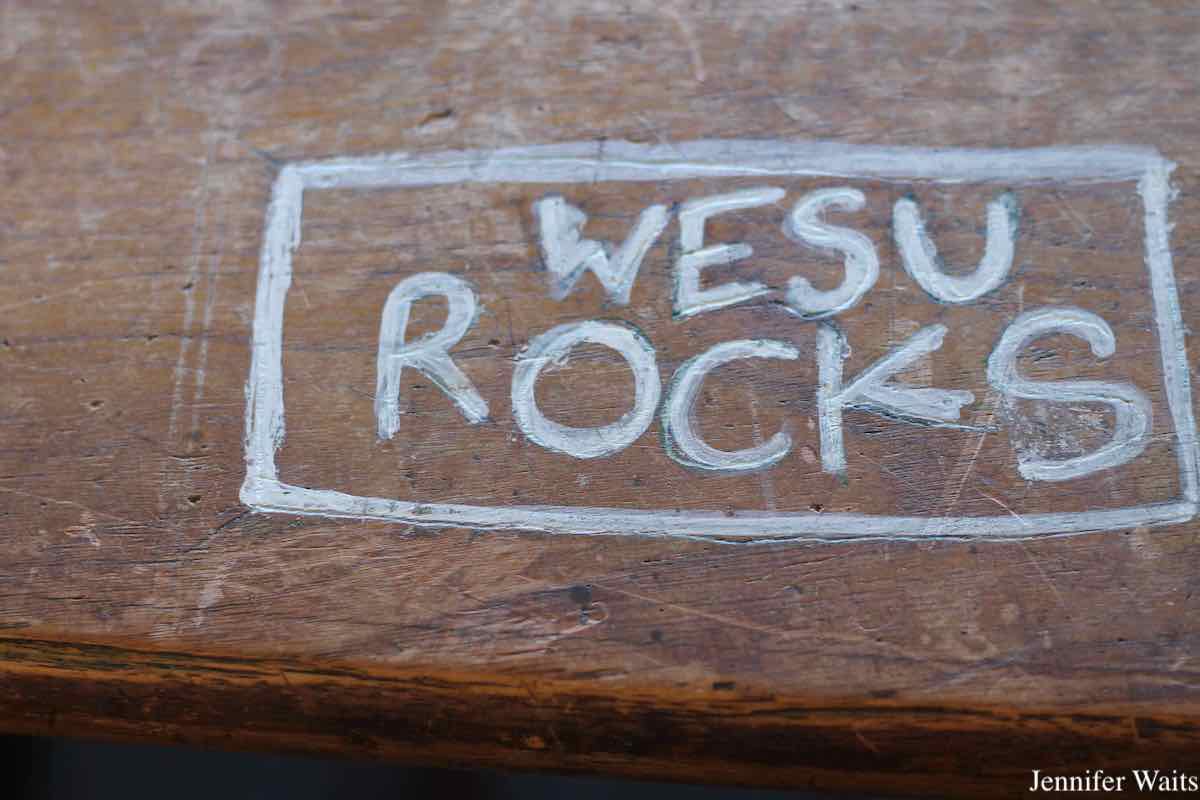
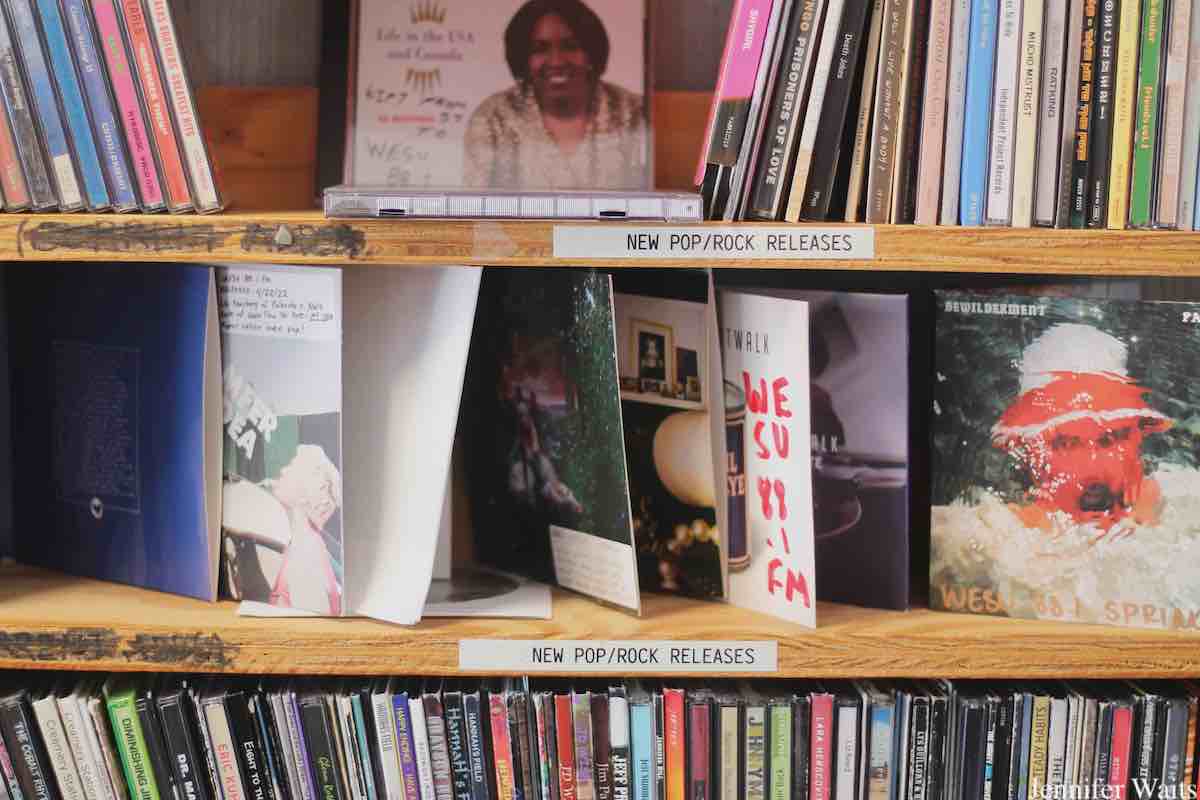
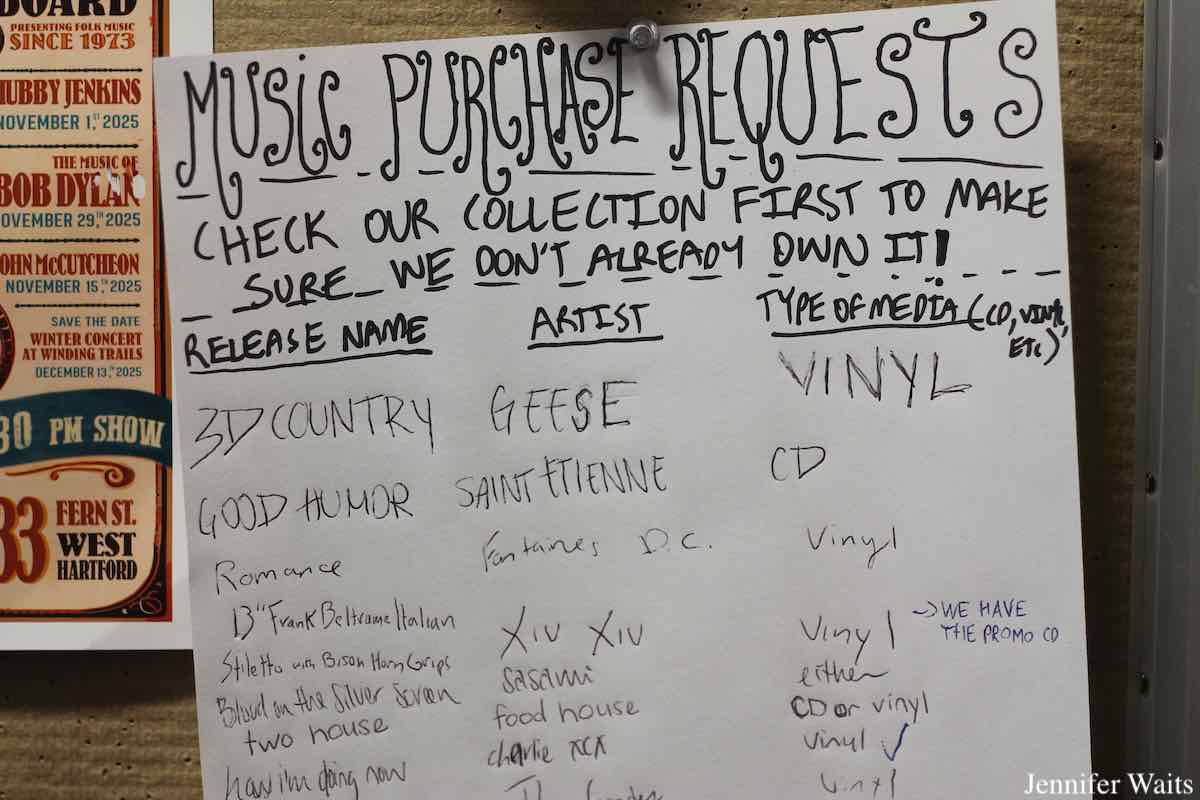
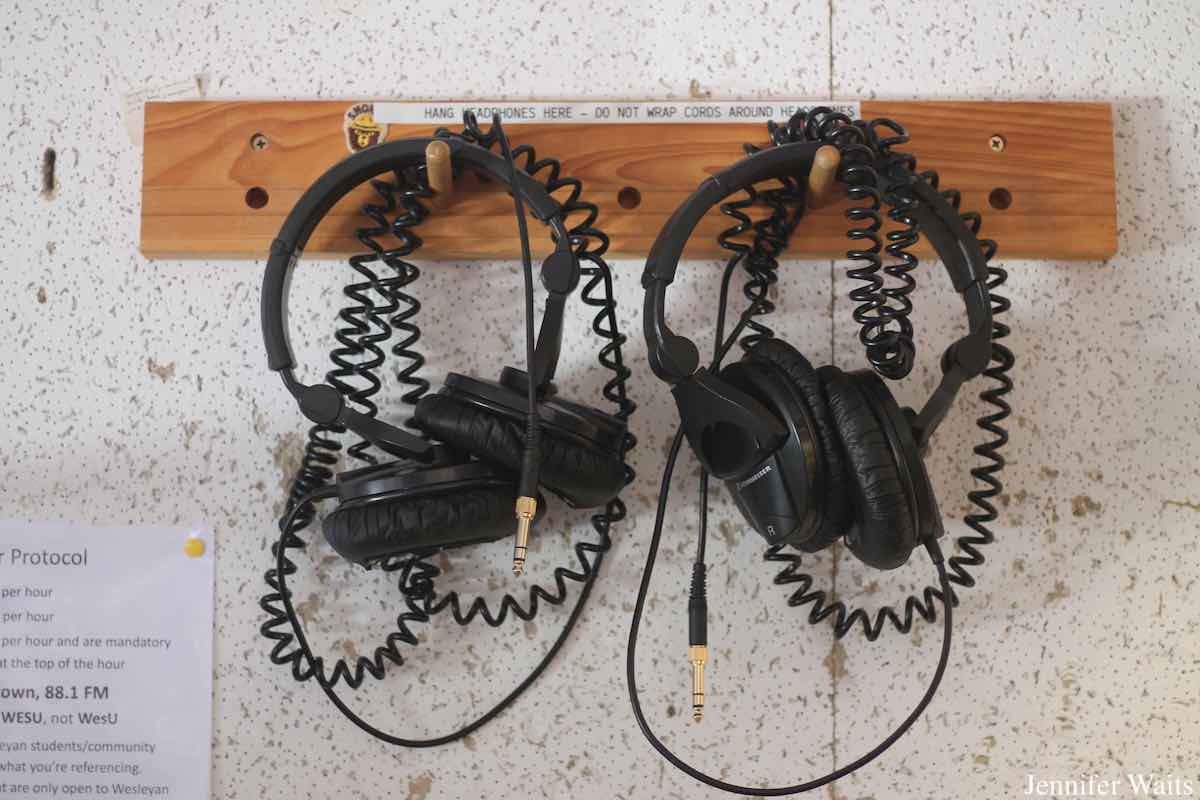
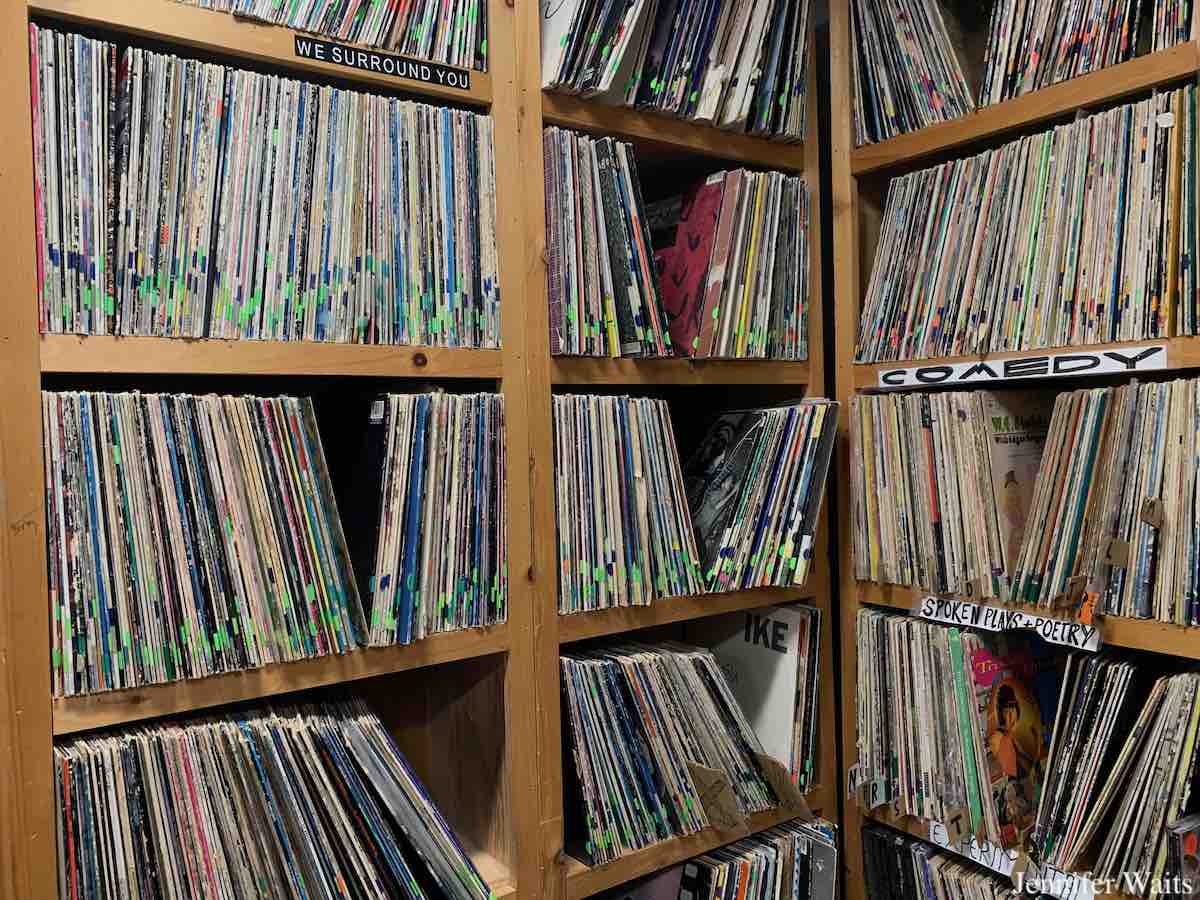
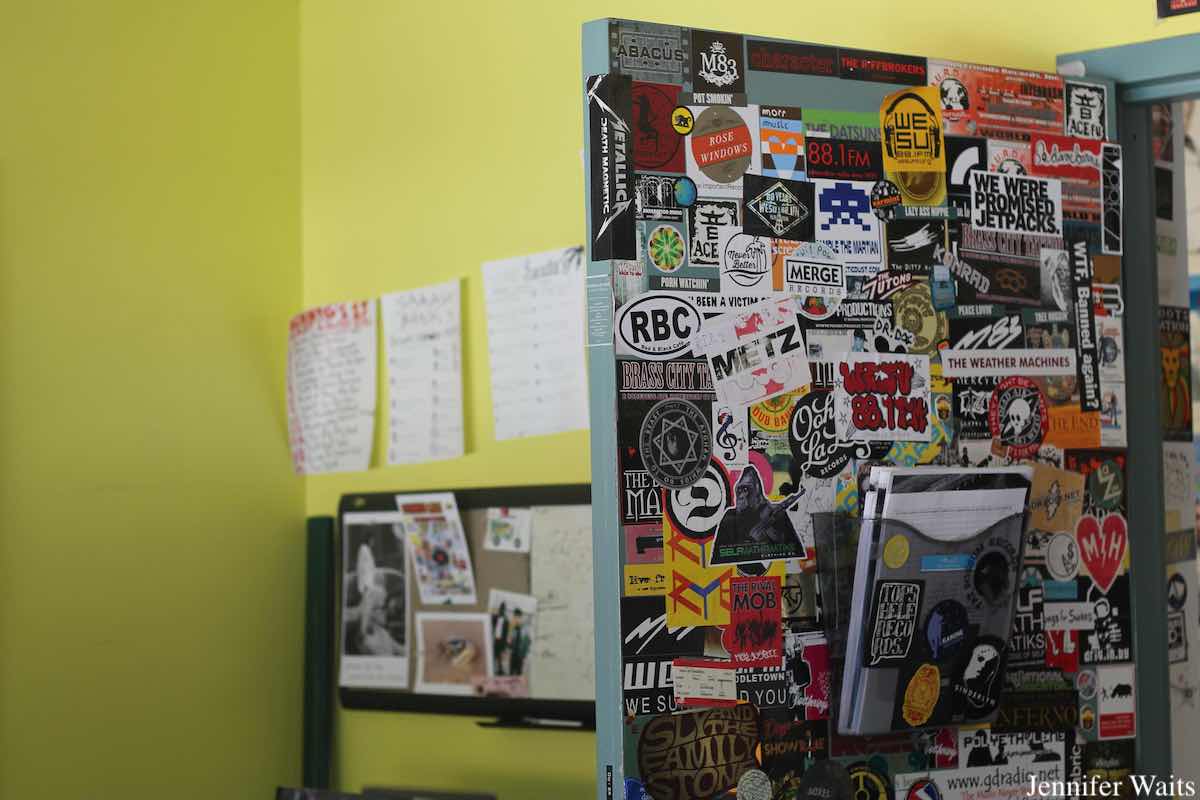
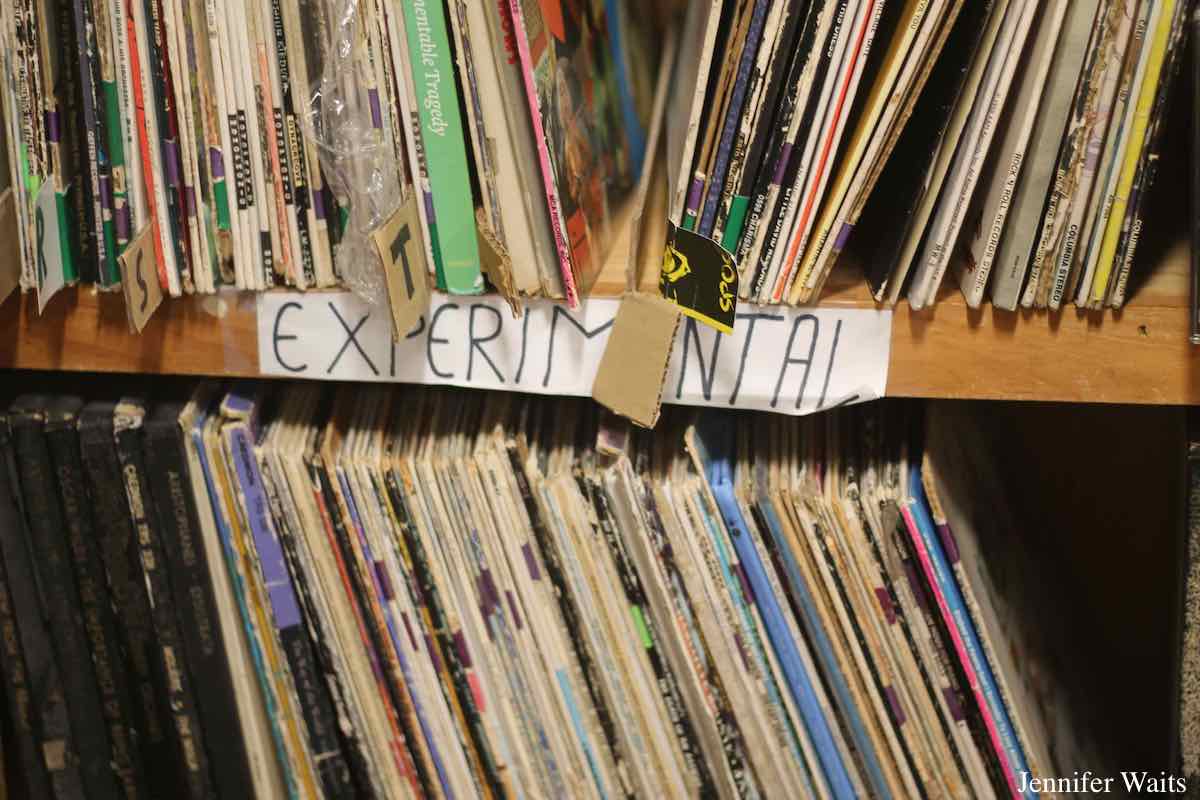
It’s no surprise that the home of one of the oldest still-operating college radio stations, WESU 88.1 FM at Wesleyan University in Middletown, Connecticut, is full of typical student radio artifacts. The walls are plastered with band stickers, posters and flyers. And most rooms contain shelves of CDs, vinyl records and cassettes. In fact, there’s so much physical music that the collection spills over into boxes and bins stashed here and there.

On the first day of October, General Manager Ben Michael greeted me in front of the station building and we ascended the stairs together to see the storied WESU space. With around 100 volunteers, the station includes both students and members of the Middletown community. Currently that works out to about a 60/40 split, but student interest in surging. The week before my visit, 140 students came by the WESU table at an activities fair to sign up for training.
Programming Mix at WESU
A bit different from many student-focused stations, WESU airs syndicated programming (mostly from NPR, Pacifica and the BBC) for about half of the broadcast day. Locally-produced music and talk shows hosted by students and community members run during the remaining hours, from around 4pm to 4am. The afternoon and late night mix includes a range of music including jazz, big band, reggae, hardcore, emo, metal, ambient, underground house, electronic music from southern Africa, Black and queer club music, punk, and more. This broad array of programming is meant to support WESU’s goal to broadcast music and ideas that can’t easily be found on the radio dial. That philosophy also applies to some of the syndicated programming at WESU, including shows that play punk and hardcore (“Maximum Rock and Roll Radio”) and radio art (“The Radio Art Hour”).
WESU’s Beginnings as Carrier Current Station WES in 1939
Founded at Wesleyan in 1939, WES was one of the first student-run carrier current radio stations in the United States. Known as the Cardinal Network of the Wesleyan Broadcasting System, the campus-only station was inspired by similar efforts at Brown University a few years earlier. Founding Technical Director Arch Doty (hear his interview with WESU GM Ben Michael) built his first radio receiver in 1932 and brought a homemade transmitter with him when he arrived on the Wesleyan campus in the fall of 1939. Officially launching as WES on November 9, 1939, the station operated out of Clark Hall.
By the 1948-1949 school year, WES was broadcasting six hours a day, with “recorded music, live shows — Jibers, drama and special events — and the best sports coverage in the history of the station,” according to the WES entry in the 1949 Wesleyan yearbook, Olla Podrida. Programming included “Jazz at its Best,” “Jive at Five,” campus news, a classical music hour, a show dedicated to war veterans, and rebroadcasts from FM station WDRC. In 1950, WES changed its call letters to WESU.

WESU Launches over FM in 1961
In 1961, WESU launched FM broadcasts over 88.1 FM, thanks to its newly granted 10 watt FM license. By the late 1960s, the station was able to expand coverage even further with a power increase to 1000 watts. WESU continued to operate its AM station during this time.
Until the year 2001, WES and its descendant FM station WESU were headquartered on the Wesleyan campus in the basement of Clark Hall. Today, the station is located several blocks away in a residential part of town on the second floor of a building that also houses student newspaper, The Wesleyan Argus.

Station Move and Addition of NPR Programming in Early 2000s
The WESU move in 2001 was abrupt and disruptive, with General Manager Ben Michael recounting to me that historic papers and equipment were lost in the process. A few years later, the ownership of the station shifted from an independent student corporation to the school, with the WESU license now held by Wesleyan University. Michael is the one full-time staff member and works alongside a part-time program manager as well as the station’s board of directors (which is mostly comprised of students) and student and community leaders. Students play a major role at WESU and currently recruit and train staff, facilitate board and staff meetings, manage PR, run events, and more. Michael was brought on as a staff member (he’d been a long-time volunteer prior to that) in 2005, around the same time that WESU began airing NPR programming.

Michael explained that the mid to late 1990s was a challenging time at WESU, with declining student interest in radio. Wesleyan University’s then-president Douglas Bennet, who had previously been President and CEO of NPR, led the charge for WESU to air NPR programming. Michael recounted, “When the university decided to bring NPR on board it was in part a response to the fact that the station was not being utilized during the day, every day.” He told me that the plan to add public radio programming led to “a major response and resistance on and off campus” and an “outcry” over the proposed changes to the station.
Community and Student Programs Continue at WESU
In particular, long-time community-hosted shows were to have been eliminated. In the end, some of those shows shifted to other time slots and remain on the air today in large part because students spoke out. Michael relayed that, “The students really had the back of the community volunteers because they realize this is essential services to under-served populations.” In order to retain all of the student and community-run shows, WESU opted to shorten the length of some programs and shifted the schedule so that some were on the air on alternating weeks.

WESU’s ongoing commitment to the local community is also reflected by some of its talk programming, including “Engage Radio,” a university-backed show that “highlights civic engagement initiatives at Wesleyan University’s Allbritton Center.” Michael said that the goal of the show is to “spotlight individuals and organizations that bridge the town and gown divide.” A recent episode focused on hip hop history and others have highlighted projects by the Middletown Historical Society. Another public affairs show, “River Valley Rhythms,” features interviews with local artists and regional arts promoters.

Honoring the WESU Archives
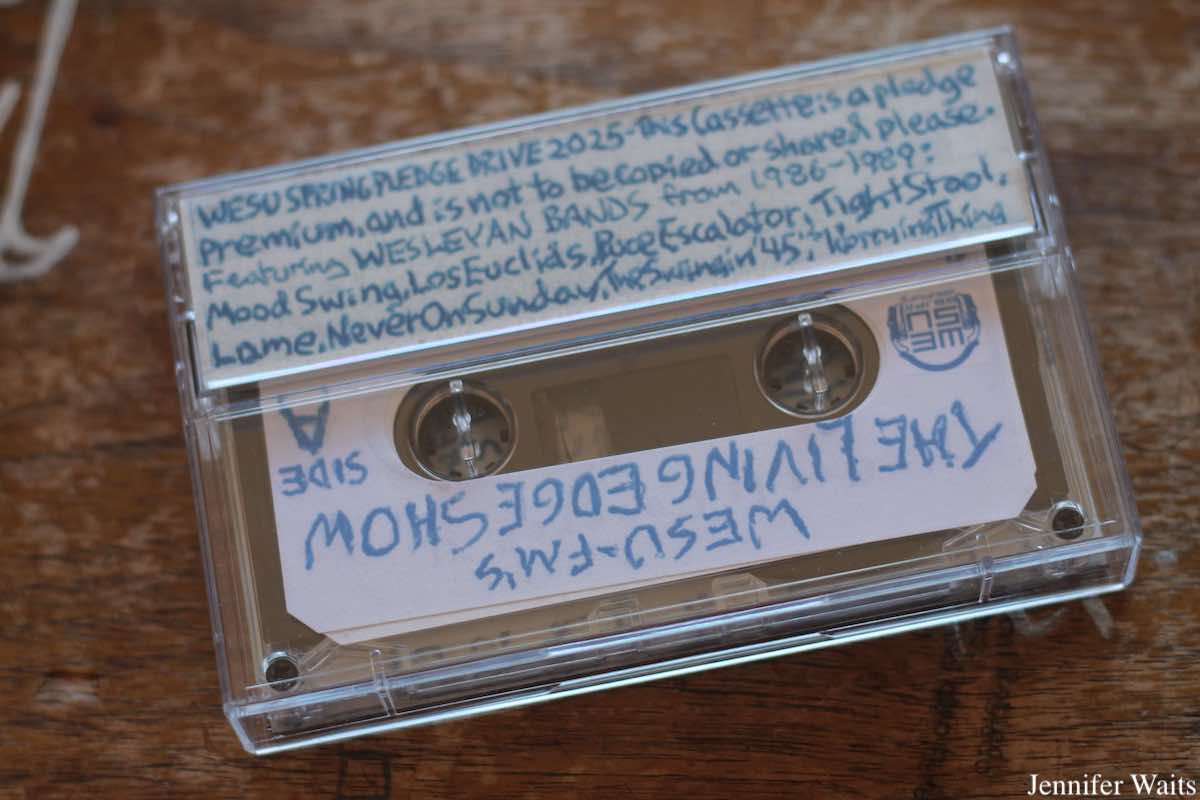
Having grown up in Middletown, Michael has a deep appreciation for the the history of WESU and its ongoing legacy. He regaled me with stories about archival audio finds and projects to bring the station’s history to life. After locating recordings from the 1980s show, “The Living Edge,” one of its co-producers crafted handmade cassettes earlier this year as a premium for WESU’s fundraiser. The cassette compilation includes cover songs performed by Wesleyan bands circa 1986 to 1989. Although a tape might seem like an unusual thing for a 2025 fundraiser gift, it makes sense for a college radio station that reveres physical music. WESU is one of the few stations that I’ve visited recently that had a collection of organized cassettes in its on-air studio.
Michael loves radio and the experience of music discovery through the stacks, telling me, “We’re all fed by these algorithms and just introducing somebody to the library and the idea of reading liner notes and using them as a cross-reference to guide you on this scavenger hunt…That’s my own experience with music here at WESU and I try and introduce students and community members to that and get them outside of the bubble a little bit.”
Thanks to WESU + Station Tour Archive
Thanks to Ben Michael for the tour of WESU and for chatting with me about the station’s past and present. This is my 190th radio station tour report and my 131st college radio station tour. You can view the entire collection of my radio station visits in numerical order or by station type in our archives.