As I was plotting out my fall vacation to New England, I imagined chilly days, falling leaves and colorful foliage. While hot weather was the norm for much of the trip, the first bit of crispness was in the air for my twilight visit to B-Rad, the student-run college radio station at Bennington College in Bennington, Vermont.
Autumn Tour of B-Rad
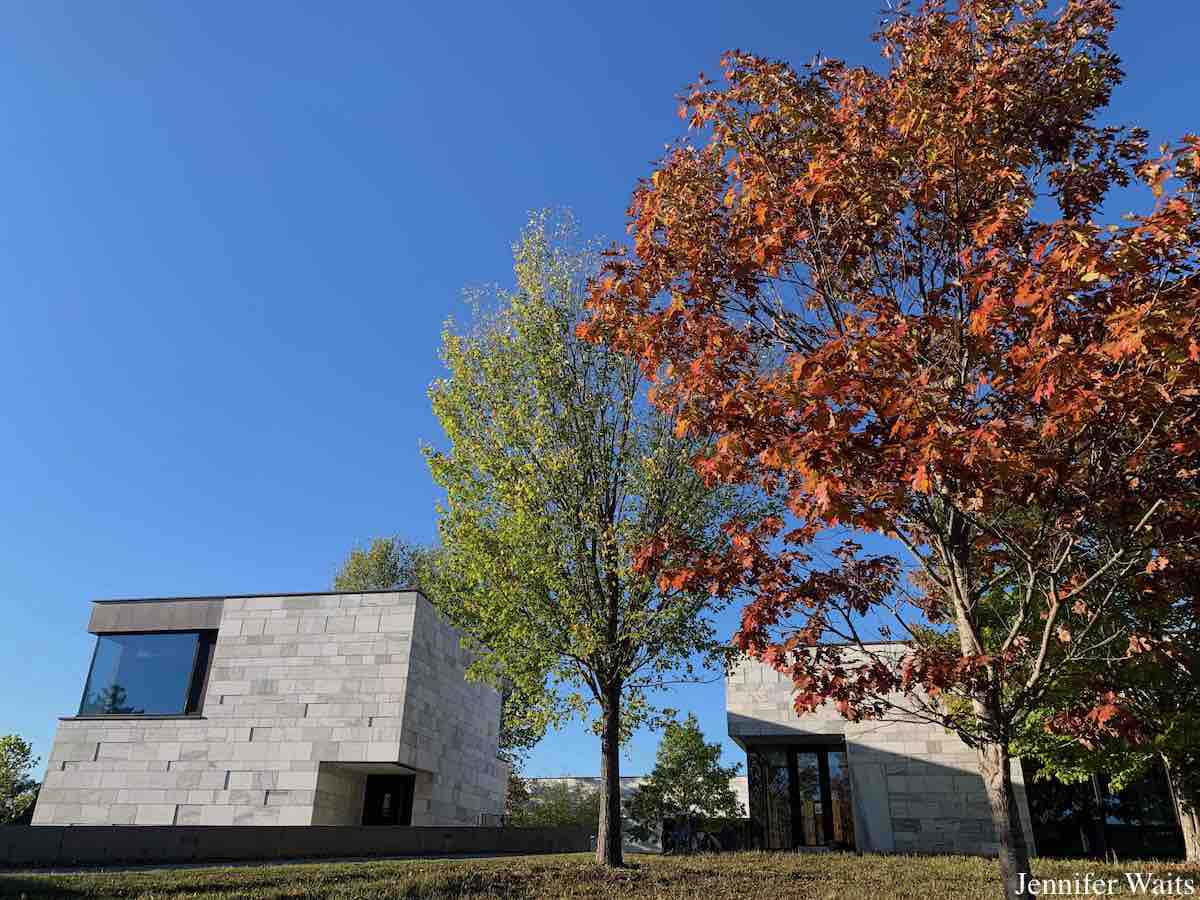
On the first day of October, B-Rad co-manager Ellie Nowak and I exchanged hellos outside of the Elizabeth Coleman Center for the Advancement of Public Action (CAPA) building, steps away from the radio station. The sun was starting to set as we approached the golden hour. Not a soul was around and I was dazzled by the view of orange-leafed trees and lush green grass. Located on a former farm, the 440 acre campus is full of rural charm.

Nowak, a senior, is already feeling wistful about her “last Bennington fall.” She’s been involved with B-Rad since freshman year and continues to do a radio show in addition to her work as a station manager. She’s always had a Saturday night time slot and remarked that she likes having “a ritual like that.” Although the show has taken different forms over the years, she has always had at least one co-host who is also a childhood friend.
Fall 2025 B-Rad Schedule was in the Works
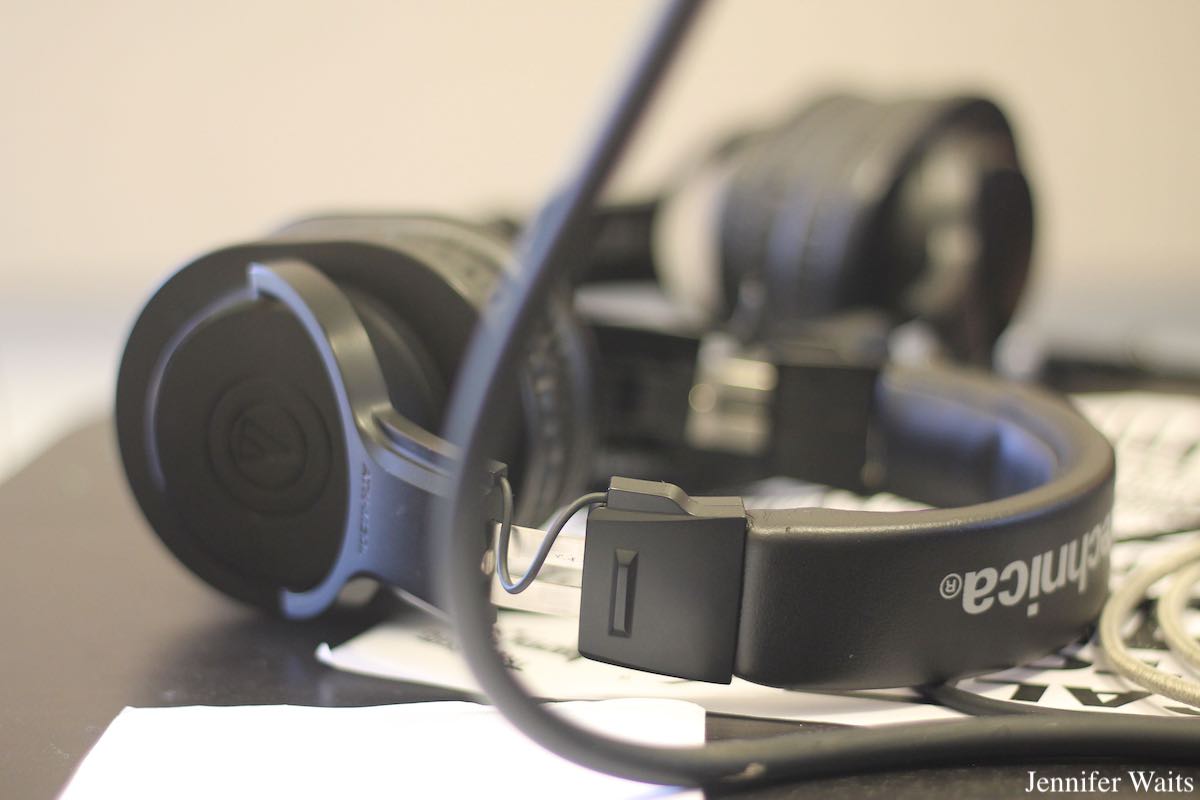
At the time of my visit, B-Rad was in the process of finalizing the fall schedule. Show applications had just been submitted and DJs were about to receive training. With a roster of around 50 participants, B-Rad was expected to have about 32 shows this semester. The station is managed by 3 student board members (Nowak and co-manager Myriel Byfield, plus tech manager Henry Altman) and B-Rad also has a faculty adviser. On such a small campus, with just under 800 students, it’s impressive to see this level of involvement.
Although B-Rad participants are mostly students, B-Rad does have some programs run by community members, including one hosted by a family with elementary-school aged children. Nowak mentioned that a few campus organizations, including the Restorative Justice Collective, had applied for shows. Additionally, a group of international students hosts a program during which they “showcase different elements of their culture from their home country,” with weekly themes focusing on “folklore, festivals…films, music, literature” and more.
Mix of Programming on B-Rad
Nowak ran through the gamut of shows, including everything from genre-focused programs to radio plays to talk shows (including comedy, feminism, and politics-focused) to “D&D and world building” shows. On music shows, DJs play a broad mix of genres, including folk, metal, goth, underground, outlaw country, grindcore, punk, and crankwave. A number of DJs do weekly theme-based shows. Participants have a lot of freedom to play and say what they’d like, especially since the station is online-only. Nowak said that the one rule is “don’t be evil on air and use common sense.” When there isn’t a live host, a mix of music and programming from the B-Rad archives is played through the station’s webstream.

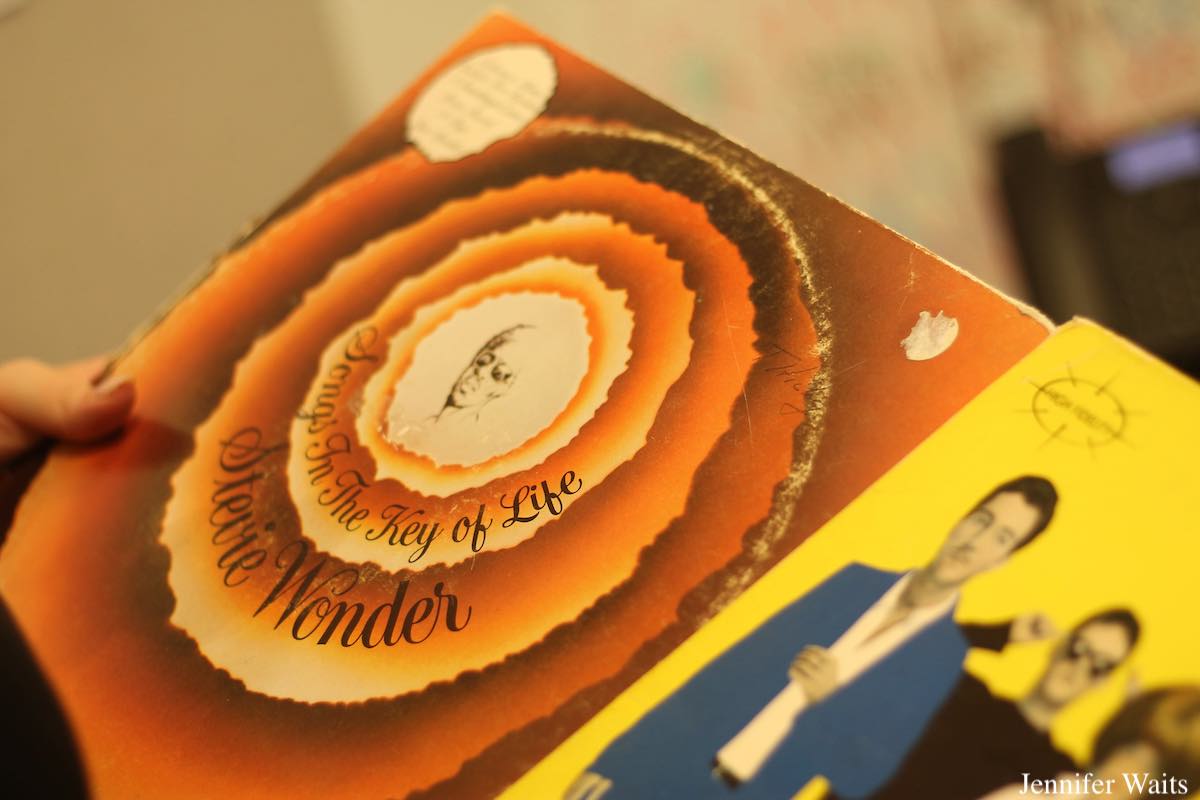
While most B-Rad participants play digital music on their shows, they do have access to a CD player and the station’s collection of physical music. Some DJs do live mixing too. A cabinet is full of CDs, many of which were acquired during the station’s early days when they sent a call-out for CD donations in order to build their library. During Nowak’s freshman year there was a record player at B-Rad. She wasn’t sure what happened to it, but told me, “I love physical media” and “the nostalgia of it all.” She said that she wished that more DJs used the station’s CD player.

Attracting Participants and Listening to B-Rad
Launched as an online station on April 1, 2017, B-Rad remained active through the COVID shutdown, but became a bit more disconnected from campus life. “I really want to help pick that up again,” Nowak said. She told me that she has been working hard to get the word out about the station, adding that “It’s more fun when it’s a big community thing.” Although the station is in a beautiful building, Nowak noted that it’s in a low traffic area compared with other buildings. For that reason, people post flyers and posters for their shows all over campus.
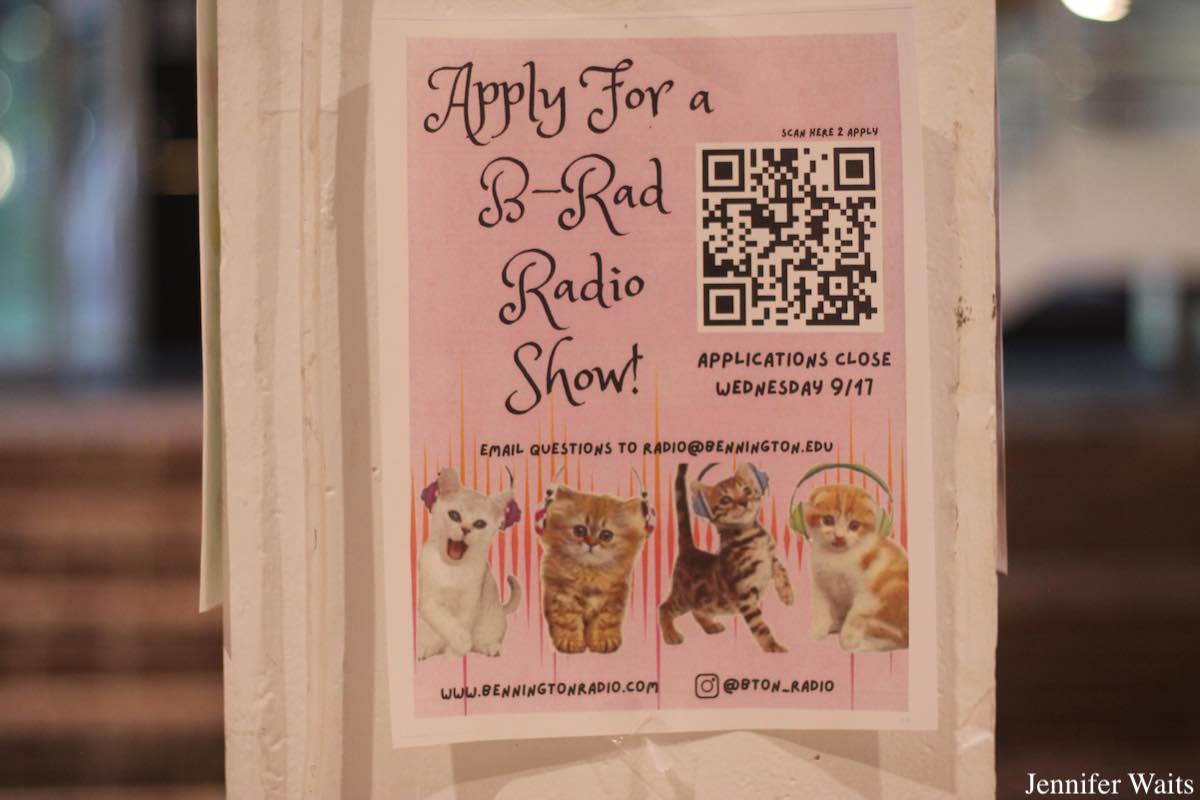
B-Rad also had a table at Bennington’s Club Fair, at which they talked to students about the radio station. Nowak said that a few seniors came to the table and didn’t know much about the station or how to listen, which was a reminder to her about the work still to be done. As we chatted, she checked the station’s stream statistics showing that there were 3 listeners (numbers go up when there’s a live show that hosts are promoting). It was between live shows and she speculated that it could be bots from Germany, noting that sometimes they have bots or perhaps dedicated fans from Finland. It is hard for B-Rad to discern.
B-Rad Launched in 2017
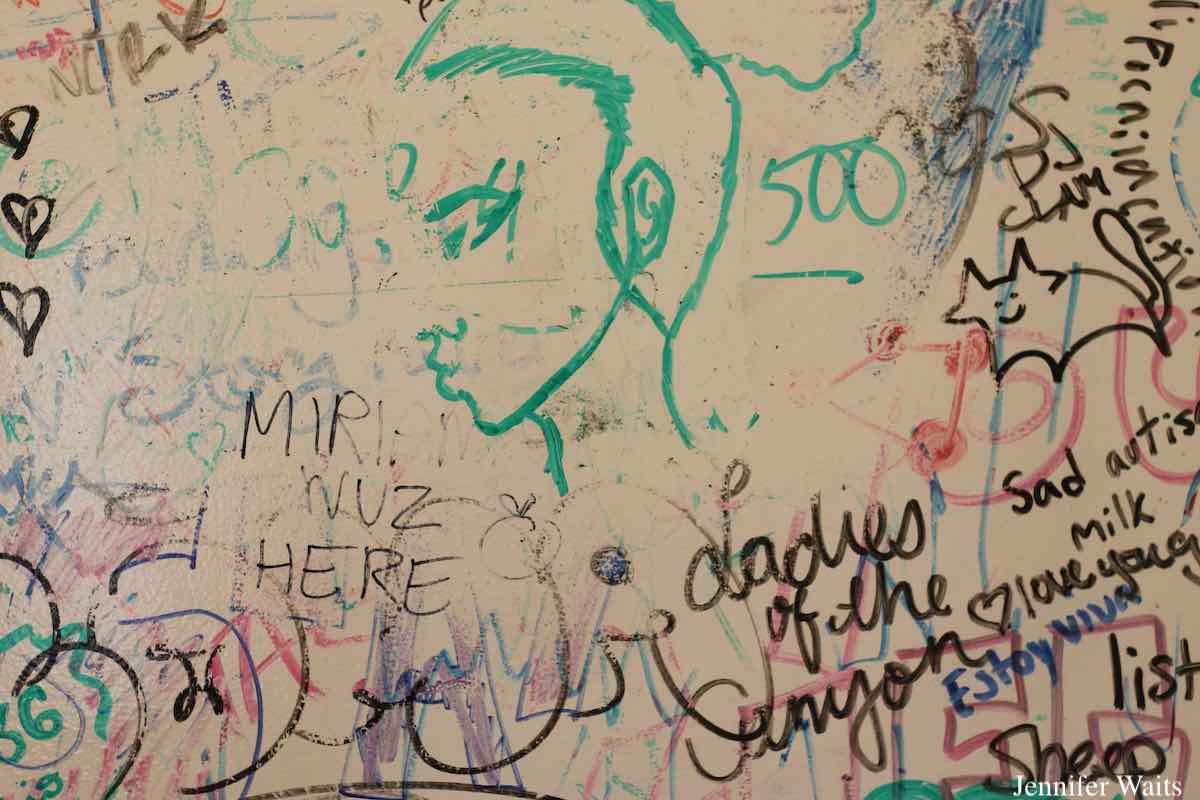
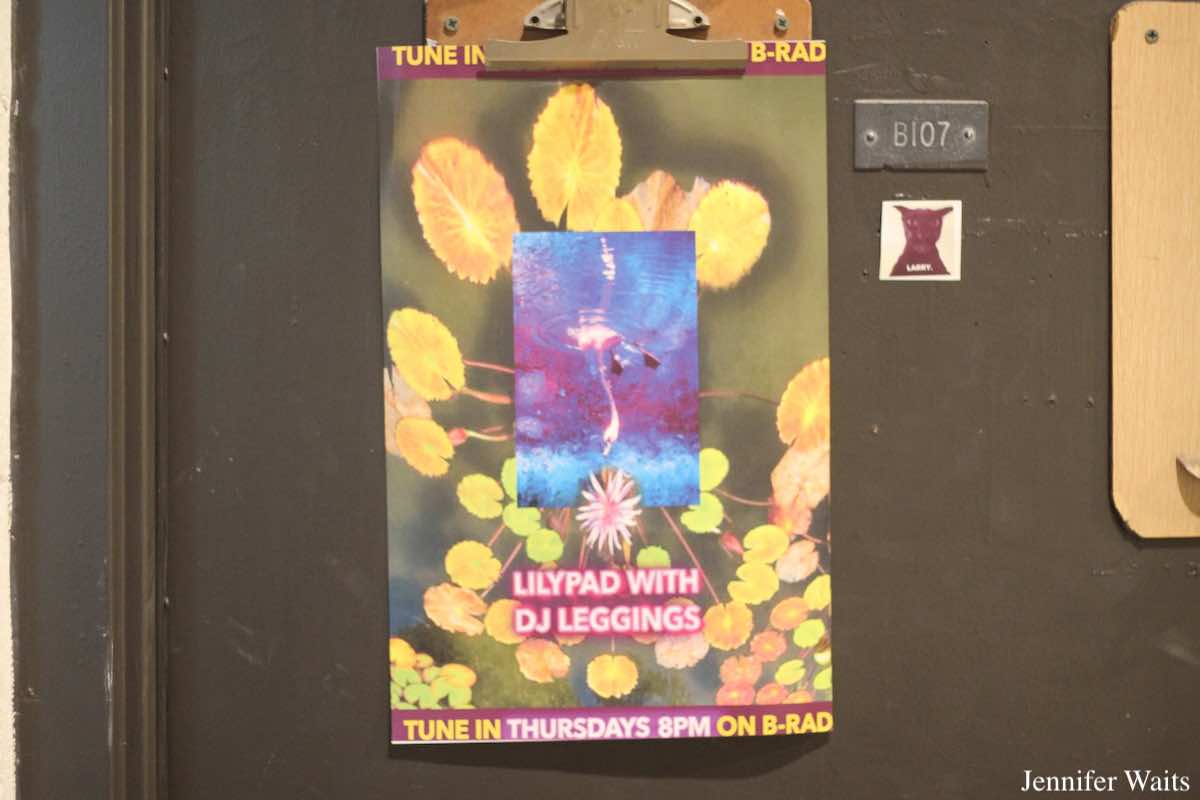
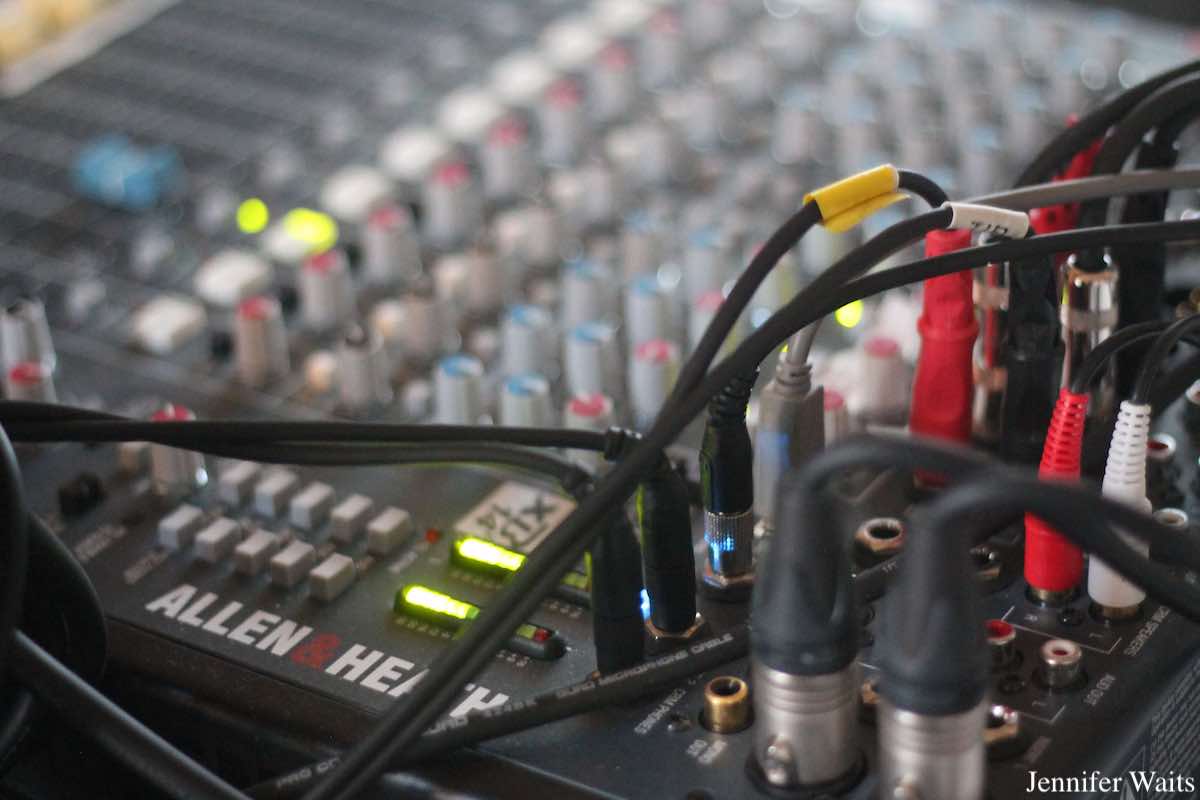
Since its inception in 2017, B-Rad has been housed in a tiny room just off the lobby of the CAPA building. The office-like space has a desk, computer, and audio equipment. A wall is crammed full of drawings and messages that have accumulated over the past few years. Nowak pointed out that the name of her old show was still there and she didn’t have the heart to erase it. In addition to on-air programming, B-Rad has hosted various campus events, game nights and a poster-making party. Nowak also hopes to bring more campus artists to B-Rad listeners and noted that Bennington College has a lot of students who do live DJ mixing.

1952 Launch of Campus Radio Station at Bennington College
While Nowak wasn’t aware of other radio stations on campus prior to B-Rad, I was determined to learn if there were any student radio predecessors. As it turns out, Bennington College has been home to many different student-led radio stations over the years. In 1952, Augusta (“Gus”) Welfer Bartlett started an AM carrier current station as her senior project, back when Bennington was a women’s college. Bartlett had spent a winter working at a radio station in Atlanta and upon her return to campus she decided that “Bennington should have a radio station that would give its talented students a chance to be heard over the air and to have fun at the same time,” reported the Bennington Weekly in December 1950. She started work on the station in spring 1951 and began test broadcasts out of the recording room in Jennings Hall in May 1952.

I was amazed to learn that Bartlett launched the station just a month before her June 1952 graduation AND the expected birth of her child. In a piece for the Bennington College Alumnae Quarterly in 1952, Bartlett talks about what prompted her to start a college radio station. Unsatisfied with the nearby radio offerings, she explains, “…some gentlemen in Schenectady have been producing radio programs for some time, but they never seemed to creep across the state line into Vermont with very much vigor, nor were the programs always what the intellectual ladies craved. So I decided the time had come for the College to have its own station.”

Bartlett built a campus-only AM station, which could be heard within the confines of Bennington College. “Finally, after a year and a half of punching holes, mounting equipment and soldering countless bits of wire, The Thing was completed,” she writes. Spring semester 1952 was a test phase for the station, which opened up for participation from the entire campus the following fall.

WGBB Expands as Campus Activity in Fall 1952
According to an article in the Bennington Biweekly, the campus station fully opened with a launch over 620 AM on November 5, 1952 under the call letters WGBB (named for founder “Gus” and her husband Bob Bartlett). Operated and managed by students, WGBB continued to receive occasional technical assistance from founder Gus Bartlett. The schedule that semester ran for about 3 hours nightly (except Saturdays) and included jazz, opera, light classical music, radio drama, a French disc jockey and dance music programs. “Pleasant taped seminars, workshops, faculty concerts…campus events” and “a full length opera” were in the works, in addition to collaborative programs (including dramas) with WMS at Williams College. A campus news show was to air announcements, including “a service for anyone wanting or offering rides for the weekend.”

By Spring 1953, WGBB had moved to 590 AM, was broadcasting from 7:30pm to 10:30pm, and was airing radio drama, a poetry and prose show, a panel show with faculty and students, seminar recordings, a dance music show, and more. The following fall, around 30 students were part of the staff of WGBB “the Voice of Bennington College.” By spring 1954, the radio station was using call letter WGBN, had become a trial member of the Intercollegiate Broadcasting System (IBS) and had started fundraising in order to move the station due to transmission issues. The move was completed by fall 1954, with WGBN relocating to the Barn from its home in Jennings. At the time, the station was once again enlisting the help of its founder to get its broadcasts operational. Sadly, by spring 1959, IBS reported that WGBN had gone off the air and was dropped from its membership roster.

Students Launch WHIP-FM in 1990s
In the years after the demise of WGBB/WGBN, there was a project called “Bennington College Radio Players” in the late 1980s, followed in the mid-1990s by the creation of the very low power WHIP-FM. Station Manager Wendy Lawrence wrote a profile of WHIP for the winter 1994 issue of Quadrille, saying “WHIP 88.5 FM, Bennington’s own student broadcast, currently operates out of the third floor of Commons with a hand-built transmitter that hangs from a hockey stick. WHIP broadcasts at about one watt and reaches most of the dorms.”

WHIP’s broadcasts were designed to only reach the campus, so it operated without an FCC license. A weekly blurb that ran in Bennington’s College Week newsletter in 1994 notes that “it may be heard anywhere from 88.3 FM to 89.1 FM Monday through Sunday after 7 p.m. If you don’t get it in. Find a friend who does…” WHIP later hosted a rave and within a few years was the largest student organization at Bennington.

Some time in the 2004-2005 academic year, WHIP seemed to have ceased operations. In a March, 2007 piece in Bennington Free Press, former WHIP participant Luna Galassini writes of the station being a “loosely defined campus club” in fall 2004 and cites “student apathy and mismanagement” taking a toll on its broadcasts. By Fall 2005, WHIP was not active and Galassini hoped to revive it over FM, yet was met with resistance.
Radio and Podcasting Proposals Lead to Internet Station Circa 2007
However, a faculty member’s spring 2006 proposal for a radio and podcasting program and a student proposal for an internet station in fall 2006 reinvigorated discussions. The old WHIP studio was unavailable as its space in the Commons was considered “condemned,” so the student-run internet station was offered a room in the Fels quad. “Bennington Radio Due to Make Waves,” reads a March 2007 headline in student newspaper Before the End of the World.

Source: Bennington Free Press, October 3, 2009
Details of the station’s debut are absent, but an October 2009 issue of Bennington Free Press contains an ad for streaming radio station WBEN – The Triangle, with a Bennington College URL. A few pages later in the issue, an article about the “deserted” upstairs Commons notes that “a still vibrant radio station lives on. The author describes the space, writing, “Decorated with patches of what seems to be ’90s grunge band glory, an oft-used couch falling apart in a corner and witty sharpie graffiti from students long gone, there exists a spirit of banter and intimacy in the room that is not often found on our crowded campus today.” I wasn’t able to find further details about this phase of radio at Bennington, but flashing forward another 7 years or so, B-Rad made its online debut in 2017.

Thanks to B-Rad + Station Tour Archive
Thanks to Ellie Nowak for the tour of B-Rad and also thanks to Dean of the Crossett Library at Bennington College, Oceana Wilson, for research assistance. I cannot believe my luck, as Wilson had just recently digitized the 1950s student newspapers, which are a goldmine of information about early radio at Bennington College. This is my 185th radio station tour report and my 127th college radio station tour. You can view the entire collection of my radio station visits in numerical order or by station type in our archives.