Radio One endorses Comcast/NBCU merger

Radio OneRadio One, the nation’s biggest African American oriented radio network, has endorsed the proposed Comcast/NBC Universal merger, now being evaluated by the Federal Communications Commission and the Department of Justice.

Its CEO Alfred Liggins III praised Comcast for helping Radio One develop its TV One cable channel.

“The result is that today, as one of the nation’s two major African-American-oriented channels (and the only one owned by African-Americans), our network now reaches more than 50 million homes via cable and satellite and has an audience with enormous race, gender and generational diversity.

In addition to supporting TV One, Comcast has a history of giving diverse voices a megaphone. The company assisted in launching African-American-owned channels like Hip Hop on Demand, the Africa Channel and Crossings and boasts an unrivaled package of 50 Spanish language channels and 150 titles available on-demand. The newly formed company plans to build on this track record in a number of exciting ways.”

Radio One has mostly been in the spotlight of late for its quarrels with advocates of the Performance Rights Act, which would require broadcast radio stations to pay royalties to performers as well as copyright holders.

Critics of the Comcast/NBCU merger warn that the union would represent another step towards an Internet/cable entertainment oligopoly.


Top radio device maker backs net neutrality

A gaggle of major Internet content companies say they support the Federal Communications Commission’s proposed new net neutrality rules, and the signers of their letter include Sony Electronics.

“This framework will ensure that consumers have access to an open Internet, one that would preserve a level playing field for all participants,” they write. “And it does so without regulating the Internet but only applying basic rules of the road to the transmission services that provide access to the Internet.”

Other backers include Amazon.com, eBay, and Skype, all directly or indirectly involved in online audio, streaming radio, or the retailing of radio gear. I am betraying my age when I note that when I think about Sony, it’s not the PS3 that first comes to my mind, but the transistor radio revolution of the 1960s. That’s what put Sony on the international map, of course.

The FCC’s proposed new open Internet rules come in the wake of the agency’s recent legal defeat by Comcast. A DC appeals court rules that the Commission didn’t have the authority under Title I of the Communications Act’s “ancillary” powers to sanction the ISP for P2P throttling. So FCC Chair Julius Genachowski says he’s going to go with a “third way” approach— something between trying to squeak by on other sections of Title I or just declaring ISPs to be Title II common carriers, like telephone companies, thus subject to telecommunications services anti-discrimination rules. (more…)


Sirius XM accuses wireless companies of “warehousing” spectrum next door to satellite radio

Dempsey v. Firpo

source: wikimedia commons

The great accusation fest which is the struggle between Sirius XM (SIRI) satellite radio and a host of wireless companies went to its next round on Friday, with Sirius accusing the companies of “warehousing” their licenses nearby the service’s bandwidth:

“There can be little question that WCS [Wireless Communications Service] licensees have warehoused spectrum in hopes of receiving regulatory relief to allow them to deploy mobile broadband services – even though such services are precluded under the WCS technical rules the Commission adopted in 1997. The WCS licenses sold for only $13.6 million in the Commission’s 1997 spectrum auction, in large part because of the restrictions the Commission established to protect satellite radio and other adjacent radio services. WCS licensees that have ignored their obligations to build out their spectrum now stand to collect a windfall profit as the Commission considers rule changes to now allow mobile use of the spectrum at the expense of increased interference into the Satellite Radio service. That profit is magnified by the minimal investment in equipment testing and development that WCS licensees have made over the past 13 years.”

Warehousing in spectrum-talk means just sitting on your licenses until you can sell them at a profit or engage in some similarly unproductive activity. (more…)


Will the FCC’s National Broadband Plan resolve Sirius XM’s little war with big wireless?

Mercedes BenzAs Federal Communications Commission watchers everywhere know, a huge part of the agency’s strategy to build out the nation’s broadband infrastructure will be to get more spectrum licenses to the wireless industry. In fact, FCC Chair Julius Genachowski says the Commission’s National Broadband Plan will propose freeing up 500 MHz over the next decade. And then there’s this comment from Genachowski, which has me scratching my head a bit:

“The Plan proposes resolving longstanding debates about how to maximize the value of spectrum in bands such as the Mobile Satellite Service (MSS) or Wireless Communications Service (WCS) by giving  licensees the option of new flexibility to put the spectrum toward mobile broadband use—or the option of voluntarily transferring the license to someone else who will.”

We’ve been watching the WCS fight for a while here at Radio Survivor, and (more significantly) so have Volvo, Ford, Chrysler, Comcast, AT&T, NextWave, and quite a few members of the House of Representatives, all of whom have communicated with the FCC on this matter (Mercedes-Benz just filed a week ago).

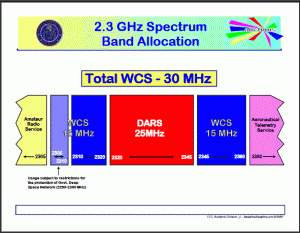
Here again is the “longstanding debate,” in a nutshell. As the table below indicates, Sirius XM transmits its content over spectrum very close in proximity to the Wireless Communications Services band. (more…)