Chicago Public Radio Calls Out LPTV Stations Exploiting Backdoor to FM Dial

Far outside the view of the general public, the virtual cratediggers of the FCC’s electronic recesses like Matthew and myself are sometimes privy to the little slap-fights that go on between broadcasters. In this case things are getting a little heated over the far left end of the FM dial, with a prominent public radio station calling out LPTV broadcasters exploiting the channel 6 backdoor to the FM dial.

As I’ve been already reported, the FCC recently ended restrictions on the use of FM frequencies adjacent to TV channel 6– 87.9 to 88.5 FM–in markets where former analog channel 6 stations went digital and changed channels.  Now, National Public Radio has petitioned the FCC to open up these frequencies everywhere, even in markets where digital TV stations decided to stay on channel 6 or where there are grandfathered analog low-power TV stations.

NPR’s argument rests on a technical analysis concluding that digital TV signals are far more interference-resistant than analog, and that modern TV tuners are selective enough to make interference from FM negligible for even analog LPTV signals.

Predictably, fellow noncommercial FM broadcasters are lining up in support of NPR’s proposal, while the ABC network and the National Association of Broadcasters have filed comments in opposition, calling into question NPR’s engineering data. There’s a few sparks coming from these opposing comments, but the real fun is buried in comments from Chicago Public Radio.

Without naming names, CPR  pointedly complains,

LPTV stations have begun to invade FM radio, broadcasting audio signals that were licensed for TV broadcast as if they were commercial radio stations on 87. 7 MHz. Not only are these signals inappropriately being broadcast as radio, they are also bleeding 24·hour dance music, with commercial advertising, over into the noncommercial stations that are on the lower NCE FM channels. Like squatters moving into recently-vacated homes, these LPTV stations are, in effect, intentionally broadcasting commercial radio which spills over onto the reserved portion of the FM band, trespassing on the limited territory of their noncommercial neighbors. Before this phenomenon becomes entrenched, the Commission owes the public, as well as public radio stations, a reasoned consideration of this problem.

(more…)


Analog TV Is Alive. It’s Radio.

A couple of weeks ago I was scanning the FM band as I made my short commute from my far-north Chicago neighborhood to WNUR in Evanston for a station meeting. At the bottom end of the dial I encountered a fading station playing a steady stream of smooth jazz with no DJ. I’d never heard the station before and I pretty much know every noncommercial station on the north side of Chicago and north shore ‘burbs. My first assumption was that it was a pirate station, perhaps run by a disaffected smooth jazz fan in protest of the recent loss of format stalwart WNUA.

WLFM 87.7FM & Channel 6

WLFM 87.7FM & Channel 6

Still listening to the station on the way home I heard commercials, but still no station ID, leaving me more confused. Listening a bit longer at home gave no more clues, so the internet I did search. I quickly learned that the station at 87.7 FM is not a radio station, but actually TV channel 6, WLFM-LP. And I was right that the broadcast was a direct reaction to the shuttering of WNUA.

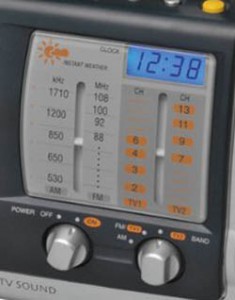
You see, analog TV channel 6 bumps right up against the bottom of the FM radio dial. TV sound is also frequency modulated, just like radio, so the sound for channel 6 can be heard at the very bottom of the dial. But, you might be thinking, “didn’t analog TV go away on June 12? Wouldn’t that kill WLFM?” Well, if you’re talking about a full-power station on channel 6, you’d be right. But WLFM is a low-power TV station (LPTV) and the digital changeover didn’t happen for LPTV.

(more…)