Chicago Public Radio Calls Out LPTV Stations Exploiting Backdoor to FM Dial

Far outside the view of the general public, the virtual cratediggers of the FCC’s electronic recesses like Matthew and myself are sometimes privy to the little slap-fights that go on between broadcasters. In this case things are getting a little heated over the far left end of the FM dial, with a prominent public radio station calling out LPTV broadcasters exploiting the channel 6 backdoor to the FM dial.

As I’ve been already reported, the FCC recently ended restrictions on the use of FM frequencies adjacent to TV channel 6– 87.9 to 88.5 FM–in markets where former analog channel 6 stations went digital and changed channels.  Now, National Public Radio has petitioned the FCC to open up these frequencies everywhere, even in markets where digital TV stations decided to stay on channel 6 or where there are grandfathered analog low-power TV stations.

NPR’s argument rests on a technical analysis concluding that digital TV signals are far more interference-resistant than analog, and that modern TV tuners are selective enough to make interference from FM negligible for even analog LPTV signals.

Predictably, fellow noncommercial FM broadcasters are lining up in support of NPR’s proposal, while the ABC network and the National Association of Broadcasters have filed comments in opposition, calling into question NPR’s engineering data. There’s a few sparks coming from these opposing comments, but the real fun is buried in comments from Chicago Public Radio.

Without naming names, CPR  pointedly complains,

LPTV stations have begun to invade FM radio, broadcasting audio signals that were licensed for TV broadcast as if they were commercial radio stations on 87. 7 MHz. Not only are these signals inappropriately being broadcast as radio, they are also bleeding 24·hour dance music, with commercial advertising, over into the noncommercial stations that are on the lower NCE FM channels. Like squatters moving into recently-vacated homes, these LPTV stations are, in effect, intentionally broadcasting commercial radio which spills over onto the reserved portion of the FM band, trespassing on the limited territory of their noncommercial neighbors. Before this phenomenon becomes entrenched, the Commission owes the public, as well as public radio stations, a reasoned consideration of this problem.

(more…)


NYC’s the Pulse Flatlines

The Pulse Flatlines

The Pulse Flatlines

Perhaps it was too good to be true. The overcrowded FM dial of the New York City metroplex offered no easy opportunity to bring a new cutting edge dance music station to the radio. But an opportunity was found at the far left end of the dial in the space occupied by TV channel 6 audio. So in February, 2008 87.7 FM the Pulse went on the air using the analog audio of low-power TV channel 6. Then, just 20 months later, the station pulled the plug yesterday at 5 PM, only four hours and forty-five minutes after announcing its imminent demise on air.

The death of the Pulse was not unexpected, given that the station’s owner Mega Media Group filed for bankruptcy in August. No doubt, commercial radio is a tough business in the 21st century, especially following nearly thirteen years of rampant industry consolidation which triggered ruthless cutting of ad rates in order to drive independent operators out of business and into the arms of megabroadcasters like Clear Channel and Cumulus. It’s fair to say that the Pulse had an uphill battle to begin with. Even with a unique format and a potentially very loyal audience, there’s fewer and fewer ad dollars to go around.
(more…)


The Pulse’s Backdoor into FM Not Paved with Gold

It takes a lot of listener donations to take on $3.5 million of debt and liabilities. That’s how far in the hole the owner of New York City’s 87.7 FM The Pulse found itself when the company, Mega Media Group, filed for bankruptcy last week. Loyal RadioSurvivor readers might recall that The Pulse is actually a low-power TV station operating on channel 6, which butts up against the left end of the FM dial, making its audio channel heard on most radios at 87.7 FM.

From The Pulse's "about" pageLast month I wrote about the quasi pledge drive that The Pulse held to try and stave off financial disaster. I found irony in the station begging for donations given that it’s commercial station run by a for-profit corporation. As it turns out, it’s for-profit in name only, since Mega Media Group only lists assets worth $180,000, less than half of the $414,000 it owes the IRS.

Invitation to "87.7 Is Alive Celebration"There’s been no report of how much The Pulse listeners donated. The station held a “87.7 is Alive Celebration” on July 24, with all proceeds from the event going to “keeping the radio station alive.” But the New York Daily News reports that the station announced that it didn’t need the donations after all. Maybe the company’s management figured out that taking listener’s money might mess up their bankruptcy plans?

It’s difficult to draw any generalizations from The Pulse’s bankruptcy. While finding a backdoor into the country’s largest radio market via a low-power TV station might be cheaper than buying an existing station, that doesn’t mean it comes without cost or risk. And, as I noted before, we don’t know to what extent management fumbled the ball, either. There were apparently plans to launch a record label in concert with the station. At this point it’s hard to know which is the worse business to get into right now, commercial radio or records.

Mega Media Group filed for chapter 11 protection, which means it’s hoping to reorganize. Presumably, the station will remain on air in the meantime.


Channel 6 Radio Backdoor No More Lucrative than Plain Old Commercial Radio?

Last month I wrote about a few legacy analog channel 6 low-power TV stations operating as radio stations, taking advantage of their audio program butting up against the low end of the FM dial. One of the pioneers is New York City’s Pulse 87. However it seems as though the backdoor to the FM dial may not be so easy to keep open.

Arcane Radio Trivia alerted me to Pulse 87’s call to listeners to donate to the station in order to keep it in good stead with creditors. Nevermind that Pulse 87 is a commercial station (ostensibly operating in the noncommercial part of the dial at that).

As of July 21 it looks like loyal listeners came through with the much needed cash, gaining the station “a reprieve from some of our creditors” and the opportunity “to attempt to raise money through more conventional means.” The station also promises to return the donations, presumably once replacement capital is raised.

I’m not really sure what to make of this situation. Commercial media is having a hard time, whether broadcast, internet or print, so I’m hesitant to place blame on the weakness of radio or the channel 6 LPTV method. We have no idea what the books at Pulse 87 look like, so it’s hard to say whether the culprit is insufficient revenue, poor management, or some mixture of both.

However, I do think it’s safe to say that the particular dance music format of Pulse 87 has tapped into some kind of loyal niche audience otherwise insufficiently served by other stations. The real test will be whether or not Pulse 87 can keep up the quality of the programming that keeps a loyal listenership in the face of cashflow problems. The temptation to cost-cut by automating and embracing other Clear Channel tactics may be too strong, even if that’s the surest route to undercut the qualities that make the station unique.

Perhaps the station would be better off going non-profit and relying on its listeners who’ve apparently already demonstrated a willingness to cough up bucks to keep Pulse 87 on air.


Analog TV Is Alive. It’s Radio.

A couple of weeks ago I was scanning the FM band as I made my short commute from my far-north Chicago neighborhood to WNUR in Evanston for a station meeting. At the bottom end of the dial I encountered a fading station playing a steady stream of smooth jazz with no DJ. I’d never heard the station before and I pretty much know every noncommercial station on the north side of Chicago and north shore ‘burbs. My first assumption was that it was a pirate station, perhaps run by a disaffected smooth jazz fan in protest of the recent loss of format stalwart WNUA.

WLFM 87.7FM & Channel 6

WLFM 87.7FM & Channel 6

Still listening to the station on the way home I heard commercials, but still no station ID, leaving me more confused. Listening a bit longer at home gave no more clues, so the internet I did search. I quickly learned that the station at 87.7 FM is not a radio station, but actually TV channel 6, WLFM-LP. And I was right that the broadcast was a direct reaction to the shuttering of WNUA.

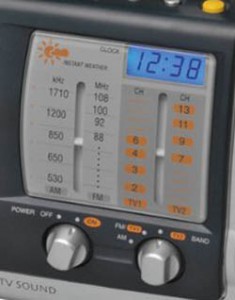
You see, analog TV channel 6 bumps right up against the bottom of the FM radio dial. TV sound is also frequency modulated, just like radio, so the sound for channel 6 can be heard at the very bottom of the dial. But, you might be thinking, “didn’t analog TV go away on June 12? Wouldn’t that kill WLFM?” Well, if you’re talking about a full-power station on channel 6, you’d be right. But WLFM is a low-power TV station (LPTV) and the digital changeover didn’t happen for LPTV.

(more…)