Posts Tagged ‘Sirius XM’

Sirius XM “extremely disturbed” by FCC wireless non-interference proposals

Sirius XM satellite radio CEO Mel Karmazin warned the Federal Communications Commission on Thursday that the FCC’s proposed non-interference rules with a nearby wireless band won’t do.

“We are extremely disturbed by the proposal,” Karmazin confided in a letter sent to the agency’s Chair, Julius Genachowski. “The proposed rules seem to bear little resemblance to the technical record in this proceeding. More importantly, the proposal raises the real and direct threat of crippling interference to our 35 million current listeners and the 90 million satellite radio-equipped vehicles that will share the road with mobile WCS by 2015.”

As we’ve reported, Sirius XM and the owners of spectrum in the Wireless Communications Services band have been wrangling for years about how to avoid interference, given the nearness of their licenses to each other in the 2.3 GHz zone. The owners of WCS, which include AT&T, Comcast, and NextWave, want to step up use of the region for broadband, but these interference concerns have gotten in the way.

Last year, WCS reps proposed compromise limits on transmission power for WCS base stations and Sirius XM repeaters. But Sirius questions whether the interference tests conducted in Ashburn, Virginia upon which the recommendation was based would be as accurate as looking at Clearwire’s WiMAX network in the Philadelphia area, especially when it comes to mobile video use. “As this data was based on the real-world functioning of an operational WiMAX system, it provides a more transparent look into mobile handset performance than any other WiMAX-related information or description previously filed in these proceedings,” the company wrote last month.

WCS and Sirius XM engineers had a meeting about the FCC’s latest proposals on Tuesday. We don’t have a copy of the plan, but here’s the rest of Karmazin’s reaction to it: (more…)


Will the FCC’s National Broadband Plan resolve Sirius XM’s little war with big wireless?

Mercedes BenzAs Federal Communications Commission watchers everywhere know, a huge part of the agency’s strategy to build out the nation’s broadband infrastructure will be to get more spectrum licenses to the wireless industry. In fact, FCC Chair Julius Genachowski says the Commission’s National Broadband Plan will propose freeing up 500 MHz over the next decade. And then there’s this comment from Genachowski, which has me scratching my head a bit:

“The Plan proposes resolving longstanding debates about how to maximize the value of spectrum in bands such as the Mobile Satellite Service (MSS) or Wireless Communications Service (WCS) by giving  licensees the option of new flexibility to put the spectrum toward mobile broadband use—or the option of voluntarily transferring the license to someone else who will.”

We’ve been watching the WCS fight for a while here at Radio Survivor, and (more significantly) so have Volvo, Ford, Chrysler, Comcast, AT&T, NextWave, and quite a few members of the House of Representatives, all of whom have communicated with the FCC on this matter (Mercedes-Benz just filed a week ago).

Here again is the “longstanding debate,” in a nutshell. As the table below indicates, Sirius XM transmits its content over spectrum very close in proximity to the Wireless Communications Services band. (more…)


Hopeful week for radio/media stocks?

Given the state of the economy, last week wasn’t so bad for radio/media company investors. And this week might improve depending on what Federal Reserve Chair Ben Bernanke says, and what Sirius XM reports in its fourth quarter and full 2009 earnings press conference on Thursday.

Saga Communications, Cumulus Media, Entercom, and Citadel all reported slight trading gains on Friday. Emmis, Westwood One, and Sirius all reported slight declines (although Sirius is still on the dollar menu). The week’s mildly bright spot was terrestrial and Internet radio giant CBS, whose stock rose nearly a point. On Thursday CBS reported revenues for the fourth quarter of 2009 came to $3.50 billion, down just 1% from $3.53 billion for the same quarter in 2008.

Here’s the radio excerpt of the report:

“Local Broadcasting revenues for the fourth quarter of 2009 decreased 8% to $680.0 million from $735.8 million for the same prior-year period reflecting lower radio and political advertising sales. Revenues for CBS Television Stations decreased 3% to $358.2 million from $369.3 million, and CBS Radio revenues decreased 12% to $322.2 million from $366.7 million for the same prior-year period, partially reflecting radio station divestitures. Non-political advertising sales increased 11% for CBS Television Stations and were flat for Local
Broadcasting.”

Perhaps this isn’t so bad, given the beating that radio took last year. Anyway, it’s not nearly as big as the drop CBS radio experienced in Q3: $318 million in revenue compared with the previous year’s same quarter: $392.5 million. And with the exception of troubled Citadel, most of these stocks are on the upswing after a period of decline.

The day before Sirius XM reports its earnings, Fed boss Bernanke will testify before the House Committee on Financial Services. And on that Thursday, he will speak to the Senate Committee on Banking, Housing, and Urban Affairs. The big question of course is how is the economy doing, and how fast will it mend? Last week the Fed raised the Discount Rate by just a smidgeon (1/4% to the surprise of some analysts) “in light of continued improvement in financial market conditions.”

Anyway, a somewhat optimistic report from Bernanke and a nice report for Sirius could mean a good week for radio by Friday. As RS’s Paul Riismandel noted last week: “The prevailing opinion on Wall Street seems to be that investors think Sirius XM has finally gotten its financial affairs in order, along with adding a net of 257,000 listeners–more than expected–in the fourth quarter of 2009.” So hope springs eternal, but we’ll have to see.


Sirius Stock Back on the Dollar Menu

Sirius XM

After languishing in near-penny-stock territory for the last year, Sirius XM Radio stock hit the dollar menu on Wednesday, topping out at $1.05 a share. Investors who bought their stock a year ago when it sold for less than 20 cents are probably cheering. Sirius hasn’t seen the plus size of one buck since September of 2008.

The prevailing opinion on Wall Street seems to be that investors think Sirius XM has finally gotten its financial affairs in order, along with adding a net of 257,000 listeners–more than expected–in the fourth quarter of 2009.

There also seems to be a growing confidence that, despite all the recent hoopla, Howard Stern will sign a new contract with Sirius. I don’t really understand how that’s a strong sign of strength for Sirius, although I guess it can be seen as a indicator of stability. If Sirius has to cough up another $300 million to keep Stern I really wonder if it will really be worth it. Even given Stern’s recent headlines over his claimed invitation to join American Idol, I doubt he has the magnetism to draw a significant number of new listeners. At best, Sirius can hope to hold onto the current crop of die-hard Stern fans.

But, then again, getting the stock price over $1 is only a relative achievement. Although the increase will likely help the company avoid a reverse stock split. Sirius’ viability will depend on how costly it is to retain Stern and how well it can continue to add listeners, despite very few new receivers being announced at last month’s CES.


Sirius XM radio: how to tell if your kids are stoned

Hey kids, let's talk about drugs! (source:goldensilents.com)

Over the weekend Sirius XM’s Doctor Radio Reports ran a show called Is Your Kid High?—Teens Speak Out, which offered advice to parents on how to tell if your tweens/teens are doing drugs. I read with great interest the summary of the wisdom offered by Elizabeth Urquhar and Naveed Etemadipour of San Diego’s Phoenix House during this program, since I went through this complicated process myself with a teen.

Here’s Naveed’s advice:

  • If you are concerned your kid might be doing drugs, go into their rooms and open their drawers when they are not there—it’s ok to cross that boundary.
  • Pens are sometimes used to smoke marijuana and other drugs. Check to see if the pen smells burnt. You can take a pen apart and make a pipe out of it and then put it back together so that nobody knows that you’ve smoked out it.
  • Broken glass could indicate methamphetamine use because glass pipes are commonly used to smoke meth.
  • Crumbled tin foil is a possible indication of drug use.
  • Marijuana can be smoked out of almost anything.
  • Light bulbs can be used to do drugs.

Well, you can decide that it’s “ok to cross that boundary,” but rest assured, your girl or boy won’t. Let’s face it, if they’re late 12 to early 14, they’ve probably already got you down as Nurse Ratched or Uncle Fester—see above photo for the latter; perhaps not the most apt analogy since the Urban Dictionary defines an “Uncle Fester” as a way to smoke  pot. In any event, doing a J. Edgar Hoover on their their room, opening their drawers, pulling apart their pens and light bulbs, or rummaging about for “almost anything” because you think they’re smoking doobies is going to kill any trust left between you and them for years. So do this only if you think it’s absolutely necessary.

The Phoenix House duo also offer these “warning signs and changes to look out for in your child’s behavior and personality:” (more…)


Ford, Volvo, Chrysler back Sirius XM on wireless interference fight

Looks like the Sirius XM satellite radio service has brought out some big automotive guns in its feud with the  WCS Coalition over tower interference concerns  between wireless and satellite services.  Ford, Volvo, and Chrysler have  written to the Federal Communications Commission to back Sirius on the question.

“We urge the FCC to be cautious and ensure that satellite radio is not degraded by changing the established rules for WCS operations,” Ford told the FCC on January 26. “Sirius XM Radio has spent billions of dollars developing networks that are based on the understanding that mobile WCS devices would not interfere. Automakers have installed tens of millions of satellite radios in their vehicles with that same understanding. Unlike cell phones, automobiles are notdiscarded every year or two – these satellite radios will remain operational and in circulation for years to come.”

Ditto says Volvo using pretty much the same language. And don’t forget, warns Chrysler, “Unlike cell phone service where momentary blips or degradation are easily overcome, satellite radio provides high-quality audio and music  where drop-outs and interruptions are neither expected nor tolerated by subscribers, in large part because competing audio services typically provide error free service.”

As we have reported, the close proximity of the Wireless Communications Services band to the Sirius XM satellite band in the 2.3 GHz area has caused quite a bit of contention about whether WCS activity interferes or could mess with Sirius XM transmissions, especially if various spectrum holders start offering broadband on those frequencies. Sirius insists that coexistence scenarios proposed by the WCS Coalition pose a threat. The coalition, which represents the license area’s owners (among them AT&T, Comcast, and NextWave) say that Sirius’ claims are exaggerated.

Indeed, “The Sun, The Moon And The Stars Must Align For Interference To Occur,” reads one WCS Powerpoint slide.

This feud has been going on for several years now. In fact it predates discussion of the Sirius XM merger. I’m unclear as to when the FCC plans to apply the elbow grease necessary to resolve the issue, but my latest theory is that the policy of the agency is to wait until the  sun turns into a Red Dwarf, thus making the problem moot.


Could the wireless spectrum crisis resolve the Sirius XM/WCS radio band interference crisis?

source: FCC

Fifteen members of the House of Representatives, all Democrats serving rural areas, have written to the Federal Communications Commission urging them to get on the ball regarding a big chunk of wireless spectrum in the 2.3 GHz area that needs new rules. Developers want to get some WiMAX action going in said Wireless Communications Services (WCS) band. And Sirius XM satellite radio is involved in the story. First, here’s the reps’ statement:

“The 2.3 GHz WCS spectrum has been mostly sitting fallow for over a decade in large part because final technical rules have not been adopted,” they wrote. “Until final rules exist, equipment manufacturers and wireless network operators cannot offer consumers cost-effective wireless mobile broadband services. In rural areas, where the need for these services is particularly acute, it is critical we make spectrum available without further delay.”

The Dems include the member of Congress with my favorite name: Zack Space of Ohio.

What does this have to do with Sirius XM? If you followed the Great Debate over the proposed and now consummated merger of the Sirius and XM satellite radio services, you know that most of the issues associated with that marriage have now been resolved. But not all. First, the FCC still has to figure out who gets those “qualified entity” (minority oriented) channels that the merger parties promised to allocate as a public interest requirement. Well over a year after the merger, that still hasn’t been worked out.

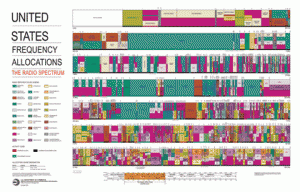
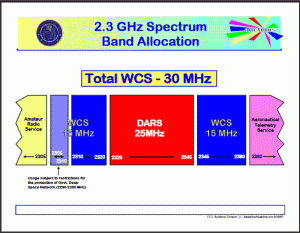
Then there’s the ongoing struggle between Sirius and the wireless industry over the so-called spectrum band, which is reserved for pinpoint accurate wireless transmission. What’s the problem here? Well, look at this handy little graphic produced by the FCC (top left), plus this table we’ve produced just for your benefit (you’re welcome). As you can see, Sirius XM is plunked right in the middle of the WCS bands. It’s got that red Digitial Audio Radio Satellite (DARS) band in the middle of the graphic.

WCS and Sirius XM bands
WCS Sirius XM WCS
Band (MHz) 2305-2320 2320-2345 2345-2360

So there’s been a huge amount of debate, much of it quite contentious, about whether WCS activity interferes or could interfere with Sirius XM transmissions. Sirius insists that various coexistence scenarios proposed by the WCS Coalition pose a threat. The coalition, which represents the spectrum area’s owners (among them AT&T, Comcast, and NextWave) say that Sirius’ claims are exaggerated. (more…)


Rosie O’Donnell gets show on Sirius XM radio

Rosie O’Donnell will get a live two hour call in program on Sirius XM radio starting on November 2nd.

“Like Rosie herself, Rosie Radio will be compelling, intriguing, unpredictable, and thought-provoking,” the press release proclaims. “The show will feature Rosie’s trademark wit, wisdom and straightforward take and outlook on life.”

O’Donnell’s actually quite formidable on TV. Here she is duking it out with Elisabeth Hasselbeck over Iraq, and it isn’t a “cat fight” like the poster who put up the video says, it’s a serious debate. O’Donnell opposed the U.S. invasion of Iraq. Hasselbeck is making some football analogy about how you can’t wait for your opponent to make a move before attacking. “What does that do for your enemy?” she asks O’Donnell, her hands flailing in the air.

“Well you know what Elizabeth, if the enemy is innocent civilians, I don’t want to play that kind of football,” O’Donnell shoots back.

Rosie Radio will stream Monday through Friday from 10:00 am – 12:00 pm ET/7:00 – 9:00 am PT on SIRIUS XM Stars, SIRIUS channel 102 and XM channel 155. It will repeat from 8:00 – 10:00 pm ET/5:00 – 7:00 pm PT, with a “Best of the Week” airing at various times on the weekend.


Sirius XM keeps hanging on

I splurged and took a taxi to JFK airport in New York City today, and waddayaknow, my driver was a dedicated Sirius XM fan. We listened to the Love Channel for a while (I would not have taken him for a Lionel Richie type of guy). I asked him how much he likes Sirius XM. A lot, he replied, and took me on an extended tour of all the channels in his package.

This made me feel a little optimistic for the company. Checking the web I found some basis for this. Turns out that Sirius XM is issuing over 250 million in senior secured notes to pay back that humongous loan it borrowed from Liberty Media. Its second quarter financial numbers aren’t all that bad either. The company reports a one percent increase in revenue from the same time last year, which isn’t a lot, but beats Clear Channel and Westwood One, both of which appear to be in free fall, revenue-wise.

On the other hand, the satellite company says it is slightly down in subscribers—a one percent drop; at this point Sirius XM has 18,413,435 customers, my taxi driver among them. But given the state of the economy, that might be another sign of the services’ strength.

The company still has some loose ends it has to tie up with the Federal Communications Commission. Sirius XM still hasn’t figured out how to distribute those minority channels it agreed to share when it got merger approval from the FCC and Department of Justice (The FCC just gave Sirius yet another extention on this problem). And it still has to resolve a nasty dispute with the Wireless Communications Service over tower and translator positioning.

But things look better for satellite radio than they have in a while. The Love Channel sounded good, too.


Who will get those Sirius XM minority channels?

Sirius XM Inc.

Sirius XM Inc.

Sirius XM radio has a tricky task ahead of it. The satellite broadcaster still has to figure out who is going to get those “qualified entity” channels that it promised to lease out to minority broadcasters when the Federal Communications Commission gave its two halves permission to marry last July. The FCC is supposed to provide guidance, but keeps pushing the decision off, probably because it has yet to figure out the legal logistics of using affirmative action to award various applicants the channels, without running afoul of various legal rulings that restrict government activity in this area.

It has been a bad couple of days for Sirius XM. The broadcaster just rolled out an app for the iPhone, but critics quickly pointed out that it doesn’t include Howard Stern. And Orbitcast reports that the company is transferring royalty fee charges to its subscribers. So this qualified entity sticky wicket is probably the last thing with which the company wants to deal.

Howard University

Howard University

A lot of broadcasters have shown some interest, though. We are talking about 4 percent of the full time audio channels on Sirius and XM’s platforms here —a minimum of twelve channels all told. The applicants include Howard University, the RSS Spanish language network, Entravision, and Radio One. The last contestant is probably the best equipped to handle this resource, since it already manages over 50 minority oriented radio stations nationally.

But lots of questions remain unanswered—like how will these minority entities “monetize” their leased channels? Will they be allowed to run ads? The issue has always been a sore point for Sirius XM fans. So there’s a case here for letting Howard run the show on a non-commercial basis, if the campus wants to do that.

In any event, the FCC keeps kicking this poor pooch down the road. The new deadline it has given itself to come up with some guidelines is June 29—ten days from now.