Radio Obsessive Profile #8: Beloit College Radio Historian Dave De Anguera

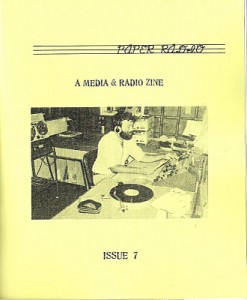
Professor Charles Culver at the controls, about 1910 (Beloit College Archives)

The early history of college radio has not been documented sufficiently and much of it is sequestered away in the archives of colleges and universities.

Last year I was thrilled to see Hugh Slotten’s book, Radio’s Hidden Voice: The Origins of Public Broadcasting in the United States, as it is one of the first publications to give credit to college radio pioneers in the very early days of radio.

Personally I’m invested in this, as I’ve done quite a bit of research to uncover the hidden history of radio at Haverford College, where I got my start in radio. Students at Haverford College built a radio station in the 1920s and achieved a great deal of press and attention for both the station and their radio experiments (including a chess match with Oxford students by radio).

While investigating the Haverford station’s history I’ve also run across a number of other histories of college radio stations, often compiled by students or staff members. One such history is Dave de Anguera’s book Ethereal Messages: A History of Beloit College Radio 1907-1994.

Radio experiments began at Beloit College with the arrival of Physics Instructor Charles Aaron Culver in 1907. During his time at the college he initiated pioneering work in radio and wireless, leaving in 1920 to join the faculty of Carleton College (where he was also instrumental in college radio). As Hugh Slotten pointed out in his interview with me, Beloit College held one of the earliest licensed stations at a small college, with WEBW, having its initial broadcast in October, 1924. Beloit’s current station, WBCR-FM, is still going strong today.

WEBW log - first entry, 1924 (Beloit College Archives)

I reached out to Beloit College radio historian Dave de Anguera, as I thought he would be a perfect addition to the Radio Obsessives series here at Radio Survivor. From my own experience, I know what a challenge it is to dig through the archives of college radio stations, in which history is not necessarily documented all that methodically.

In his interview, Dave shares with me why he was inspired to research the history of radio at Beloit College, his take on how the trials and tribulations of college radio today are similar to its struggles in the past, and provides some perspective about the role of technology in college radio in 2010.

Jennifer Waits: What prompted you to research and write the history of radio at Beloit  College?

Dave de Anguera: I’ve always loved radio and have been a lifelong history buff to boot. So, when I kept coming across information on WBCR’s history, and the fact that it stretched back so far, I couldn’t contain my curiosity any longer and thus started investigating further.  I eventually made a proposal to the college (with the support of Beloit College archivist Fred Burwell and Professor Carl Balson) for writing and publishing a book on the subject. (more…)


Radio Obsessive Profile #6 and #7: Jonathan Winter and John Jenkins of American Museum of Radio and Electricity

Folks in Bellingham, Washington are lucky to have an amazing resource for radio history right in their backyard.

What is now known as The American Museum of Radio and Electricity (AMRE) began in 1985 as the Bellingham Antique Radio Museum as an outgrowth of Jonathan Winter’s personal collection of vintage radios and radio-related objects. As his collection grew, he sought out a bigger venue and eventually joined forces with fellow radio collector John Jenkins.

With their move to bigger quarters in 2001, the museum’s name was changed to The American Museum of Radio and Electricity to reflect its now broader mission of presenting exhibits focused on a variety of scientific innovations. According to their website:

“Today, the Museum is dedicated to the interpretation of the relationship between the scientific exploration of electricity and the development of broadcast radio into its Golden Age—a story with immense cultural, historic, aesthetic, and scientific significance. Among the Museum’s current holdings are unique examples of early scientific instruments and 19th century electromagnetic apparatus, an outstanding collection of more than 10,000 vacuum tubes, and an authentic reproduction of the radio room on the Titanic displaying an original Marconi wireless set.”

The museum galleries contain interactive exhibits recounting nearly 400 years worth of innovations related to electricity and wireless, from the “Dawn of the Electric Age,” to the early history of radio, to the radio’s “golden” age. AMRE also houses more than 1000 radios, operates a low power FM radio station (KMRE-LP), and hosts science education classes for kids.

I talked to founders Jonathan Winter and John Jenkins in order to learn more about the museum and find out how their collective passion for radio inspired its creation. (more…)


Radio Obsessive Profile #5: Herculodge’s Jeff McMahon- The Man Who Loved Radios Too Much

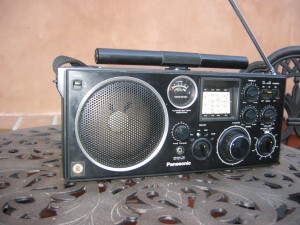
Jeff McMahon's Rare Panasonic RF-1130 Radio

It’s time for another installment in our ongoing series Radio Obsessives, in which we share tales about people who are passionate about radio.

So far we’ve profiled Garrett Wollman’s Radio Tower Quest, Jose Fritz and his amazing Arcane Radio Trivia website, Radio Sticker of the Day curator Greg Blouch, and radio historian/Seattle Radio Theater founder Feliks Banel.

Blogger Jeff McMahon muses about radio on his blog Herculodge. Although the blog is ostensibly focused on a myriad number of topics (from vegetarian cooking to parenthood to cars), Jeff found that his posts about radio seemed to generate the most interest and excitement from readers.

Filed under the category “Radio Lovers Can’t Be Cured,” Herculodge’s radio posts typically focus on reviews of both new and vintage radios, as well as radio-related products. Written by Jeff and a crew of guest contributors, the radio section of Heculodge is kind of like a clearinghouse for feedback about specific radios. I was also amused by a post by Radio Russ enumerating a “12-Step Program for Radio Addicts.” He writes that step 1 is: “We admitted we were powerless over Radios, that our lives had become unmanageable without a radio in every room.”

On the site, Jeff also has a 3-part semi-autobiographical story “The Man Who Loved Radios Too Much,” in which he describes both the origins of his radio love and how he has descended into obsession.

In our email interview, I chatted with Herculodge founder Jeff McMahon about his website and why he’s so passionate about radio and radios. (more…)


Radio Obsessive Profile #2: Jose Fritz’s Arcane Radio Trivia

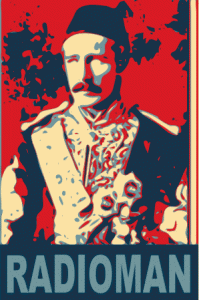
Jose Fritz's "Radioman" Profile Picture

Jose Fritz

I’m awed by all the radio enthusiasts, collectors, historians, and scholars out there; so I’m going to try to feature some of my favorites on Radio Survivor in a new feature called Radio Obsessives.

I didn’t realize it at the time, but my interview with Garrett Wollman about his fascination with radio towers is what prompted me to begin this quest to profile radio obsessives; simply because I love talking to other radio fans about radio.

“Jose Fritz” lives for radio and regularly blogs about radio factoids from the olden days on his blog Arcane Radio Trivia. In many ways I’ve found a kindred spirit in radio reportage, as Jose is also a fan of non-commercial radio and continues to remain optimistic about the future of college radio.

Interestingly, he’s opted on his blog to focus entirely on the past, avoiding “topical” stories for the most part. Consistently writing an impressive 5 posts a week, he’s covered everything from the long-forgotten radio show “The Fleischmann’s Yeast Hour,” to WXPN’s scandalous student radio past, to James Brown’s career as a radio station mogul, to little-known radio pioneers like Reverend Jozef Murgas.

I had an email chat with Jose Fritz to learn more about his radio obsession and to attempt to peel back some of the layers of his secret identity. I can tell you that he’s an engineer by day, is a blogger by night, has a music and radio past, and writes a fun and educational blog. On to the interview:

Jennifer Waits: When did you start Arcane Radio Trivia and what prompted you to begin writing the blog?

Jose Fritz: I began Friday, May 13th 2005. I decided one day maybe a few weeks prior that I needed a structure that would compel me to write more regularly.  I gave myself a set of strict rules and started that Friday. It’s been 5 posts a week since then for 220 weeks; that’s 1047 posts not counting today.  I keep thinking I should edit and compile them into a book.

I though it would make my other writing more productive. I was wrong.  I did write more, but I wrote more about radio, instead of becoming a writing exercise it became a consuming hobby.  I still manage to get the rest of my writing done, but I often end up posting after midnight. (more…)