Posts Tagged ‘noncommercial radio’

FCC Awards Full-Power Licenses to 5 LPFMs, Plus 52 More Orgs

The FCC opened up an important licensing window for new noncommercial FM stations in 2007, announcing the first round of license winners in 2008. However another 59 licenses remained up in the air due to the Commission needing to pick a winner amongst competing applications. The FCC announced those winners on Tuesday [PDF].

The Commission uses a point system to judge which group should receive a noncommercial FM license amongst multiple competitors. The system awards points with preference to candidates that are locally headquartered with an “established” presence, do not have a controlling interest in another nearby station and which propose to serve the largest number of people.

For the first time the FCC had to contend with applicants who are currently running low-power stations. Because the operators of LPFM stations cannot also operate full-power stations, the Commission will require these operators to give up their LPFM licenses before signing on with their full-power stations. In order to make sure their communities are not deprived of service any longer than necessary the Commission is allowing the LPFM stations to petition to maintain broadcasts until they are ready to begin test broadcasts with their full-power stations.

Radio Free MoscowA total of nine LPFM station operators were in competition for licenses nationwide, and of these five won. Two winners are stations that have been operating as traditional community radio stations: Radio Free Moscow in Moscow, Idaho and Berkshire Community Radio in Great Barrington, MA.

Radio Free Moscow (RFM) edged out Fire Media Corporation and Country Roots Preservation Group based upon RFM demonstrating that it is an “established local applicant,” which neither of the other contenders claimed. Berkshire Community Radio (BCR) won out over the University of Massachusetts and Home Improvement Ministries. BCR and UMass both scored the same number of points, which required the FCC to use “tie breaker” criteria. The first tie-breaker criterion prefers the organization that has fewer licenses in other communities. UMass operates WBCR in Boston, while BCR, as a LPFM, operates no other, which resulted in BCR winning this competition.
Berkshire Community Radio
Amongst the rest of the licensees [PDF], seventeen appear to be obviously religious groups, three are universities or colleges, two are primary or secondary schools, two are established public broadcasters and one is a Native American group. The nature or affiliation of the other licensees can’t be easily discerned from their names.

These awards are considered tentative because will be an opportunity for the filing of petitions to deny a license to any of the winners. However, in practice, such denials rarely occur.


Today We’re Half-Way to LPFM


It’s a day that thousands of low-power FM and community radio activists have been awaiting for just about nine years. This evening, at 7:06 pm the House of Representatives, with a minimum of drama, passed H.R. 1147, the Local Community Radio Act of 2009 by voice vote. Little drama for the House nevertheless meant nearly two days of sitting on the edge of the seat for LPFM advocates as they waited for the House to move through its usual machinations and other business. Regardless of how much we might wish LPFM was at the top of the legislative agenda, instead it seemed more like an afterthought. At least it was enough of a no-brainer for the House that they didn’t even need a roll call vote. I’ll take it.

The bill restores the original technical specifications for LPFM which the FCC instituted in 2000. These specs allow a low-power station to be placed as close as the third adjacent channel on the dial. In practice that means if a full-power station broadcasts on 100.1 FM then a LPFM may be placed at 100.7 FM, provided that the frequency is otherwise available.

On Dec. 18, 2000 a provision limiting LPFM stations to obeying the spacing requirements of full-power stations was slipped into an omnibus budget bill and signed into law by President Clinton after a long series of back-room horsetrading. Under these still-current rules, a LPFM station may only be spaced as close as 100.9 FM next to that hypothetical full power station at 100.1 FM.

.2 MHz may not seem like a big difference, but when it comes to spacing stations on the FM dial, it is a game fought and won by tenths of a megahertz. This difference is of particular importance in the nation’s largest radio markets which already have very full dials that will not permit the addition of another full-power station or LPFM that has to obey full-power spacing rules. LPFM proponents estimate that passage of the Local Community Radio Act will create the potential for at least a hundred new stations nationwide.

Now the focus moves to the Senate, where the Commerce Committee has already approved the Senate version of the bill. If it goes to a floor vote and is passed then it is likely to be signed by President Obama.


The Clock Is Winding Down for Channel 6 Backdoor to FM

Regular readers may recall that I’ve been doggedly pursuing the minor phenomenon of analog TV channel 6 broadcasters exploiting their audio signal’s proximity to the FM dial to become radio broadcasters. At present the only analog TV stations capable of exploiting this backdoor are low-power TV stations which were not required to go digital this year.

Photo credit: Yukon White Light / flickr

Photo credit: Yukon White Light / flickr

However, the future viability of that idea became a little less secure this past week when the FCC’s Media Bureau announced (PDF) that beginning Oct. 27 it will end the protection of channel 6’s audio spectrum in areas where a formerly analog channel 6 moved to a new UHF channel when it went digital.

In effect, the FCC is just saying that now that in places where there’s now no analog or digital channel occupying the space next to 87.7 FM, there’s no point in expecting FM stations to avoid encroaching on it. What it doesn’t mean is any sudden increase in available noncommercial licenses at the far left end of the dial. This is because no application window for this class of licenses is scheduled in the near future.

It might allow a few existing noncommercial stations occupying frequencies from 87.9 to 88.5 or so to either raise their power, relocate their transmitter or otherwise improve their signal because they won’t have to protect the vacant channel 6 space any longer. Yet, this might be complicated by the upcoming January 25, 2010 filing window for new digital-only LPTV stations. VHF channel 6 spectrum space should still be in the offing for new LPTV stations, which could block any significant expansion of noncommercial FM into the area of 87.7 FM. However, none of these new LPTV stations will be analog. So they won’t be broadcasting an audio signal that will be heard on the FM dial.


FCC Opens another Window for Aspiring Educational Broadcasters

There’s some excellent news from the FCC today. They’ve just announced that there will be another window of opportunity for non-commercial, educational broadcasters to obtain an FM frequency.

Between Friday, December 11 and Friday, December 18, 2009; aspiring stations will be able to apply for open FM frequencies.

Take a look at some of the markets where these frequencies are located to see if your community might be able to benefit from this fantastic opportunity to go FM. I count 67 open frequencies, ranging from stations in Hemet, California to Otter Creek, Florida.


Radio Obsessive Profile #2: Jose Fritz’s Arcane Radio Trivia

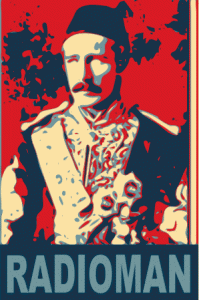
Jose Fritz's "Radioman" Profile Picture

Jose Fritz

I’m awed by all the radio enthusiasts, collectors, historians, and scholars out there; so I’m going to try to feature some of my favorites on Radio Survivor in a new feature called Radio Obsessives.

I didn’t realize it at the time, but my interview with Garrett Wollman about his fascination with radio towers is what prompted me to begin this quest to profile radio obsessives; simply because I love talking to other radio fans about radio.

“Jose Fritz” lives for radio and regularly blogs about radio factoids from the olden days on his blog Arcane Radio Trivia. In many ways I’ve found a kindred spirit in radio reportage, as Jose is also a fan of non-commercial radio and continues to remain optimistic about the future of college radio.

Interestingly, he’s opted on his blog to focus entirely on the past, avoiding “topical” stories for the most part. Consistently writing an impressive 5 posts a week, he’s covered everything from the long-forgotten radio show “The Fleischmann’s Yeast Hour,” to WXPN’s scandalous student radio past, to James Brown’s career as a radio station mogul, to little-known radio pioneers like Reverend Jozef Murgas.

I had an email chat with Jose Fritz to learn more about his radio obsession and to attempt to peel back some of the layers of his secret identity. I can tell you that he’s an engineer by day, is a blogger by night, has a music and radio past, and writes a fun and educational blog. On to the interview:

Jennifer Waits: When did you start Arcane Radio Trivia and what prompted you to begin writing the blog?

Jose Fritz: I began Friday, May 13th 2005. I decided one day maybe a few weeks prior that I needed a structure that would compel me to write more regularly.  I gave myself a set of strict rules and started that Friday. It’s been 5 posts a week since then for 220 weeks; that’s 1047 posts not counting today.  I keep thinking I should edit and compile them into a book.

I though it would make my other writing more productive. I was wrong.  I did write more, but I wrote more about radio, instead of becoming a writing exercise it became a consuming hobby.  I still manage to get the rest of my writing done, but I often end up posting after midnight. (more…)


Listen to the Radio Survivors

In the vein of practice what you preach, two of the bloggers here, myself and Jennifer Waits, have regular weekly radio programs. Our third accomplice, Matthew Lasar, is a frequent guest on my program, mediageek. The mediageek radioshow covers grassroots media along with a focus on the regulatory and legal maneuvers that affect our ability to communicate freely.

Matthew was my guest last week to talk about this here little blog and the new FCC, which just saw its last two new commissioners ratified by the Senate.

The previous week I was lucky to have Jennifer as my guest to talk about the value and importance of college radio in the modern multichannel universe.

Matthew has made several appearances on the radioshow in the last fifteen months, and I hope that I’ll have the opportunity to have Jennifer on again, too.

Mediageek airs live weekly for an hour on WNUR 89.3 FM in Evanston and Chicago, IL at 9 PM on Thursdays. A half-hour syndicated version airs on thirteen other non-commercial stations in the US and Canada, which are listed at the radioshow website. And if the show doesn’t air on a station near you, you can always listen at the show’s website.

The program is free to air for any noncommercial radio station. So if you work at a noncomm station or have a local station that you think should broadcast it, drop me a line and let me know.