FCC orders fix to unleash wireless broadband near Sirius XM band

source: wikimedia commons

source: wikimedia commons

The Federal Communications Commission’s long awaited Order to fix interference problems between Sirius XM [SIRI] and the neighboring Wireless Communications Services (WCS) band is published. Here’s hoping it will at long last resolve this feud, and allow for peaceful coexistence on the 2.3 MHz band. At least that’s the idea, says FCC Chair Julius Genachowski.

“I am pleased that by taking a fresh look at the WCS rules, we are able to create an environment for innovative, cutting-edge mobile products and services in a spectrum band that has essentially remained fallow for years,” Genachowski said on Thursday, “while still protecting adjacent band services from harmful interference and providing important clarity about the long-term operation of satellite radio terrestrial repeaters.”

We’ve been covering this issue for months here at Radio Survivor (see links to related stories at bottom of this piece), and we’ll spare you the hairy technical details. The Order sets up permanent rules for Sirius’s terrestrial repeaters and power level limits for WCS mobile and portable stations.

So now 25 MHz of WCS band is unleashed for wireless broadband, which is kind of exciting!  The FCC’s Order says that WCS license holders have to get moving:

“For mobile and point-to-multipoint services, WCS licensees must serve 40 percent of a license area’s population within 42 months, and 75 percent within 72 months. For fixed point-to-point services, WCS licensees must construct and operate 15 point-to-point links per million persons in a license area within 42 months, and 30 links within 72 months, together with a minimum payload capacity to ensure that the spectrum is used intensively. Licensees will not be required to satisfy submarket construction requirements.”

Here’s hoping that everybody will accept this as a workable compromise.


DJ Chairman Genachowski Throws a Few Bones to Radio at NAB

DJ Genachowski

The National Association of Broadcasters wraps up its annual national trade show in Las Vegas tomorrow. Radio has its own annual show, so at the big one it tends to take a back seat to television when it comes to big announcements. Nevertheless, when FCC Chairman Julius Genachowski gave his remarks [PDF] to the crowd on Tuesday, he had a few things to say about radio.

First, the Chairman revealed his own secret radio past, telling attendees that he was “a radio DJ while in high school, spinning disks — literally — on an old carrier current station.” I must note that means young Julius was actually broadcasting without a license. But I also presume his high school station operated legally under Part 15 rules for AM carrier current, which also kept his signal confined to school grounds.

Genachowski laid out the statistic that “radio has actually grown its over-the-air audience by almost 10 percent over the last decade.” If accurate that about matches the growth in the US population over the same period (based upon the Census Bureau’s current population estimate of 309,069,148). He also touted a couple of the bones the Commission recently threw to the radio industry, authorizing the HD Radio power increase and allowing AM stations to have translator repeater stations on the FM dial.

Genachowski used most of his time to defend the FCC’s controversial proposal to ask TV broadcasters to sell back some spectrum space to be repurposed for wireless broadband. Still, he did make a nod towards the upcoming ownership rules review, saying that the Commission will issue a Notice of Inquiry “soon.” At the moment its up to tea leaf readers to decipher what will be up for consideration. Genachowski’s only comments on the rules review amounted to vague pronouncements of respect for “the traditional Communications Act values of competition, localism, and diversity,” while acknowledging that “an America with universal broadband access and deployment looks different from one without.”

At least it’s nice to hear the FCC Chairman give some props to radio, especially since he didn’t attend last year’s NAB Radio Show (Commissioners Atwell-Baker and Clyburn went instead). We’ll see if he chooses to grace this year’s.


FCC says broadband will help bring country music to the Internet

Country Music AssociationFederal Communications Commission Chair Julius Genachowski did his best to sell the agency’s upcoming National Broadband Plan to country music and country radio fans this week—both on and off the ‘Net. The Plan is due to be released this Tuesday—a blueprint for how to speed up high speed Internet adoption across the country.

“What will the National Broadband Plan mean for this marketplace of artists, radio station owners, Internet entrepreneurs, and music lovers?” he asked at a meeting of the Country Music Association’s Board of Directors on Wednesday. The answer is that it will get more rural country music lovers on line.

One thing is for sure, Genachowski had a good time delivering this pitch . “You thought I was going to say something about my wife leaving me, my dog and my truck, didn’t you?” the FCC’s boss asked the Board.

Relevance needed

But seriously folks, the meat and potatoes of the talk was that the venues for selling country music are going to the Internet. The challenge is to get the country music market to the ‘Net too, Genachowski explained: (more…)


Sirius XM “extremely disturbed” by FCC wireless non-interference proposals

Sirius XM satellite radio CEO Mel Karmazin warned the Federal Communications Commission on Thursday that the FCC’s proposed non-interference rules with a nearby wireless band won’t do.

“We are extremely disturbed by the proposal,” Karmazin confided in a letter sent to the agency’s Chair, Julius Genachowski. “The proposed rules seem to bear little resemblance to the technical record in this proceeding. More importantly, the proposal raises the real and direct threat of crippling interference to our 35 million current listeners and the 90 million satellite radio-equipped vehicles that will share the road with mobile WCS by 2015.”

As we’ve reported, Sirius XM and the owners of spectrum in the Wireless Communications Services band have been wrangling for years about how to avoid interference, given the nearness of their licenses to each other in the 2.3 GHz zone. The owners of WCS, which include AT&T, Comcast, and NextWave, want to step up use of the region for broadband, but these interference concerns have gotten in the way.

Last year, WCS reps proposed compromise limits on transmission power for WCS base stations and Sirius XM repeaters. But Sirius questions whether the interference tests conducted in Ashburn, Virginia upon which the recommendation was based would be as accurate as looking at Clearwire’s WiMAX network in the Philadelphia area, especially when it comes to mobile video use. “As this data was based on the real-world functioning of an operational WiMAX system, it provides a more transparent look into mobile handset performance than any other WiMAX-related information or description previously filed in these proceedings,” the company wrote last month.

WCS and Sirius XM engineers had a meeting about the FCC’s latest proposals on Tuesday. We don’t have a copy of the plan, but here’s the rest of Karmazin’s reaction to it: (more…)


FCC may use “tribal priority” radio model to bring wireless to Indian country

Last month the Federal Communications Commission announced new rules that will give Native Americans “tribal priority” when it comes to applying for radio licenses. Now the agency may extend that principle to wireless licenses as well. Here’s what FCC Chair Julius Genachowski told the National Congress of Native Americans today:

“The Commission recently adopted rules giving priority to Tribes in getting broadcast radio licenses in Tribal communities. These rules will give precedence to federally-recognized American Indian Tribes and Alaska Native Villages that want to set up new radio stations that serve communities on Tribal lands. Many of the comments we received in the broadband context encouraged the FCC to establish a similar priority for wireless licenses. The National Broadband Plan will recommend that the Commission look at expanding any Tribal priority policy to include the process for licensing fixed and mobile wireless licenses covering Tribal lands.”

That’s the National Broadband Plan that the FCC will release on March 16, BTW. This can’t come too soon as far as I’m concerned. Broadband penetration out on the res is somewhere between five and ten percent, according to FCC stats. Even plain old telephone penetration is only around 65 percent.

On top of that, Genachowski says the NBP will propose:

· Creating a separate Tribal Broadband Fund to support sustainable deployment and adoptionprograms in Indian Country;

· Providing funding to upgrade connectivity for federal facilities on Tribal lands,  including those managed by the Bureau of Indian Affairs, the Bureau of Indian Education, and the Indian Health Service; and

· Allowing more members of the Tribal community to share connectivity funded by the E-rate and Rural Health Care programs.

Those last programs come out of the FCC’s Universal Service Fund. The Health Care program finances connectivity for rural medical centers; E-Rate offers cash to wire up schools and libraries. Despite the huge digital divide, there’s a lot of really creative wireless stuff going on in Indian country. Hopefully this will bring out more.


Will the FCC’s National Broadband Plan resolve Sirius XM’s little war with big wireless?

Mercedes BenzAs Federal Communications Commission watchers everywhere know, a huge part of the agency’s strategy to build out the nation’s broadband infrastructure will be to get more spectrum licenses to the wireless industry. In fact, FCC Chair Julius Genachowski says the Commission’s National Broadband Plan will propose freeing up 500 MHz over the next decade. And then there’s this comment from Genachowski, which has me scratching my head a bit:

“The Plan proposes resolving longstanding debates about how to maximize the value of spectrum in bands such as the Mobile Satellite Service (MSS) or Wireless Communications Service (WCS) by giving  licensees the option of new flexibility to put the spectrum toward mobile broadband use—or the option of voluntarily transferring the license to someone else who will.”

We’ve been watching the WCS fight for a while here at Radio Survivor, and (more significantly) so have Volvo, Ford, Chrysler, Comcast, AT&T, NextWave, and quite a few members of the House of Representatives, all of whom have communicated with the FCC on this matter (Mercedes-Benz just filed a week ago).

Here again is the “longstanding debate,” in a nutshell. As the table below indicates, Sirius XM transmits its content over spectrum very close in proximity to the Wireless Communications Services band. (more…)


Could the wireless spectrum crisis resolve the Sirius XM/WCS radio band interference crisis?

source: FCC

Fifteen members of the House of Representatives, all Democrats serving rural areas, have written to the Federal Communications Commission urging them to get on the ball regarding a big chunk of wireless spectrum in the 2.3 GHz area that needs new rules. Developers want to get some WiMAX action going in said Wireless Communications Services (WCS) band. And Sirius XM satellite radio is involved in the story. First, here’s the reps’ statement:

“The 2.3 GHz WCS spectrum has been mostly sitting fallow for over a decade in large part because final technical rules have not been adopted,” they wrote. “Until final rules exist, equipment manufacturers and wireless network operators cannot offer consumers cost-effective wireless mobile broadband services. In rural areas, where the need for these services is particularly acute, it is critical we make spectrum available without further delay.”

The Dems include the member of Congress with my favorite name: Zack Space of Ohio.

What does this have to do with Sirius XM? If you followed the Great Debate over the proposed and now consummated merger of the Sirius and XM satellite radio services, you know that most of the issues associated with that marriage have now been resolved. But not all. First, the FCC still has to figure out who gets those “qualified entity” (minority oriented) channels that the merger parties promised to allocate as a public interest requirement. Well over a year after the merger, that still hasn’t been worked out.

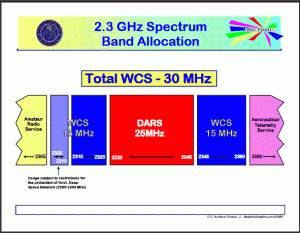
Then there’s the ongoing struggle between Sirius and the wireless industry over the so-called spectrum band, which is reserved for pinpoint accurate wireless transmission. What’s the problem here? Well, look at this handy little graphic produced by the FCC (top left), plus this table we’ve produced just for your benefit (you’re welcome). As you can see, Sirius XM is plunked right in the middle of the WCS bands. It’s got that red Digitial Audio Radio Satellite (DARS) band in the middle of the graphic.

WCS and Sirius XM bands
WCS Sirius XM WCS
Band (MHz) 2305-2320 2320-2345 2345-2360

So there’s been a huge amount of debate, much of it quite contentious, about whether WCS activity interferes or could interfere with Sirius XM transmissions. Sirius insists that various coexistence scenarios proposed by the WCS Coalition pose a threat. The coalition, which represents the spectrum area’s owners (among them AT&T, Comcast, and NextWave) say that Sirius’ claims are exaggerated. (more…)


Low Power FM gets backing of new FCC Commissioners

Mike Doyle with some kind of robot that hopefully will get Congress to pass his LPFM bill.

Rep. Mike Doyle (second on left) with some kind of robot that hopefully will get Congress to pass his Low Power FM bill.

Congressmember Mike Doyle (D-PA) came to today’s House Commerce subcommittee hearing on the Federal Communications Commission with a question posed to all the new Commissioners. “Do you recommend that Congress lift the restrictions on LPFM stations—the so-called ‘third adjacent protections’?”

“Based on what I know, yes,” new Chair Julius Genachowski quickly replied. “Yes,” responded new Commissioner Mignon Clyburn. “Yes,” somewhat faintly declared her new Republican colleague Meredith Attwell Baker.

“Ok! It’s unanimous, Mr. Chairman,” Doyle happily announced. “Thank you very much. It is my hope that our esteemed Chairman will allow us to do a markup and pass this legislation soon.” That would be Commerce Committee Chair Rick Boucher (D-VA).

The legislation in question is H.R.1147 – Local Community Radio Act of 2009, which would eliminate the tough restrictions on setting up Low Power FM stations that Congress slapped on the service in 2000. There’s a parallel bill in the Senate sponsored by Maria Cantwell (D-WA) and co-sponsored by John McCain (R-AZ).

“We are very pleased that the Commission has again voiced their support for this important bill, which would allow community radio to expand into thousands of towns, cities and neighborhoods throughout the US,” declared Cory Fischer-Hoffman, Campaign Director at the Prometheus Radio Project in a statement sent to us.

The problem is that this is the third time that the FCC’s Commissioners have unanimously pledged allegiance to this worthy cause. A 2003 study showed that LPFMs don’t interfere with full power stations at the third adjacent channel. Yet no bill ever gets to the Presidents’ desk.

It is unclear to us who has to get a head noogie for this law to go forward, but here at Radio Survivor we’ve got at least thirty knuckles ready for the task.


Fairness Doctrine phobes target FCC

FCC Fairness Doctrine enforcer, back in the Bad Old Days

FCC Fairness Doctrine enforcer, back in the Bad Old Days

Federal Communications Commission Chair Julius Genachowski is in hot water with the right wing talk radio crowd. They’ve discovered that his Associate General Counsel and Chief Diversity Officer, Mark Lloyd, is a co-author of that noted and/or notorious study, The Structural Imbalance of Political Talk Radio. So Senator Charles Grassley, Republican of Iowa, has written Genachowski an open letter, expressing worry that Lloyd’s presence at the FCC may signal a return to [insert Vampire flick music here] the Fairness Doctrine, which Genachowski has promised not to bring back.

“I am concerned that despite his statements that the Fairness Doctrine is unnecessary, Mr. Lloyd supports a backdoor method of furthering the goals of the Fairness Doctrine by other means,” Grassley wrote.

This missive was quickly followed by the usual alarmist headlines: New FCC Chief Supports the Fairness Doctrine . . . Fairness Doctrine Raises Its Ugly Head Under New FCC ‘Diversity Czar’ . . . Mark Lloyd: FCC Chief Diversity Officer Seeks to Punish Conservative Broadcasters.

You don’t even have to read these articles to get the idea. Hopefully people will eventually calm down about this stuff. Here’s my attempt at rational thinking on the matter.

Not shutting down perspectives

The FCC upheld the Fairness Doctrine for almost 40 years. It required radio and television stations to provide reasonable access to contrasting points of view. The Supreme Court upheld its constitutionality in 1969. Liberals blame the rightward drift of media on its abandonment by the Commission in 1987. Conservatives says its return would kill free speech—theirs’ in particular (and isn’t that what usually matters most). (more…)


Genachowski confirmed by Senate to run FCC. What is his agenda for radio?

I am listening to San Francisco’s hip hop station KMEL stream the suddenly dead Michael Jackson’s opus, and reading press releases hailing the full Senate confirmation of Julius Genachowski – he soon to be chair of the Federal Communications Commission.

“I look forward to working with Julius,” declared interim Chair Michael Copps this evening, “and all my colleagues at the Commission in tenacious pursuit of a communications policy that truly puts the public interest first.”

There are still two more FCC nominations that await Senate approval, one for South Carolina Public Service Commissioner Mignon Clyburn (she daughter of prominent Democrat James Clyburn) and another for former National Telecommunications and Information Administration biggie Meredith Attwell Baker. With their approval, the Obama administration will have a full Commission.

Julius Genachowski at his Senate confirmation committee hearing last week.

Julius Genachowski at his Senate confirmation committee hearing last week.

None of these new people have any substantial experience with radio. Genachowski is a new media guy. Clyburn, like most state public utilities folk, is most familiar with wireline regulation, and may be the least prepared of the new crop for her new job. Republican Baker’s focus at the NTIA was with the DTV transition, spectrum grants, and Internet domain issues. Incumbents McDowell and Michael Copps have their opinions about radio, but neither has any real affinity for the medium. McDowell was a telecom lobbyist prior to his coming to the FCC.

And my guess is that they won’t pay much attention to radio. It’s all going to be about broadband, wireless, spectrum allocations, white space, wireless issues like openness and exclusive handset deals, and, of course, the future of network management. All crucial issues, but so is radio.

(more…)