Could smartphone data cap plans hurt Internet radio?

The National Association of Broadcasters is sending around an interesting think piece about Internet/mobile radio. The report was published by the Station Resource Group, a consortium of public media services. It’s titled “The Mobile Internet: A Replacement for Radio?” and is pretty circumspect about the question—pondering the various differences between broadcast and Internet audio streams.

This paragraph caught my eye.

A potentially critical new market variable has entered the picture, with the recent AT&T Wireless announcement that new customers will no longer be offered unlimited flat-rate data service. Although early analysis of the specifics of the new AT&T rate structure shows that most Internet radio users would still fall within the flat-rate zone, the move by AT&T crosses a virtual Rubicon. It is now conceivable that the current rate structure is simply the first step in a gradual throttling down of flat-rate service thresholds, and that if one provider has done so, others may follow. This movement could affect the uptake of wireless Internet radio by future consumers.

AT&T announced its two new data capped plans for the iPhone and other smartphones in June. DataPlus offers 200 megabytes of data for $15 a month. DataPro provides two  gigabytes for $25 a month.

Why might other carriers follow suit?

“Witness the still increasing ‘foreign’ ATM charges that nearly all banks now levy after years of offering such service for free,” the survey notes. ”During those years, strong consumer usage patterns were established, and once such behavior was created, the institution of small but incrementally growing fees for continued usage was grudgingly but broadly accepted by consumers.”

It’s an interesting question. AT&T’s DataPro says the plan offers consumers the capacity to watch 200 minutes of streaming video a month, the carrier claims. Streaming audio isn’t mentioned, but obviously that would take up less bandwidth.

Any comments on this out there in Radio Survivor-land? Do data caps make you nervous about tuning into Pandora on your iPhone?


My Jungle Boogie moment

It was 1975. I was 20 years old. I had just left home. I worked and went to college in Manhattan, and lived with my girlfriend in the Bronx.

Meanwhile, Kool and the Gang’s hit tune “Jungle Boogie” jumped to one of the most requested songs on the radio. Transcriptions of the lyrics to this enduring hit don’t really do it justice, but here goes:

“Get down, Get down, get down, get down, get down, get down . . . .
Ahhhhhhhhhhh !
Jungle Boogie
Jungle Boogie
Get It On
Jungle Boogie
Jungle Boogie
Get It On”

I did not experience the lines as such. Here’s my version of the chorus:

JUNGLE BOOGIE
(deedly-up! deedly-up!)
JUNGLE BOOGIE
(squawk! squawk!)
JUNGLE BOOGIE
(deedly-up! deedly-up!)
JUNGLE BOOGIE
(squawk! squawk!)

Anyway, you get the idea. I saw Jungle Boogie as the archetypal Disco song with the archetypal Disco message. Forget the Sixties. Forget all that Woodstock crap. Just dance, wiggle, screw, then dance some more. Be yourself. Be your identity, no matter what it really is. Don’t be afraid. Just be.

Most political types I knew in college strongly disapproved of Disco. They thought it wasn’t radical enough or something. Gay people, black/Latino people, and women loved it—especially if they fit into all of those categories. As for me, I did not have the New Left sophistication to resist Disco’s charm, although I more often listened to classical music at the time.

Back in those days, to get to a train into Manhattan, I took a bus that ran from the northern Little Italy area where I lived through the South Bronx. This was quite an experience. The latter region was falling apart. Landlords and tenants took turns torching their residences. Drug use skyrocketed. The place was a mess. (more…)


Is radio really the next killer app for smartphones?

It’s the rumor that won’t die. Last November the blogosphere was alive with reports that iPhones have a latent FM radio built-in, just waiting to be turned on by Apple. However, the new iPhone 4 is on the streets and there’s still no sign of that radio-in-waiting. Now AppleInsider reports on a patent application from Apple that points towards not just an FM radio but possibly an HD Radio appearing in a future iPhone.

An FM radio is already featured in the current generation iPod Nano, as well as MP3 players from competitors like SanDisk. Microsoft’s Zune even has HD Radio. But all of these devices are media players only, not smartphones. As of yet there are no major smartphones available from a US carrier that have FM radios.

According to a recent consumer survey, that might be a major oversight on the part of manufacturers. Research firm Vision Critical asked more than 4,000 adults what missing feature on the iPhone 4 they would most like to see, and an FM tuner was the top pick when averaged across respondents from all three countries.

An FM radio was the most popular in Canada. Vision Critical senior vice-president Jeff Vidler suggests this is because streaming services like Pandora are not available in Canada and because mobile data charges are higher there.

But here in the US features like having a choice of carrier (39%), a 4G network (38%) and an eight megapixel camera (33%) were all more popular amongst respondents than an FM radio (30%). Still, the radio was more popular than a larger display or wireless syncing.

If the recent Apple patent really means an FM radio, then maybe we’ll see it in iPhone 5. If so, then I won’t be surprised if other smartphone manufacturers follow. It’s also possible that one of Apple’s competitors will try to beat them to the punch.

Actually, with the new AT&T data caps pouring some cold water on streaming music to the iPhone I’m more convinced of how desirable an FM tuner would be to the average consumer than I would have been a month ago.


Slacker Radio’s caching aims to bypass AT&T data caps

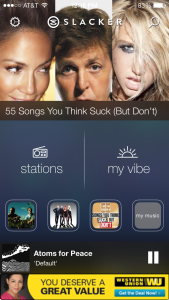
Hot on the heels of AT&T’s new data pricing plans, Slacker Radio released the new version 2.0 of their app which will permit listeners to cache their stations while on a wifi network. Then the stations can be listened to without using up precious data from the 3G network.

On the surface this may sound like a great alternative to Pandora or last.fm. But it must be noted that the caching feature is only available with a paid Slacker Radio Plus subscription. Users of the free service can take advantage of a 14-day trial of caching.

Under the monthly paid subscription model Slacker Radio caching seems a whole lot more like the Rhapsody service, which provides access to unlimited music for $10 a month. Rhapsody also lets you download as much music as you like to your smartphone to listen to without using a wifi or cellular data connection. Now, it’s true that Rhapsody is less radio-like than Slacker, in that you choose the artists and albums. However, the service also features Rhapsody Radio, although it isn’t cacheable and isn’t based upon user preferences.

Overall Slacker caching looks like a middle ground between listening to streaming Slacker (or Pandora or last.fm) and listening to a playlist or music podcast stored on your smartphone. That might be worth the $3.99 – $4.99 a month for some folks, especially since it’s cheaper than the data overage charge.


New iPhone 4 offers background listening but not much else for radio

iPhone 4 with Pandora playing in the background

Today Apple CEO Steve Jobs made his now-annual announcement for the new version of the company’s top product. While there were several surprises in store, like the addition of video conferencing and HD video recording, there wasn’t anything unexpected for radio enthusiasts.

Jobs confirmed the debut of multitasking with the new version 4 of the iPhone OS which already had been revealed last month. What’s nice about multitasking is that audio apps like Pandora, Slacker, last.fm, AOL Radio and the Public Radio Player will play in the background while using other apps, just like listening to iPod music.

For a hard core online radio listener multitasking may indeed be the “killer app” that makes it worth spending the $199 to upgrade to the 16 GB iPhone 4 from a first generation iPhone or the 3G. Owners of the 3GS will get multitasking, too, which also makes for a cheaper upgrade for owners of earlier models, at $99.

Apple says the new iPhone has a bigger battery offering up to 40 hours of music listening time and up to 6 hours of 3G web browsing. Listening to streaming radio over 3G is quite a bit more data intensive than simple web browsing, so it’s doubtful you’ll get 6 hours of 3G audio streaming.

Unfortunately, new iPhone owners starting contracts with AT&T will no longer have an unlimited data plan available to them, with the biggest data plan topping out at 2 GB per month, with $10 for each additional 1 GB. It’s unclear if a current iPhone owner can continue to have an unlimited plan if she starts a new contract upon buying an iPhone 4, though I should expect so.

Still missing from the iPhone is an actual radio capable of receiving traditional analog or HD broadcasts. When the radio-equipped iPod Nano debuted last October rumors starting swirling that there was a latent radio receiver inside the iPhone. One would think that if the rumor were true, that radio would have come out with the introduction of the iPhone 4. Since we’ve seen no sign of an iPhone radio with this major update of its OS, I’m guessing we’re unlikely to see one in the near future, if ever.


New AT&T data plans threaten to stunt the growth of mobile internet radio

AT&T Iphone with stopwatch

Last week AT&T announced that new smartphone customers will no longer be eligible for the unlimited data plans that current customers enjoy. Instead, two somewhat less expensive plans will be available. For $15 new customers may download 200 MB of data per month, with a charge of $15 for every additional 200 GB over the limit. 2 GB per month will cost $25, plus another $10 for each 1 GB after that. Current data plan customers pay $30 for unlimited data. For its part AT&T says that either of these new plans provides enough data to satisfy 98% of their customers.

While it may be true that the vast majority of AT&T customers use less than 2 GB of data in a month, I would argue that’s because data-hungry mobile streaming media is just starting to take off. But the these new caps threaten to stunt that growth just as mobile internet radio is gaining steam.

The 200 MB of data offered by the least expensive plan covers only about 200 minutes of streaming stereo music at the common bitrate of 128kbps. And that’s without any other data usage for email, web browsing or anything else. Even listening to a lower-quality mono talk station at 32 kbps will only stretch listening to 800 minutes, or 13 hours.

The 2 GB plan will cover about 34 hours of stereo music and as much as 136 hours of low-bitrate mono talk. At first blush that seems like a fair amount of listening time, but how does it measure up against real-world radio listening? Someone whose commute lasts about an hour each way will easily listen to over 40 hours of radio in a month. If that commuter wants to use her iPhone or Blackberry to listen to Pandora, last.fm or another streaming music station she’ll be over her limit by the last week of the month.

Without access to hard statistics on how many hours the average mobile Pandora or last.fm user listens it’s hard to say for sure how many new AT&T customers are likely to be affected. However, I do think it’s fair to say that these limits will make many smartphone users cautious about how much time they’ll spend listening to internet radio on the go, especially in order to avoid overage fees.

Of course, AT&T is not the only wireless data carrier in the US. As long as you don’t have your heart set on an iPhone there are lots of other carriers to choose from who still offer unlimited data plans. But for how much longer? Computerworld quotes several analysts who predict that Verizon, the nation’s second largest carrier, will set caps in as soon as six months. While there may be some pricing competition on these plans, I’m guessing they’ll offer pretty similar amounts of data for prices that only vary by a few dollars a month.

With a cost between 75 cents and $4.50 and hour, listening to mobile internet radio on an AT&T smartphone starts to look pretty uncompetitive compared to traditional broadcast, which is free, or satellite radio which offers unlimited listening for $10 – $20 a month. While it may be inevitable that the days of unlimited data plans will come to an end, I hope that the metered pricing quickly becomes more reasonable, permitting a reasonable amount of streaming radio listening. If not, this vibrant new way of listening to radio might be stunted before it has a chance to blossom.


New iPhone OS to bring background online radio listening

Soon you can listen to This American Life and tweet about it at the same time. How will you get anything else done?

As an iPhone user I can say with full knowledge that one of the things that holds the device back when it comes to listening to online radio is the lack of multitasking. While the iPod app allows you to play your audio files in the background while surfing the web or using other apps, you can only use third-party apps one at a time. Since listening to online radio, Pandora, last.fm or Slacker requires a third-party app, there’s no reading facebook or playing video games.

This restriction is sort of tolerable on a small mobile device like the iPhone, but it’s far more annoying on the iPad. Imagine if your laptop or netbook wouldn’t let you listen to streaming stations while word processing or web browsing. In fact, for work I use a Palm Pre which does permit multi-tasking. I do occasionally listen to Pandora on the Pre while answering emails, even though it kills the battery more quickly.

Wired’s Gadget Lab has a sneak preview of a beta of the forthcoming iPhone OS version 4. Top on the feature list is real multitasking. When the new OS drops later this summer iPad and iPhone 3GS users finally will be able to run their favorite streaming audio app in the background while using other apps. You might even be able to run two audio apps at the same time to test your bandwidth and tolerance for cacophony.

Unfortunately multitasking will not be available for first generation iPhones or the 3G. I guess our puny little processors can’t handle it.


Pandora promises background listening for the iPhone

iPhone OS 4

You can listen to Pandora just about anywhere if you’ve got an iPhone, BlackBerry, or Android (or at least anywhere that your respective network can reach). But there’s one thing missing on the iPhone: background listening. That, however, is about to change, according to Pandora’s Tom Conrad.

“Some weeks ago Apple invited us to a secret meeting where they revealed that background applications were coming to the iPhone OS 4 and that they’d like to use Pandora to show off these new capabilities at their big iPhone OS 4 product unveiling,” he wrote on Monday on Pandora’s blog. “Under the new operating system, Pandora will stream in the background while you use your iPhone to browse the web, read an e-book or play a game.”

Pandora sent an engineer to Apple to get its software up to speed for OS 4. “ This of course was all done with the utmost secrecy,” Conrad says. “Just a tiny handful of people even inside Pandora knew what we were doing.”

None of this is very secret any more, of course. According to Apple’s iPhone OS 4 page, developers will be able to take advantage of seven multitasking services,  ”which will allow tasks to be performed in the background while preserving performance and battery life. So you’ll be able to make a Voice over IP call while playing a game or checking email, find a restaurant on Urbanspoon while listening to Pandora, and more.”

The event was a “lifelong dream,” for Conrad, he says. “The Apple folks are masters of these types of presentations and it was an incredible experience to get to experience it from the inside. As our Founder Tim [Westergren] and I stood on stage presenting, there was a moment about halfway through where my nerves calmed enough (The software was going to work! It was going to be ok!) that I could just enjoy the moment and just take it all in. I don’t think I’ll ever forget it.”

Apple says OS 4 will be released this summer for the iPhone and iPod touch; some time this fall for the iPad.


What does the iPad mean for radio?

Is the iPad good for mobile internet radio?

Already some of us have been listening to live streaming internet radio on our mobile devices, like iPhones and Blackberries. But, as I argued last month, the experience still doesn’t quite add up to true mobile internet radio, especially because when you’re using cell data like 3G it saps the heck out of your battery. My experience streaming live radio on my iPhone gives me a little more than an hour before I’m nearly out of juice. The new Apple iPad looks to be a great mashup of an iPhone and netbook, which are both decent devices for listening to internet radio on the go, but also have their drawbacks.

The fact that some iPad models offer 3G wireless data connectivity out-of-the box, for a very reasonable $30 a month without any contracts make it a great candidate for mobile internet radio listening. It won’t necessarily be any better for the car than an iPhone, Blackberry or Android phone. But in other mobile circumstances it shows distinct promise.

So the question is, will the iPad bring us one step closer to truly mobile internet radio? Based on early specs, and having never touched it myself, the answer is a distinct maybe.

The first important factor is battery life. If the battery poops out after only an hour, then it’s only good for short trips. But if you have a longer train or bus commute, or are outside away from a wi-fi connection you probably want at least two good hours. While Apple specifies that you get 10 hours of active wi-fi use on a charge, no 3G batterly life specs are published. With a much bigger battery than an iPhone one would expect that constant 3G use would go longer, but we’ll have to wait until the first longer-term reviews come out.

The next big issue is sound quality. I currently use my iPhone, netbook or MacBook Pro to stream audio in a variety of circumstances, including home and when away in hotels. They’re all fine for using with headphones or external speakers, though the iPhone is the clear winner for fidelity. But I don’t always want to use headphones or lug around speakers. In a pinch the iPhone’s speaker is better than nothing at all (sounding like a pocket radio), and the netbook is barely any better. My MacBook’s speakers are the best in this category, but at the same time it seems wasteful overkill to use this powerful laptop computer just to listen to radio. My hope is that it will sound at least as good as a MacBook Pro, which itself is on par with a portable radio the size of a paperback book. We’ll have to see how the iPad’s speakers measure up against these competitors.

The final big factor is multitasking, and on this measure we already know the answer: there is no multi-tasking on the iPad. This is important because all of the streaming radio apps are not made by Apple, and you can only run one non-Apple app at a time. So you want to listen to a live feed of a Cubs game while Tweeting? No can do. Catch a live feed of the State of the Union while reading the New York Times online? Also a big no. So, unless Apple decides to add the ability to listen to live streams to the iPad’s iPod app–which is allowed to multitask with other apps–this is probably the biggest count against the radio capabilities of the iPad.

At least as far as mobile internet radio is concerned, the iPad looks like a tiny step forward. If the 3G battery life and sound quality are up to snuff, then it’s a bigger step. But without multitasking where you can listen to a live stream while using other apps, the iPad is not the next big thing in mobile internet radio.


My favorite iPhone radio apps: Pandora, last.fm, and AOL

I am one of those music Junkies with over 25,000 songs in my music library at home. When I sit down on my computer, I know exactly what I want to hear.  But the iPhone  changed that. It offered me radio options that I’d never considered before. Here are my favorites.

Pandora Radio

There is a reason why Time Magazine ranked Pandora among the Top 10 iPhone applications.  It’s awesome. If you are familiar with Pandora Radio then you already know what I am talking about. Its service has matching algorithms that allow users to listen to a completely customized radio service for free. I have found countless new music, artists and songs that are now a permanent mainstay in my iPod thanks to Pandora Radio.

In fact, I find the iPhone application is actually easier and more pleasant to use than their full online version. Pandora’s interface for the iPhone is simple and easy. It includes all the features their full website has to offer on a 3.5 inch screen. The advantages are that the advertisements are so small, so it’s hard to read them. You can even close the ad windows right within the application. But the elegant and simple interface is not why Pandora on the iPhone is truly great, it’s because the iPhone allows Pandora to be mobile.  Compared to my huge iTunes at home, my tiny eight gig iPhone seems downright claustrophobic. Sometimes I want something new and Pandora lets me do that wherever I am (barring the chance of spotty AT&T service). When I am walking to class, at the gym, or riding the bus home I can enjoy something new and maybe find my next favorite artist or song. (more…)