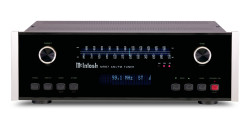
More car makers offer HD Radio, but can you actually buy it?

Car dealer asks, WTF is HD Radio

On Monday the trade publication Automotive News reported that the number of car makers offering HD Radio is up, mostly relying on stats provided by iBiquity, which owns the technology. According to the article pricey brands Volvo, BMW and Rolls-Royce now offer HD Radio as standard, while twelve other brands offer it as an option. Curiously, only one Japanese brand, the Toyota division of Scion, offers HD.

However, there are a lot of things one can buy as an option on a car, so the more important question is, Is anyone buying? On the surface, thing don’t look too bad for HD. Apparently 438,000 automotive receivers were sold in the nine months ending June 30, contributing to a total of three million HD Radio receivers sold in the US, both car-based and not. By comparison about eight million cars were sold in the same period, meaning only about five percent of new cars sold were equipped with HD Radio.

After reading a recent Radio World article, I wonder if at least part of the blame is due to the difficulty of actually buying the option. Writer Thomas R. Ray III, who is normally a cheerleader for HD Radio, recounts the difficulty he faced in getting an HD receiver in his brand new Ford Escape. It turns out the Ford dealership had never heard of HD Radio, and so he ended up with a factory-installed analog radio. He encountered further trouble integrating an aftermarket receiver because of the Ford’s much ballyhooed Sync system.

As long as HD Radio remains an option on most cars, I don’t think it’s going to see the kind of growth it needs to become a mainstream technology. As it is, there isn’t enough to recommend HD Radio to make it work the extra hundred bucks or so to the average car buyer, who is probably more concerned with a CD player or iPod connectivity. I remember back when I was a kid in the 70s that AM radios were standard and FM was an option. It wasn’t really until AM/FM radios became standard that you saw FM radio start to take off. I’m not convinced HD offers nearly as much extra as FM did thirty years ago.


First day with HD Radio – not impressed

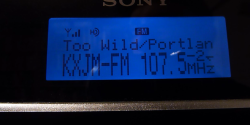
I spent the better part of this afternoon listening to my new HD Radio receiver, the Sony XDRF1 HD, tuning through the Chicago FM dial. There are 33 FM stations broadcasting HD in Chicago according to iBiquity, which owns the technology. I was able to tune in the HD signal for 19 of them. After several hours of listening I remain rather unimpressed by HD Radio.

My Sony XDRF1-HD tuner in its habitat.

Primary HD Channels

First off I will address the question of sound quality and fidelity. iBiquity claims “drastically improved sound quality” for HD Radio over its analog counterpart. I do not agree with this claim. Tuning between the analog and primary HD channel for each station I could perceive slight differences in sound quality between them. The biggest difference is the loss of background noise and hiss in the HD channel. Now, this is a very subtle difference, primarily perceptible during quiet music passages (which are rare on commercial FM) and voice breaks. This leads to the perception that there’s a bit more dynamic range on the HD channel, but it requires fairly high listening volume to clearly detect.

While I welcome the lower noise floor of HD, I otherwise don’t perceive any other significant increase in fidelity. On nearly every station I listened to the primary HD channel sounded nearly identical to the analog FM. Much of commercial FM is overcompressed, and I found that if a station’s analog signal was so overprocessed, so was the primary HD channel.

Sometimes I would lose the HD signal–since it’s broadcast at a much lower power level than the analog signal–and I never noticed just by listening. I had to look at the tuner’s display to know for sure. The shift between the HD and analog signals is pretty smooth sounding on the Sony tuner. I can tell when it happens, but it’s quite unobtrusive. If I’m not paying close attention to the radio it can happen without me noticing.

All of the 19 HD FM stations I received are stations that come in reasonably well in analog in my apartment in the Rogers Park neighborhood on the far north side of Chicago. The Sony XDRF1 turns out to have very good analog FM performance, bringing in the analog FM signals of these stations better than any other radio in my house except my Tivoli Model One, which is another room. Of the 10 stations where I couldn’t tune in an HD signal, 8 of them don’t come in clearly in my house in analog, either. For two stations my tuner did not indicate there was an HD signal present. More details listening notes by station are at the end of this post.

Secondary HD Channels

The other big advantage touted for HD Radio are the additional subchannels a station can have. Each HD station I listened to broadcast one or two additional channels. By and large the second HD channel had decent sound quality, but that nevertheless never matched the quality of the primary analog or HD channel. This should be expected because there is only so much digital bandwidth for each station to exploit, and the FCC requires that the primary HD channel–which must have the same programming as the analog signal–have the biggest share of the bandwidth.

The second HD channels typically sound like a good webcast station. That is, they sound like medium-quality MP3s with bitrates of 128 kbps or lower. I hear more compression and less dynamic range than the analog side, and some rolling off at the high end. Right now I’m listening to WXRT’s commercial-free HD channel 2 called “Channel X” and it’s pleasant to listen to, no more fatiguing than most web stations.
(more…)


FCC Commissioner Clyburn Suggests Channels 5 & 6 for Radio

FCC Commissioner Mingon Clyburn

The National Federation of Community Broadcasters just wrapped up its annual conference this past weekend in St. Paul, MN. The NFCB has been a true anchor in the community radio movement, both supporting individual stations and advocating on their behalf in DC. This year the FCC actually graced the conference, with Commissioner Mingon Clyburn giving a speech on June 10.

Commissioner Clyburn certainly let loose quite a few surprises, starting with suggesting that TV channels 5 and 6 could be reallocated for non-commercial FM radio, low-power FM or AM broadcasters. While she said that she wasn’t suggesting an immediate change, Clyburn said that, “it is time for us to take a serious look at
where these services fit within the overall spectrum plan, and that Channels 5 and 6 maybe a good home.”

The spectrum allocated to analog channels 5 and 6 sits just below the FM band’s lower limit of 88 MHz. Before the digital transition you might remember being able to hear channel 6 TV audio at the bottom end of your FM dial. Although the transition meant full-power stations lost their analog audio signal, low-power TV stations were permitted to remain analog. As I’ve reported before, there are several low-power channel 6 stations taking advantage of their proximity to the FM dial to function effectively like radio stations rather than TV.

Any reallocation of channel 5 and 6 spectrum would require dealing with the few full-power stations that chose to stay put rather than move to different spectrum space. It would also have to deal with the LPTV stations on channels 5 & 6. My guess is that these stations could be offered to move into spectrum allocated for digital, though it might take some horse trading. It’s also likely that those few LPTV stations on channel 6 are going to be very reluctant to move and give up their radio-like business, although it’s just a matter of time before the FCC kills that business model by forcing all LPTV to go digital.

Commissioner Clyburn also suggested that community stations consider the charms of HD Radio. She acknowledged that, “limited receiver penetration and the cost of digital transmission equipment may make owning an HD Radio station an unappealing option for community radio groups.” However, she also proposed that “HD can provide yet another way to promote broadcast diversity and expanded programming option.” She even suggested that community stations or groups seeking stations could partner with other commercial or non-commercial stations to program their secondary HD-2 and HD-3 channels.

It’s pretty rare for community radio to get such a courtesy call from an FCC commissioner, and all the more rare for a commissioner to drop so many bombshells. I’m cautiously optimistic to hear such support for community radio and an apparent willingness to consider an expansion of the FM band in order to accommodate more non-commercial stations. I do have to note, however, that there’s no indication that an expanded band would be only for community radio. Nevertheless, it will be interesting to see if the idea gains any traction with the full Commission.


FCC Awards Another 26 Full-Power NonComm FM Licenses

The FCC has released the winners of another twenty-six full-power noncommercial FM broadcast licenses from the 2007 application window [PDFs: 1, 2]. Like the fifty-seven licenses announced in February, the winners in this set were chosen from amongst two or more mutually-exclusive applications. The Commission uses a point system to judge which group should receive a noncommercial FM license amongst multiple competitors. The system awards points with preference to candidates that are locally headquartered with an “established” presence, do not have a controlling interest in another nearby station and which propose to serve the largest number of people.

Portsmouth Community Radio

The owner of WSCA-LP was awarded a full-power NCE license.

This time around three of the new licensees are current operators of low-power FM stations. As a condition of obtaining their new full-power construction permits they will have to divest themselves of their LPFM licenses. One owner of a translator repeater station, Educational Information Corp, won out over three other applicants for a license to serve Milton, NC. EIC offered to divest itself of the translator in nearby Danville, VA, and won out for the license because it has an interest in fewer other stations than any of its competitors.

Amongst the other twenty-two license winners there were six universities and colleges, with New Mexico Highlands University winning a total of three. One independent Catholic school, Vineyard Academy, won a license for Vicksburg, MI. The vast majority of licenses–fourteen–went to churches or other religious organizations.

One of the most interesting winners is the Committe for the Rescue and Development of Vieques in Puerto Rico, which is apparently dedicated to the rehabilitation of this region that has been used for military exercises–including bombing–by the US military. A couple of other interesting community groups that won licenses are Neighborhoods United for a Better Alachua in High Springs, FL and North Curry Families and Childrens Center in Port Orford, OR. It also looks like the Americana music group the Western Oregon Opry won a license in Cottage Grove, OR.

There are also a couple of mysterious winners of licenses. One of them is the B. Stephen Demchuk Foundation in Glen Spey, NY. It is listed as an IRS 170(b)1)(a)(vi) community foundation, but I cannot easily find any information about what the foundation actually does. The best I can figure out is that the applicant, Julian Demchuk, seems to be active in the Ukranian-American community.

Another mysterious winner is ST’AL-SQUIL-XW of Kettle Falls, WA. Looking at the name I’m guessing it may be a Native American associated group. The group has received grants from the Environmental Support Center, so it’s not a bad guess to say that it has an environmental outlook, too.

Overall I’m glad to see that some groups dedicated to a variety of community work, in addition to arts and culture, were able to win licenses.

I should note that these awards are still tentative because there is now a thirty-day period for filing peitions to deny against any of the winners. For better or worse, in practice it’s highly unlikely for such a petition to be successful. Nevertheless, it could happen.


College Radio 101: UW-Parkside Station Learns When You Need a License

The University of Wisconsin-Parkside’s student-run station WIPZ has apparently been on the air since the early 1990s, broadcasting on AM, then FM and online. The station has never had a license, presumably operating at very low power under what are known as Part 15 regulations which govern unlicensed operation of devices that radiate radio frequency power. These are the same regs that dictate the operation of the small transmitters sold to broadcast an MP3 player into a car radio.

Last week WIPZ learned a tough lesson from the FCC when agents showed up and determined their signal was broadcasting at a level way above the limits set by Part 15 for the FM dial. In fact, the agents reported measuring the signal at 334,559 microvolts per meter (uV/m) at 3 meters. Compare that to the Part 15 limit of 250 uV/m at 3 meters. My rough back-of-the-envelope calculations say that WIPZ must have been operating at around 5 watts of effective radiated power. Generally speaking, anyone who wants to broadcast in accordance with Part 15 should keep their power under 100 milliwatts (.1 watts).

I’m a little surprised that anyone at a university station would think it was legal to broadcast with that much power without a license. FCC Chicago district director James M. Roop told the Journal-Sentinel, “Somewhere they were misinformed by people who told them that operating a station by low power would be OK.”

I’ve seen a number of references to WIPZ being a carrier-current station, which is a type of very-low power AM broadcasting where a building’s electrical wiring is used as a big radiator for an AM signal. Schools are permitted to operate carrier current stations provided their signal obeys Part 15 limits with regard to the signal’s transmission off school property. WIPZ probably used carrier current back in its AM days. However, there are no similar rules for FM broadcasting; there is no such thing as a carrier-current FM station.

My best guess is that the station’s management confused the more lenient restrictions for unlicensed AM broadcasting with the tighter ones for FM. Working in and around universities for some 20 years I’ve often heard misguided educators claim they can legally set up FM transmitters using several watts of power provided the signal stays on campus. But the simple fact is that this is not true.

It appears that WIPZ will attempt to return to air using power levels that obey Part 15 limits. They will probably be disappointed at how limited their broadcast range will be. They might actually be better off going back to AM and taking advantage of the techniques devised by the sizeable community of Part 15 broadcasters.


That Next License Is Going to Cost You

While we commonly accept that broadcast stations and, especially, their licenses to broadcast have a market value, for most of US broadcasting history there was no direct cost to obtain that license. Sure, there were engineer surveys to conduct, lawyers to pay, and so on. But the license itself came at no cost from the FCC. That license was supposed to be in exchange for operating in the “public interest, convenience and necessity.” Given that this obligation was rendered mostly unenforceable, if not laughable, by 1996, Congress figured it was better to try to cash in.

So, for all intents and purposes the Telecommunications Act of 1996 pretty much changed the whole free license thing for commercial stations, instituting an auction process for new commercial radio licenses whenever there are competing applicants. Since there it’s a rare occasion when there’s only one applicant for a commerical frequency, in practice most new licenses are auctioned off. There hasn’t been much hubub about this change in part because there have been relatively few new broadcast radio licenses available in the last fourteen years; most major metropolitan radio dials pretty well filled up by the 1990s.

Nevertheless, there are a few spots on the dial left, scattered about the country. In fact the FCC will be auctioning a total of 15 radio licenses this coming July–thirteen commercial FM, one commercial FM translator and one commercial AM [public notice PDF]. Before you start counting your pennies and cashing in savings bonds, understand that if you haven’t already submitted an application to the FCC, then you’re out of luck. The participants in the auction are already determined because they’ve submitted applications for frequencies for which there are other competing applications.

The number of bidders for a single frequency range from just two to as many as seven (that’s for a spot on the dial in Idalou, TX, just outside of Lubbock). The FCC sets a minimum opening bid, which each bidder must also submit as an upfront payment. This opening bid is based upon the prices obtained in earlier auctions from the same market. To bid on a license in the Hudson Valley town of Rosendale, NY you’d have to pony up $100,000 to start, whereas in New Holstein WI, about 25 miles northwest of Sheboygan, the starting bid is just $15,000. A hundred grand may not sound like chump change for a station license, but compared to the market value it’s a bargain. An existing station in New York’s Hudson Valley is likely to be at least five times that, if not more.

We’ll be watching to see what the selling prices end up being when the final gavel falls. Stay tuned.


Pirate Cat Radio Fined by FCC and Ceases Terrestrial Broadcast

Pirate Cat Leaving Terrestrial Radio

Pirate Cat Leaving Terrestrial Radio

It was probably only a matter of time before the FCC would catch up with San Francisco’s Pirate Cat Radio.

The unlicensed broadcaster was increasingly putting itself in the public eye by operating a cafe adjacent to its studio, granting interviews with mainstream press, and even appearing on the national television show No Reservations this August.

Since at least April, the FCC has been monitoring Pirate Cat’s operations and eventually levied the station and owner Daniel K. Roberts (aka Monkey) a $10,000 fine on August 31st when it became clear that the station was continuing to broadcast without a license

Pirate Cat issued a press release on Halloween stating that the station would cease their terrestrial broadcast in light of the FCC’s action against the station. According to the statement from Pirate Cat:

“…the FCC asserted that Monkey, the founder of Pirate Cat Radio, ‘willfully and repeatedly violated Section 301 of the Communications Act of 1934′ and proposed to fine him $10,000 for the infraction… the FCC’s order effectively ends Pirate Cat Radio’s thirteen-year run as one of the Bay Area’s most consistent voices of protest against corporate-run media monopolies and monocultural programming.”

According to the “Notice of Apparent Liability for Forfeiture” document prepared by the FCC, not only was Pirate Cat Radio found to be broadcasting over FM without a license, but the frequency being used, 87.9, is also “not allocated to the FM broadcast band.” (more…)


A Latent Radio Hidden in Your iPhone?

iPhone Radio app mockup by 9 to 5 Mac.

iPhone Radio app mockup by 9 to 5 Mac.

Hot on the heels of the new FM-enabled iPod Nano comes the rumor that there’s actually an FM radio already hidden inside current iPhones, and that Apple is about to turn it on. Apparently the radio circuitry is currently used as part of the Nike+ that connects up certain sneakers to report exercise data back to your phone.

According to 9 to 5 Mac, which originated the rumor, the hold-up on the radio is getting it integrated into the iTunes music store the way that the new Nano is, so that users can tag songs for future purchase as they listen. I’m not entirely sure I buy that explanation, since I’d think it would be harder to implement in the Nano–which has no application platform–than the more powerful iPhone and iPod touch.

If Apple does decide to wake up the sleeping iPhone radio I’m wishing for more recording time than the Nano’s short fifteen minutes.  Recording airchecks on the go, like the CC Witness Radio, would be a great bonus to have in addition to not having to take a separate radio with me when I travel. But I wonder if the FM radio will sap the battery all the faster, or if it will be more efficient than listening to streaming internet radio which kills the battery with just an hour or so of listening. Perhaps users of the Nike+ app might be able to illuminate this mystery based on their experiences.

I’ve heard no timeline for release of the radio app, but we’ll be sure to keep you up to date here at Radio Survivor.


Recording Radio for Fun, Games and Posterity

I started reading the Professor’s detailed travelogues of his AM and shortwave radio band excursions back when he was writing for WFMU’s Beware of the Blog. After he quit contributing to BotB I learned that he was keeping things going at his own Radio Kitchen blog.

The Professor belongs to a group of radio enthusiasts who record what are known as “airchecks,” which are simply off-air recordings of radio stations. Usually created as a form of historical record, air check recordings serve as an often valuable capture of what is an otherwise mostly ephemeral medium.

In the analog era airchecks were mostly recorded on boombox style radios with built-in cassette recorders. Enthusiasts often traded copies of these tapes with folks from other parts of the country or the world. You see before the internet that was the only way to hear what local radio sounded like somewhere else without traveling.

Only the fanciest radio cassette recorders come in woodgrain.

Only the fanciest radio cassette recorders come in woodgrain.

In the digital era you’d think that recording and sharing radio airchecks would be much easier, given the near ubiquity of digital audio and video recording devices. But while radios with built-in cassette recorders were omnipresent at any electronics or discount store in the 1970s through the 1990s, there are few digital equivalents in existence in the 21st century. Although Apple recently included limited FM radio recording capabilities into its newest iPod Nano, it only records up to 15 minutes, and has no AM reception. So what do you do to digitally record hours of AM or shortwave radio?

The Professor recently took up that very question. One solution one might consider is connecting your computer’s audio input to a radio. The big problem there, however, is that computers generate a ton of RF interference which can seriously mess up AM and shortwave reception. iPods and other MP3 devices wreak similar radio havoc.

In his long, but worthwhile and info-rich, post the Professor gives an overview of the state of recording radio digitally, giving a nice user review of C. Crane’s CC Witness radio, which includes an MP3 recorder.

Aside from recording my own radio programs (usually direct off the studio board), I’ve only dabbled in recording radio airchecks over the years. In the 20th century I also mostly used cassette recorders. Due to sloppy labeling practices I’ve mostly lost all of those tapes over the years. I’ve also done some recordings in the 2000s, primarily to capture source material off shortwave for unfinished audio art projects. I did most of those recordings on minidisc recorders which seem to be very well shielded compared to other digital recorders, injecting almost no noise into the signal. Dual minidisc recorders 2The last Hi-MD models let me upload the recordings directly onto my computer for sharing and manipulation. Hi-MD is also how I recorded my mediageek radioshow for podcast distribution up until last year.

I’m not sure that I will ever record enough radio airchecks to merit spending $179 on a dedicated digital radio recorder. But I sure am glad that such a device exists, keeping alive a hobby that documents the rich history of broadcasting that otherwise would just dissipate into the ether.


Apple’s cutting edge tech? Radio!

Today’s highly anticipated 9/9/09 Apple product announcement brought the return of the Messiah (Steve Jobs) but not the band bigger than Jesus. Alas, the much hoped-for debut of the Beatles in the iTunes music store did not arrive, despite Yoko telling Sky News to the contrary.

iPod Nano, now with radio!

iPod Nano, now with radio!

The really big news today is a second coming of sorts. The new iPod Nano debuts a feature missing from all iPods so far: an FM radio! And not just any radio, but one with what Apple is calling “live-pause,” which is kind of like having a built-in mini TiVo for radio. Now, this isn’t quite a full-on PVR, in that the Nano doesn’t have the ability to schedule a recording. However you can pause the radio for up to fifteen minutes, or rewind back fifteen minutes. Seems like a feature aimed right at the mobile radio listener who might want to pause while taking a phone call, changing commuter trains or some other brief interruption. I can certainly recall many times when I was listening intently to the news or a talk show on my portable radio on public transport and had my sound drowned out by a loud noise or I needed to stop listening for a few seconds so I could hear an announcement. Being able to rewind a minute or so is a great boon for those annoying moments.

Apple's making sure the iPod Nano won't kill music like home taping.

Apple's making sure the iPod Nano won't kill music like home taping.

Not to look a gift-horse in the mouth, but it would be great if the pause and rewind would last for as long as you have memory left to store the audio stream. However, I’m sure the quarter-hour limit is there to keep “home taping” from taking a bite out of Apple’s lucrative Music Store business.

I think the radio in the iPod Nano was today’s biggest surprise since Jobs and other Apple spokespeople have scoffed at the idea in the past. Back in 2005, Apple’s iPod division head told the Apple Expo in Paris that,

in Apple’s experience, customers just don’t want radios on their iPods. “Believe it or not, we don’t get a lot of requests from customers” for a radio, he said. “We’re very hesitant to add new features unless we feel a significant portion of the customer base want it.”

It is true that Apple introduced the iPod radio remote back in 2006, although it seems no longer to be available. Perhaps it was killed in anticipation of the new radio Nano.

I’ll be curious to hear reviews and reports from radiophiles who get their hands on the new Nano and evaluate how good the reception is. A truly decent portable headphone radio is actually difficult to find. While $150 is a bit much to pay for one–especially one that only has FM–when combined with an 8 GB iPod and a video camera (!), it’s not a bad deal. I just wish Apple would have put the radio in my iPhone 3G, since listening to internet radio over the 3G data network kills my battery in about an hour. By comparison I have a ten-year-old RCA brand pocket radio that runs over 100 hours on two AAAs.

If we see radios with live-pause show up in the next generation iPhone or iPod Touch. Then we can anoint Mr. Jobs as St. Steve, savior of radio.