New AT&T data plans threaten to stunt the growth of mobile internet radio

AT&T Iphone with stopwatch

Last week AT&T announced that new smartphone customers will no longer be eligible for the unlimited data plans that current customers enjoy. Instead, two somewhat less expensive plans will be available. For $15 new customers may download 200 MB of data per month, with a charge of $15 for every additional 200 GB over the limit. 2 GB per month will cost $25, plus another $10 for each 1 GB after that. Current data plan customers pay $30 for unlimited data. For its part AT&T says that either of these new plans provides enough data to satisfy 98% of their customers.

While it may be true that the vast majority of AT&T customers use less than 2 GB of data in a month, I would argue that’s because data-hungry mobile streaming media is just starting to take off. But the these new caps threaten to stunt that growth just as mobile internet radio is gaining steam.

The 200 MB of data offered by the least expensive plan covers only about 200 minutes of streaming stereo music at the common bitrate of 128kbps. And that’s without any other data usage for email, web browsing or anything else. Even listening to a lower-quality mono talk station at 32 kbps will only stretch listening to 800 minutes, or 13 hours.

The 2 GB plan will cover about 34 hours of stereo music and as much as 136 hours of low-bitrate mono talk. At first blush that seems like a fair amount of listening time, but how does it measure up against real-world radio listening? Someone whose commute lasts about an hour each way will easily listen to over 40 hours of radio in a month. If that commuter wants to use her iPhone or Blackberry to listen to Pandora, last.fm or another streaming music station she’ll be over her limit by the last week of the month.

Without access to hard statistics on how many hours the average mobile Pandora or last.fm user listens it’s hard to say for sure how many new AT&T customers are likely to be affected. However, I do think it’s fair to say that these limits will make many smartphone users cautious about how much time they’ll spend listening to internet radio on the go, especially in order to avoid overage fees.

Of course, AT&T is not the only wireless data carrier in the US. As long as you don’t have your heart set on an iPhone there are lots of other carriers to choose from who still offer unlimited data plans. But for how much longer? Computerworld quotes several analysts who predict that Verizon, the nation’s second largest carrier, will set caps in as soon as six months. While there may be some pricing competition on these plans, I’m guessing they’ll offer pretty similar amounts of data for prices that only vary by a few dollars a month.

With a cost between 75 cents and $4.50 and hour, listening to mobile internet radio on an AT&T smartphone starts to look pretty uncompetitive compared to traditional broadcast, which is free, or satellite radio which offers unlimited listening for $10 – $20 a month. While it may be inevitable that the days of unlimited data plans will come to an end, I hope that the metered pricing quickly becomes more reasonable, permitting a reasonable amount of streaming radio listening. If not, this vibrant new way of listening to radio might be stunted before it has a chance to blossom.


Slacker updates apps for BlackBerry and Andoid with caching features

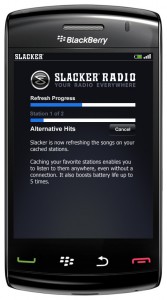
Slacker radio's auto refreshing feature

Slacker radio's auto refreshing feature

The Slacker mobile radio service unveiled BlackBerry 3.0 and Android 2.0 from Research In Motion today. The upgraded operating systems allow users to update their favorite stations via a “Cache Station” menu within the app. Or they can use an “auto refresh” feature that wakes the mobile up overnight and updates station content.

“Cached stations are stored on the memory card of the BlackBerry smartphone and can be played on subways, planes and all destinations in between with no network drop-outs and minimal battery usage,” the release Slacker sent us boasts. “Along with station-storing capabilities, Slacker Radio Plus features ad-free listening, song lyrics, unlimited song skipping, unlimited song requests and more.”

Ditto for the Android, that is, if the user has a Slacker Radio Plus subscription. If you’ve got Slacker Basic Radio you can try the new features out on either Android or BlackBerry for free for fourteen days. (more…)


What does the iPad mean for radio?

Is the iPad good for mobile internet radio?

Already some of us have been listening to live streaming internet radio on our mobile devices, like iPhones and Blackberries. But, as I argued last month, the experience still doesn’t quite add up to true mobile internet radio, especially because when you’re using cell data like 3G it saps the heck out of your battery. My experience streaming live radio on my iPhone gives me a little more than an hour before I’m nearly out of juice. The new Apple iPad looks to be a great mashup of an iPhone and netbook, which are both decent devices for listening to internet radio on the go, but also have their drawbacks.

The fact that some iPad models offer 3G wireless data connectivity out-of-the box, for a very reasonable $30 a month without any contracts make it a great candidate for mobile internet radio listening. It won’t necessarily be any better for the car than an iPhone, Blackberry or Android phone. But in other mobile circumstances it shows distinct promise.

So the question is, will the iPad bring us one step closer to truly mobile internet radio? Based on early specs, and having never touched it myself, the answer is a distinct maybe.

The first important factor is battery life. If the battery poops out after only an hour, then it’s only good for short trips. But if you have a longer train or bus commute, or are outside away from a wi-fi connection you probably want at least two good hours. While Apple specifies that you get 10 hours of active wi-fi use on a charge, no 3G batterly life specs are published. With a much bigger battery than an iPhone one would expect that constant 3G use would go longer, but we’ll have to wait until the first longer-term reviews come out.

The next big issue is sound quality. I currently use my iPhone, netbook or MacBook Pro to stream audio in a variety of circumstances, including home and when away in hotels. They’re all fine for using with headphones or external speakers, though the iPhone is the clear winner for fidelity. But I don’t always want to use headphones or lug around speakers. In a pinch the iPhone’s speaker is better than nothing at all (sounding like a pocket radio), and the netbook is barely any better. My MacBook’s speakers are the best in this category, but at the same time it seems wasteful overkill to use this powerful laptop computer just to listen to radio. My hope is that it will sound at least as good as a MacBook Pro, which itself is on par with a portable radio the size of a paperback book. We’ll have to see how the iPad’s speakers measure up against these competitors.

The final big factor is multitasking, and on this measure we already know the answer: there is no multi-tasking on the iPad. This is important because all of the streaming radio apps are not made by Apple, and you can only run one non-Apple app at a time. So you want to listen to a live feed of a Cubs game while Tweeting? No can do. Catch a live feed of the State of the Union while reading the New York Times online? Also a big no. So, unless Apple decides to add the ability to listen to live streams to the iPad’s iPod app–which is allowed to multitask with other apps–this is probably the biggest count against the radio capabilities of the iPad.

At least as far as mobile internet radio is concerned, the iPad looks like a tiny step forward. If the 3G battery life and sound quality are up to snuff, then it’s a bigger step. But without multitasking where you can listen to a live stream while using other apps, the iPad is not the next big thing in mobile internet radio.


NPR goes Android, launches new mobile site

Getting NPRs Fresh Air on your Android

Getting NPR's Fresh Air on your Android

Android users will now be able to access the full range of National Public Radio programming thanks to a new app – “NPR News.”  The feature for the open source smart phone was built for NPR by Google developer and public radio fan Michael Fredrick. In addition, NPR has launched a new site for mobile listeners to access: www.m.npr.org.

“We’ve seen a nearly ten-fold increase in our mobile traffic since the launch of our iPhone app earlier this year,” declared Kinsey Wilson, senior vice president and general manager, NPR Digital Media in a press release. “With the redesign of our mobile web site and the launch of the Android app we’re now able to bring that superior experience to a much wider audience.”

Doesn’t look like either of these services is actually available yet. NPR says the Android app will be downloadable “later this month.” We’re getting a 504 link to the mobile site on our BlackBerry at this point. But it all looks like it will be good stuff when up and running.

Here’s the list of features for both offerings, starting with the mobile site (source: NPR): (more…)


Pandora announces Pandora for Android

Pandora for Android

Pandora for Android

You can get it on the iPhone, you can get it on your Blackberry. Now you can get Pandora on Android. “I know this has been a really long time coming and I’d like to thank all of you for your patience. Hope you enjoy the app,” declared Pandora “tech and product guy” Tom Conrad on his blog today. This was the guy who once said he “needed Android like a hole in the head” (he apologized later).

Android is the open source/open platform Linux based smart phone backed by the Open Handset Alliance, a consortium that most famously includes Google. Open platform means that developers can add apps much more freely.

In his youtube explanation of the Android, co-founder Nick Sears explains that he helped create the open source phone because “it was too difficult to get new products out to consumers in a timely fashion.” This wasn’t example of timeliness, but better late than never.


RADIO ON!! My favorite rock songs about radio

“Do you remember rock ‘n ‘roll radio?” asked The Ramones in their 1980 album, End of the Century. “Do you remember Murray the K, Alan Freed, and high energy?” How about “lying in bed, With your covers pulled up over your head? Radio playin’ so no one can see.”

Yes, I remember all that. But but what sticks with me most about that Ramones tune was that it got sort fatalistic and weird at the conclusion. “We need change, we need it fast,” the band warned. “Before rock’s just part of the past / ‘Cause lately it all sounds the same to me.” The last stanza declared that “It’s the end, the end of the 70s. It’s the end, the end of the century.”

In retrospect, Do You Remember Rock and Roll Radio was a prophetic song. It foresaw the decline and fall of the rock/commercial radio alliance—a marriage so intimate it made both genres feel identical. When the album came out, Free Form FM was slowly being tamed by Format, a milquetoast substitute that to this day plays second fiddle to Talk Radio. The Rap to Hip Hop explosion was just beginning. And two years earlier Walkmans, stooped ancestor to the iPod, hit the market, allowing everyone to become their own DJ. The end of the century was still twenty years off. The last days of the rock and radio duopoly, however, were just off  the horizon.

(more…)


Slacker radio does The Crash on Blackberry Curve

Problem solved! See update to this story.

Drat and double drat, I said, following the considerable amount of time it took to put Slacker radio’s app on my Blackberry Curve. It took about 15 minutes for the whole shebang to download and install, and then what? It played a tune for about a minute and crashed the whole darn operating system.

I patiently waited for my Blackberry to reboot, then tried again, thinking maybe that would fix the problem. The thing just bonked out again. Nuts.

It’s slow as poop too. Pandora is so much faster. But I’m trying the app again as I write this. Meanwhile I went over to Blackberry Cool today and it looks like I’m not the only one encountering this problem. Here’s what Ed had to report in his comments:

“Slow? Yes but also bugged up. It crashes my curve often. Still I think its great when it works. I never bothered with radio streams until slacker came out with their caching feature. I have deleted all my mp3 files from my media card to make room for stations.”

Ditto says Martin. “On a Curve the thing is almost unusable. The performance is dog slow and seems to tie up the whole device,” he notes. “I removed it figuring its probably designed for a Bold….”

Alas. But hmmm… When I fire the app up it says, “You’ll need an SD card to cache stations.” I think that might be the problem. More on this when I find out.

Meanwhile, Slacker whacked my system again. Doh!