Posts Tagged ‘AM’

Recording Radio for Fun, Games and Posterity

I started reading the Professor’s detailed travelogues of his AM and shortwave radio band excursions back when he was writing for WFMU’s Beware of the Blog. After he quit contributing to BotB I learned that he was keeping things going at his own Radio Kitchen blog.

The Professor belongs to a group of radio enthusiasts who record what are known as “airchecks,” which are simply off-air recordings of radio stations. Usually created as a form of historical record, air check recordings serve as an often valuable capture of what is an otherwise mostly ephemeral medium.

In the analog era airchecks were mostly recorded on boombox style radios with built-in cassette recorders. Enthusiasts often traded copies of these tapes with folks from other parts of the country or the world. You see before the internet that was the only way to hear what local radio sounded like somewhere else without traveling.

Only the fanciest radio cassette recorders come in woodgrain.

Only the fanciest radio cassette recorders come in woodgrain.

In the digital era you’d think that recording and sharing radio airchecks would be much easier, given the near ubiquity of digital audio and video recording devices. But while radios with built-in cassette recorders were omnipresent at any electronics or discount store in the 1970s through the 1990s, there are few digital equivalents in existence in the 21st century. Although Apple recently included limited FM radio recording capabilities into its newest iPod Nano, it only records up to 15 minutes, and has no AM reception. So what do you do to digitally record hours of AM or shortwave radio?

The Professor recently took up that very question. One solution one might consider is connecting your computer’s audio input to a radio. The big problem there, however, is that computers generate a ton of RF interference which can seriously mess up AM and shortwave reception. iPods and other MP3 devices wreak similar radio havoc.

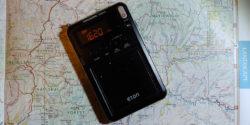
In his long, but worthwhile and info-rich, post the Professor gives an overview of the state of recording radio digitally, giving a nice user review of C. Crane’s CC Witness radio, which includes an MP3 recorder.

Aside from recording my own radio programs (usually direct off the studio board), I’ve only dabbled in recording radio airchecks over the years. In the 20th century I also mostly used cassette recorders. Due to sloppy labeling practices I’ve mostly lost all of those tapes over the years. I’ve also done some recordings in the 2000s, primarily to capture source material off shortwave for unfinished audio art projects. I did most of those recordings on minidisc recorders which seem to be very well shielded compared to other digital recorders, injecting almost no noise into the signal. Dual minidisc recorders 2The last Hi-MD models let me upload the recordings directly onto my computer for sharing and manipulation. Hi-MD is also how I recorded my mediageek radioshow for podcast distribution up until last year.

I’m not sure that I will ever record enough radio airchecks to merit spending $179 on a dedicated digital radio recorder. But I sure am glad that such a device exists, keeping alive a hobby that documents the rich history of broadcasting that otherwise would just dissipate into the ether.


AM on FM Begins Oct. 1

After rendering the AM dial a garbled mess after sunset by cramming in too many stations along with space-hogging HD signals, in 2007 the commercial radio industry came a-calling to the FCC with it’s hand out. It’s request? To let AM radio stations have repeater stations–called translators–on the FM dial.

While sitting on the NAB’s proposal for nearly two years, the Commission quietly let AM stations utilize FM translators that their parent companies already owned, provided they applied for what is known as “special temporary authority.” Then, this past July, the FCC made the policy official.

Those of us concerned that the rule would signal an influx of new commercial low-power stations eating up frequencies that might otherwise go to community LPFM stations were relieved. The Commission’s new rule essentially reflected its earlier shadow policy, only permitting AM stations to use already existing FM translators. The Commission also signaled that no new opportunities to obtain a commercial FM translator was imminent.

While I still think it’s bad policy, it could be a lot worse. Commercial translator owners now will have to make a choice as to whether it’s more valuable to repeat their AM or FM stations. Also, the same existing rules apply which limit commercial translator to being located only within its parent station’s broadcast area. This is because the commercial translator station’s purpose is to fill in areas where geographic or other anomalies hinder reception where otherwise one would be expected to receive a station. Noncommercial translators are not subject to this restriction, and may be located any distance away from parent stations. So, a commercial AM station’s new translator still has to be located in its protected broadcast radius.

As the CommLawBlog gleefully reminds us, this new policy kicks into affect on October 1. It will be interesting to see which, if any, AM stations take advantage of this opportunity, or if the rule sparks a spike in selling and exchanging FM translator licenses.


Garrett Wollman’s Radio Tower Quest

WLS Radio Tower Photo by Garrett Wollman

WLS Radio Tower Photo Copyright 2004, Garrett Wollman from The Archives@ BostonRadio.org.

Fandom is an amazing thing and thanks to the Internet it’s easier and easier to find like-minded obsessives who share one’s passion for the most obscure objects, idols, and idiosyncrasies. Radio is no exception. Loads of websites document radio history, with nostalgic archivists collecting ephemera, airchecks, and reminiscences from San Francisco to Boston. Various forums also exist, like those on Radio-Info.com, allowing listeners and industry types to talk shop and share current radio gossip.

And then there’s Garrett Wollman. I recently ran across some of his photographs of radio towers and was fascinated. As part of his work with The Archives @ BostonRadio.org, he’s been traveling around the country meticulously photographing every radio tower that he can find. Sometimes he even ventures into radio and television stations; but for the most part it’s the outside architecture and landscapes that he finds so compelling.

In order to learn more about this project, I contacted Garrett to get the scoop about his love for radio towers and his work to help document the history of radio and television. I was surprised to find out a couple of things: 1) Garrett’s a young guy—a rarity in radio history circles and 2) He’s not a big fan of current radio offerings. After chatting with Garrett, I also was made aware of pursuits like DXing and county counting, making me realize that there’s so much more to the radio scene than I ever realized. On to the interview: (more…)


AM on FM

Back in the early days of FM, when AM radio ruled the roost and an FM radio was still a rare commodity, many station owners simply simulcast their AM station’s programming on their FM stations. In the 1960s the Federal Communications Commission put the kibosh on that scheme, ordering FM stations to air different programming. This, in turn led to the development of freeform FM radio, since many station owners were glad just to have something to put on air that didn’t cost them much money. However, by the early 70s the increased fidelity of FM would make that band profitable in its own right, overtaking AM in audience share by the 80s.

Colorado Dept. Transportation radio network with repeater stations

Colorado Dept. Transportation radio network with repeater stations

Yesterday the FCC took us back to the future, in a way, approving the use of FM translator stations by AM stations (PDF of Report & Order). Translator stations are repeaters for full-power stations intended to fill in gaps in its signal area that might exist due to geography or other propagation anomalies. By design translator stations are low powered at anywhere from 10 to 1000 watts and may not originate their own programming. They’re also allowed to be short-spaced on the dial, crammed into channel spaces closer than permitted for full-power stations, or LPFM stations (for more on that discrepancy see this post from Matthew).

When the idea of AM stations having FM translators was first proposed I was quite skeptical, fearing an onslaught of new translators repeating commercial AM programming filling up every available nook and cranny on the FM dial, pre-empting the further expansion of LPFM. Luckily the actual order passed by the FCC is more rational than feared.

As the Broadcast Law blog points out, AM stations will only be permitted to make use of FM translators already licensed or issued a construction permit as of May 1, 2009. That means there won’t be a land grab brought on by a rush of new translators–station owners will have to rely on the translators they’ve already been granted by the FCC. It also means stations owners will have to make a choice as to whether their FM translators will be more valuable repeating an FM property or AM.

The NAB lobbied for AM repeaters on FM in order to compensate for two situations. First, the overly crowded AM dial is often useless at night (and I wonder who’s to blame for that?) due to interfering signals brought on by the ability of AM signals to propagate further after dark. The second is that many AM stations still have day-time only licenses, since they would cause too much interference after dark.

I’m still skeptical of the need for AM stations to have translators on the FM dial, since any broadcast group large enough to have licenses for FM translators already has FM properties it could switch its AM stations over to. This change isn’t going to help any of the few remaining independently owned AM stations not accompanied by any FM licenses. So it just sounds like the big commercial broadcasters want to have their cake and eat it too.

I’m just glad there isn’t a new translator license application window scheduled so that there might still be some frequencies available for low-power FM in the near future.