
source: FCC
Fifteen members of the House of Representatives, all Democrats serving rural areas, have written to the Federal Communications Commission urging them to get on the ball regarding a big chunk of wireless spectrum in the 2.3 GHz area that needs new rules. Developers want to get some WiMAX action going in said Wireless Communications Services (WCS) band. And Sirius XM satellite radio is involved in the story. First, here’s the reps’ statement:
“The 2.3 GHz WCS spectrum has been mostly sitting fallow for over a decade in large part because final technical rules have not been adopted,” they wrote. “Until final rules exist, equipment manufacturers and wireless network operators cannot offer consumers cost-effective wireless mobile broadband services. In rural areas, where the need for these services is particularly acute, it is critical we make spectrum available without further delay.”
The Dems include the member of Congress with my favorite name: Zack Space of Ohio.
What does this have to do with Sirius XM? If you followed the Great Debate over the proposed and now consummated merger of the Sirius and XM satellite radio services, you know that most of the issues associated with that marriage have now been resolved. But not all. First, the FCC still has to figure out who gets those “qualified entity” (minority oriented) channels that the merger parties promised to allocate as a public interest requirement. Well over a year after the merger, that still hasn’t been worked out.
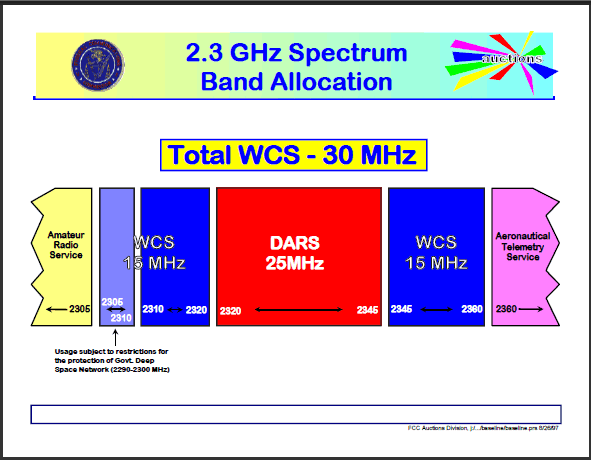
Then there’s the ongoing struggle between Sirius and the wireless industry over the so-called spectrum band, which is reserved for pinpoint accurate wireless transmission. What’s the problem here? Well, look at this handy little graphic produced by the FCC (top left), plus this table we’ve produced just for your benefit (you’re welcome). As you can see, Sirius XM is plunked right in the middle of the WCS bands. It’s got that red Digitial Audio Radio Satellite (DARS) band in the middle of the graphic.
| WCS | Sirius XM | WCS | |
|---|---|---|---|
| Band (MHz) | 2305-2320 | 2320-2345 | 2345-2360 |
So there’s been a huge amount of debate, much of it quite contentious, about whether WCS activity interferes or could interfere with Sirius XM transmissions. Sirius insists that various coexistence scenarios proposed by the WCS Coalition pose a threat. The coalition, which represents the spectrum area’s owners (among them AT&T, Comcast, and NextWave) say that Sirius’ claims are exaggerated.
This fight has been going on since even before Sirius proposed to acquire XM. I can’t say I understand why it’s taken so long for the FCC to get a handle on it. But help seems to be on the way. Now there’s a “looming spectrum crisis,” according to the Commission. Big wireless warns its running out of the bandwidth it needs to handle the enormous surge in smartphone demand. Even the agency’s Chair Julius Genachowski says it’s a top challenge and crucial to expanding broadband deployment across the country.
So now making more wireless spectrum available is a big cause—Exhibit A that Congressional letter. Maybe this will put some fire under the FCC to get this issue out the door. Hope springs eternal.