Wrapping up the decade in radio and looking forward to the decade ahead

Wrapping up our decade in review.


As I said in my introduction to our subjective and opinionated review of radio in the 2000s, I still think it was darn near impossible to predict how the medium of radio would end up at the beginning of 2010. Sure, the seeds for satellite radio, HD radio, low-power FM, internet radio and MP3s were already planted by the turn of the century. But home broadband–nevermind wireless or mobile–was a relatively exclusive luxury. MP3 players were lucky to sport enough memory to hold about a hundred minutes of music and weren’t integrated into cell phones. Satellites for Sirius and XM were launched, and HD Radio was being experimented with, but no stations were on the air. Clear Channel was flying high for more than $90 a share.

Anyone taking a broad view of the radio industry in 2000 could certainly see a lot of balls being thrust up into to the air, but it would have taken a psychic to predict where they would land. Nevertheless, for all of the churn we can say very safely that audio-focused content is alive and well.

It’s become clear to me that we Radio Survivors do consider radio to be greater than just the traditional electromagnetic broadcast medium. While we included the RF-based college radio, pubic radio, LPFM, HD Radio and satellite radio in our review, we also touched upon internet radio, Pandora and digital downloads. I believe we are first and foremost fans of terrestrial broadcast radio, but that does not cause us to ignore or discount new audio media. Nor does it cause it us to claim that they are not, in essence, radio services.

The homogenization and delocalization of the broadcast dial caused listeners to seek alternative places to hear more interesting and diverse content. At the same time the popularity of MP3 players and Pandora shows that people were also looking for customization.
(more…)


The decade’s most important radio trends: #2 The growth of Internet radio

#2 in our series on radio trends of the decade

Although today’s New York Times claims that “Internet Radio Stations are the New Wave,” a look back at the past decade makes it very clear that Internet Radio’s growing influence is hardly revolutionary news. In fact, it’s hard to overstate the importance of the Internet and Internet Radio during the last 10 years.

The radio landscape has changed tremendously and much of that had to do with the adoption of both the Internet and streaming media by the mainstream.

According to the decade-spanning report, The Infinite Dial 2009: Radio’s Digital Platforms, by Arbitron and Edison Research, in 1999 only 50% of Americans had online access compared with 85% in 2009.

Beginning in 2006, the majority of Americans with at-home Internet access had a broadband connection; making it easier to download and stream audio content. By 2009, approximately 42 million Americans listened to online radio weekly (twice the number who did in 2005).

Although this massive growth of Internet radio happened in this decade, the first attempts at streaming radio started in the early 1990s. The very first terrestrial radio stations to begin broadcasting online were college radio stations WXYC (University of North Carolina at Chapel Hill) and WREK (Georgia Tech University) in 1994.

Always ahead of the curve, many college radio stations embraced webcasting, online playlists, blogging, podcasts and broadcast archives well before these technologies were adopted by their commercial counterparts. Tech-savvy students were often the instigators and developers of the technology (as was the case at WREK). Commercial station KPIG claims to be the first commercial radio station to broadcast online with its first webcasts in 1995. (more…)


The decade’s most important radio trends #3: iPod and iTunes lure listeners away from terrestrial radio

#3 in our series on radio trends of the decade

Music listening has changed dramatically in the past decade in large part because of the rise of digital music. Following the explosion and shut down of illegal file sharing service Napster (1999-2001), a variety of digital music companies attempted to profit from the burgeoning interest in music delivery via the Internet.

Some focused on music subscription services (such as Rhapsody and eMusic), others turned toward music recommendations (like my former employer Uplister, which had hoped to turn the playlist into the “next unit of global music consumption”), and the legal descendants of Napster (from Apple to Amazon.com) became purveyors of MP3 downloads.

The timing of the digital music explosion couldn’t have been better; as many radio listeners were turned off by the increasingly consolidated commercial radio landscape that appeared on the scene as a result of the Telecommunications Act of 1996 which reduced limitations on the number of stations that could be held by one owner.

A direct result of the reduction in the number of station owners was less diversity on radio, with shorter playlists and fewer artists represented. As a 2002 report by The Future of Music Coalition pointed out, music fans were not pleased by this and stated that they actually “want longer playlists with more variety,” flying in the face of commercial radio’s own survey results. (more…)


The decade’s most important radio trends: #13 College radio tightens its playlist

#13 in our series on radio trends of the decade

Although college radio as a rule is much more diverse than commercial and public radio stations, there’s been a trend in the past decade for many stations to create a more focused identity surrounding a specific style of music. In some cases this is done with the help of professional consultants and paid staff members; whereas in others, it’s simply due to a rigid (and perhaps lazy) mirroring of playlists from other college radio stations.

In 2001, University of Washington station KCMU was transformed into KEXP after an infusion of cash and equipment from The Experience Music Project in Seattle. The station moved off campus and has a more specific music focus than when it was a student-run station.

Some stations, like WERS at Emerson College, have opted to adopt formats more familiar to commercial and public radio listeners. In 2006 they switched to AAA (adult album alternative) programming during the day, moving specialty shows to the evening and weekends.

In August 2009, University of Nebraska station KRNU modified its format in order to appeal more to college-age listeners. Changes at that station included a narrower playlist of indie/alternative music and a shifting of specialty music shows to a new web channel. The new web channel serves to play the more experimental sounds that their terrestrial station used to play.

Rochester Institute of Technology station WITR recently reduced the number of specialty music shows so that they don’t comprise more than 25% of the station’s schedule and is cutting down the number of slots available to non-student DJs. Many speculate that this is also part of a bigger mission to narrow their playlist into a more standardized rock format geared towards college students. Their current format is described as “Modern Music and More.”  Similarly, Vanderbilt University station WRVU is also putting a limit on the number of non-student DJs.

With college radio under much more scrutiny from administrators, many of these changes may simply be out of fear that a school may abandon, sell, or cede control of its radio station if few students listen or participate. In the process, though, some stations may be losing their edge and what really differentiated them from mainstream radio to begin with.


The Decade’s Most Important Radio Trends

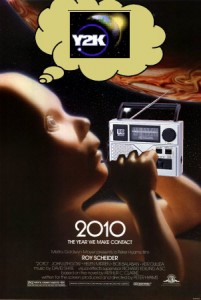
Y2K is a distant memory. Will radio soon be, too?

Myself, I can hardly believe that another decade is coming to a close. It seems like just yesterday we were stockpiling canned goods, bottled water and batteries in anticipation of the Y2K global computer meltdown. Of course, on every millennial survivalists’ compound shopping list was a good battery-operated radio.

Now, ten years on, radio has undergone many changes. Many–like the rise of internet radio–were certainly predictable, even if the particular forms were not. While those of us critical of the consolidation fever that gripped the industry in the late 90s certainly believed that trend would lead to no good, I’m not certain that any of us knew just how badly Clear Channel and its brethren would gut commercial radio, and how many bankruptcies would arise by the end of the decade.

Between now and New Year’s Day my fellow co-bloggers and I will set about enumerating the fourteen most important trends in radio during the 2000s. These trends are in no particular order. Why fourteen? Well, ten was too few, and, uh, we ran out of steam at fourteen.

So, tune back in tomorrow when Matthew and Jennifer will school you about numbers 14 and 13.

The radio-trends-of-the-decade series