Rice University Plans to Sell Off KTRU’s FM Frequency

There’s more sad news on the college radio front today, with the report that Rice University is selling off the 50,000 FM signal for their long-time college radio station KTRU. According to a press release issued today, University of Houston System plans to buy KTRU’s tower, frequency, and broadcast license for $9.5 million in order to expand their public radio network. They plan to air classical music and fine arts programming over KTRU’s frequency and will devote their current station KUHF’s frequency (88.7 FM) to news and talk. The press release states,

“‘The acquisition of a second public radio station delivers on our promise to keep the University of Houston at the forefront of creating strong cultural, educational and artistic opportunities that benefit students and the city of Houston,’ said Renu Khator, chancellor of the UH System and president of the University of Houston.”

Ironically, these same arguments about the cultural and artistic benefits of the radio station are also being used by fans of KTRU who don’t want Rice University and listeners to lose an existing cultural institution.

KTRU, which began as a student experiment in 1967, will continue to operate as an online-only college radio station, but this option is not being embraced by those who see the ongoing relevance of having a terrestrial signal.

Official word from Rice University indicates that they believed that KTRU’s audience was too small to merit a the 50,000 watt station. According to a set of FAQs on the Rice University News and Media relations website,

“The economic downturn, and the resulting losses to Rice’s endowment, led to careful evaluation of how the university prioritizes and spends its resources, both its annual operating budget and its assets. In KTRU’s case, it became clear that the radio tower and 50,000-watt frequency served very few people. Because of Internet technology, KTRU can continue to serve its audience through www.ktru.org, while the university applies the proceeds from the sale to programs and services that will serve more people and help achieve the university’s aspirations.”

Students, alumni, and fans of the station couldn’t disagree more and are already stating their displeasure and have set up a number of groups in order to try to convince the administration of Rice University to reconsider. According to the website Save KTRU, Rice University abruptly shut down KTRU in 2000 and after talks with station members failed, the university agreed to continue running KTRU after more than 400 alumni wrote to the school stating that they would no longer donate to the university. Those with an interest in saving the station are encouraged to write letters to university officials, sign an online petition, join the Save KTRU Facebook page, follow Save KTRU on Twitter, and spread the word about the plight of the station.

A post on the Burn Down blog expresses the important role that KTRU has played both on campus and in the wider Houston community:

“KTRU provided a sense of community, creating a joint pride that despite our research-oriented ways, Rice was one of the hippest places in Houston. KTRU’s eclectic music requirements ensured that it constantly played music that was on the edge. More so than any other Rice institution, KTRU provided new and exciting art to anyone with a radio. Not just the Rice campus, but all of Houston benefitted from KTRU’s artistic endeavors. By selling KTRU, Rice is selling one of Houston’s most valuable artistic centers, and it was located on Rice University.”

Personally I’m disappointed to see another example of a university selling off a station for some quick cash. The result of this particular transaction will be that the Houston airwaves will become less diverse, with yet another public radio station (and presumably national programming) taking the place of a long-standing, well-respected local college radio station. FM does still matter, why else would University of Houston offer to pay over 9 million dollars for it.


College Station KVTI Hands Control over to Public Radio Group

Bye Bye 1-91 FM

Why do I always feel like I’m the bearer of bad news about college radio?

In another sad sign of the times, Clover Park Technical College in Tacoma, Washington has decided to cut costs by passing along control of its 51,000 watt college radio station KVTI to Washington State University’s Northwest Public Radio. As a result of this change, the formerly top 40 station known as I-91 FM began piping in classical music programming and NPR news on June 21st. An article in the Tacoma News-Tribune stated that:

“The new programming at 90.9 FM doesn’t require a person, let alone students, to operate the studio in Lakewood. WSU’s radio arm, Northwest Public Radio, is based in Pullman. It sends feeds to Clover Park and 14 other participating stations in Washington, Oregon and British Columbia.”

It’s really sad to see another college turning control of its radio station over to an outside entity, especially when the previous format seems to have been doing quite well. According to the Tacoma News-Tribune piece, Clover Park Technical College plans to eliminate its radio broadcasting program:

“The college also said it was paring back programs that offer less promising careers, and that radio broadcasting is struggling along with other media. ‘We can’t sit back and invest money in something that doesn’t have a strong future for students,’ Clover Park spokesman Shawn Jennison explained this week. ‘If a program is considered successful, you have to have more than a dozen students interested.’”

This is a comment sure to send chills down the spine of college radio DJs everywhere, as radio programs and radio stations are notorious for attracting a low percentage of students. Their corresponding value, however, isn’t necessarily linked to campus popularity. The article points that out in sharing the perspective of KVTI’s former station manager, program director and radio instructor John Mangan, who said that the station was extremely popular:

“Mangan…said even as the station counted down to its inevitable closure, it grew in popularity. Its audience peaked to an all-time high of 160,000 listeners per week over the winter, and hovered around 120,000 listeners when it closed this month. He said it also had plenty of local sponsorships and support from local businesses. And while the broadcast program had a 20-student maximum, 19 students were enrolled when the closure was announced last year. The last six students graduated this month. He estimates that more than 500 students enrolled in the program since 1982, and many went on to work at radio stations all over the country.”

I fear that more and more college stations may be heading in this direction, which unfortunately means that there will be fewer independent radio outlets on the air. When the same programming gets duplicated on a number of different stations, I think it’s an unfortunate loss for local communities.

I-91 FM A History from Martin Brockhaus on Vimeo.


The Storm Brewing at University of Virginia radio station WTJU: Crisis or Opportunity?

WTJU's Programming Quagmire

University of Virginia radio station WTJU was at the center of much buzz and heated online debate last week, as staff and listeners reacted to news about proposed changes to both the station’s format and volunteer involvement. Concerned and frustrated DJs turned to the Internet, with one penning a blog post called, “WTJU is Facing a Horrible Crisis” and another creating the website “Save WTJU” in order to chronicle the events of recent weeks.

In April, the 53-year-old college radio station hired General Manager, Burr Beard after the previous General Manager retired.

According to WTJU’s former Rock Music Director, Nick Rubin, Burr met with the station’s department directors on June 7th to share both a proposal for a new weeknight schedule for the station and reveal several “policy planks.” Nick told me that “once these got out to the general DJ lists (and then, to the listeners), the outcry was instant and widespread and ran the gamut from conciliatory to outraged.”

The proposed schedule included blocks of jazz programming from 5 to 8pm, specialty music shows from 8 to 10pm (soul, reggae, etc.), and rock music shows from 10pm to 3am. In the case of jazz and rock, this schedule represented a drop in the number of weekly hours for these genres. One of the new proposed policies included having one DJ per shift, which would be a change for WTJU, which currently allows for alternating DJs from week to week. According to Nick, the new Station Manager also called for “a rotation of four songs per hour, which would be chosen by department directors from 20 releases, and rotated by computer to appear in a DJ’s program log for airplay each hour.” Currently DJs have a lot of freedom at WTJU, so these changes were met with opposition. (more…)


Lizards and Satellites: Community Public Radio Hybrid KZYX’s Station in the Woods

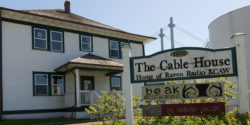
KZYX Signage. Photo by Jennifer Waits

Back in January when Matthew, Paul and I were listing off our favorite radio shows of all time, I pronounced my love for “Trading Time,” a locally-produced call-in swap show on community radio station KZYX out of Philo, California.

I’ve always found this show to be riveting since it provides a glimpse of everyday life in a small town. Callers to the show list off the items that they are hoping to sell or give away, and the hosts read additional items and services from lists emailed or faxed in to the station. One day a caller might be getting rid of some old tires, another day there could be chicken eggs for sale or the announcement of a ride needed to Ft. Bragg.

So, when I had another trip planned to Mendocino County, I relished the opportunity to get a glimpse of KZYX. Although there’s a sign for the station on Highway 128, the station is hidden from the road in a house on the edge of the woods near vineyards and a saw mill.

KZYX is interesting in that it is both a community radio station and a public radio station, airing programming created by local residents as well as syndicated shows from NPR and others. The day that I visited two weeks back, a local DJ was doing a world music show in which she was playing selections from Asia, but I also tuned in to the station when they were airing well-known public radio shows.

I’m always curious how stations such as KZYX figure out how to balance their programming schedules to satisfy a range of listeners, as I know that with expensive public radio programming, comes the pressure to both increase the number of listeners and the money collected during pledge drives in order to pay for the programs.

When I talked to KZYX General Manager John Coate, he said that national programming can be “polarizing” for listeners, pointing out that “a lot of people don’t want to hear music at all.” He said that if you look at the broad picture of radio, talk radio “outperforms” community radio, with community radio the “worst performing segment.” Yet with that said, said he was happy with the balance that his station provides (about half local programming, half syndicated) and pointed out that they truly see themselves as a resource for the local community, which didn’t have local radio before the station came along in 1989. John said, “We have to serve everybody, sort of like a partyline.” So, in addition to syndicated shows like “Fresh Air” and “All Things Considered,” local DJs curate their own music shows and host public affairs programming, including extensive coverage of the upcoming local elections in Mendocino County.

To read more about my trip to KZYX (with tales of encroaching helicopters, lizards, satellites, and cabooses), take a look at my post on Spinning Indie.


Do community advisory boards protect public radio stations?

Free Press has a provocative new report on the state of public media and how to more adequately fund it. Many of the reform group’s proposals involve siphoning income from commercial station advertising revenue or Federal Communications Commission spectrum auctions. I’ve got an overview of the document up on Ars Technica, which has generated quite a few comments. They largely focus on the question of whether the government should get more involved in media—always a subject for heated debate.

I’m not inclined to hash that out here, but do wonder about one of the report’s smaller recommendations. A section of the piece titled “Restoring Public Media’s Heat Shield” focuses on the very legitimate concern that the Corporation for Public Broadcasting fails to protect public media from external political pressure.

“The current appointment process for leadership at the CPB is overly politicized. Presidential appointments govern the entire process — into which neither the public nor the core constituency of public media producers have any input. It also often leads to appointments as rewards for political support, rather than simple calls to service for qualified people, including those who have broadcasting or media experience.”

(more…)


Website Campaigns to Keep the Public in Public Radio

Keeping the Public in Public Radio

My pal John Anderson at DIYmedia.net alerts us to a new group blog written by some fellow radio survivors who intend to hold public radio’s feet to the fire, called Keeping the Public in Public Radio (KTPIPR). Featuring the contributions of public radio supporters, authors and broadcasters, the site is covering the changing landscape of public radio which often mirrors commercial radio in emphasizing national programming and ratings over local service.

The site’s bloggers hailing from Boston and Austin are focusing on changes happening at the public stations in those cities, WGBH and KUT, respectively. Concerns over KUT, owned by the University of Texas, stem from July 2009 changes in which three long-time DJs had their roles reduced while the station’s playlist became more “structured.” More recently the site has been critically following plans for the station to take over the university’s on campus bar and music venue, the Cactus Café.

For WGBH complaints arise from the station’s December, 2009 decision to go all-talk, canceling long-running folk and blues programs. A growing priority on news and information programming has been happening at public radio stations nationwide for well over a decade, with many long-running local music programs coming to an end. Even back in 1997 when I attended the CPB’s Public Radio Program Directors conference the emphasis was on research indicating that moneyed listeners valued keystone syndicated programs like All Things Considered more than local programming, especially music. Since then the trend has only grown.

KTPIPR isn’t only focusing on Boston and Austin, it’s got at least four other stations on its radar for regular coverage, along with keeping a wide angle lens on the national scene. The site also takes aim at NPR for the network’s support of HD Radio, calling it the “Huge Debacle.”

KTPIPR has been going strong for about a month and a half. I’m always supportive of informed and critical coverage of radio issues, so I’m hoping the site’s authors can keep it up.


Radio Survivor’s Top Radio Shows – Paul’s #2: On the Media

On The Media logoI’m a media geek, hence my nom de internet. And I pretty much have always been, ever since I recognized that there were people, organizations and companies behind the shows I saw on TV and listened to on the radio. I remember reading Billboard and Radio and Electronics in the library while still in elementary school. I always read the paper’s TV supplement and radio listings (yeah, papers once had those) so I would know channels had what shows and what stations played what music — even stuff I had no interest in (as a result, for years I thought Get Smart was an educational program until I actually watched it).

I always wanted to understand how all this mass media got made, who was making it and what machinations affected what we could watch and listen to. That’s what fueled my interest in radio, why I got into college radio, and why I learned video production. I spent some time in graduate school studying the political economy of the media, only to realize being a professor wasn’t so much for me. I produced a weekly radio show exploring both the policy and grassroots angles of media for seven years, and now I blog here about radio.

And, really, until I got out of college I always felt a little bit alone in my interest in the behind-the-scenes of broadcast media, rather than being interested in the shows and programs themselves, like normal people. Graduate school and the rebirth of academic consciousness about media ownership and control in the 1990s showed me that I wasn’t so strange, at least in this interest. At the same time, aside from the short-lived Brill’s Content, there didn’t seem to be much in the way of a mass media publication or program that consistently looked at media that wasn’t intended for a strictly academic or industry audience.

Then I heard NPR’s On the Media. I’m not sure when that first happened–the program went national in 2001, but I think it was a few years before my local affiliate picked it up. Anyway, I recall initially being skeptical of the premise, expecting the program to sound like a radio version of a local media column, covering the coming and going of various executives and on-air talent, reviewing new program line-ups, ratings and the like.

In a manifesto for the program, co-host Brooke Gladstone explains that one of the reasons why she abandoned the typical media beat was that,

I would be asked to do a three-and-a-half minute piece every time Tina Brown passed wind (or so it seemed to me.) I wasn’t interested in that, and I lived in one of the half-dozen zip codes where people genuinely cared about Tina Brown [former New Yorker editor-in-chief].

Instead, she writes that,

I wanted to show how the media sausage is made.

That explains why when I actually heard it, I was pleasantly surprised.
(more…)


Wrapping up the decade in radio and looking forward to the decade ahead

Wrapping up our decade in review.


As I said in my introduction to our subjective and opinionated review of radio in the 2000s, I still think it was darn near impossible to predict how the medium of radio would end up at the beginning of 2010. Sure, the seeds for satellite radio, HD radio, low-power FM, internet radio and MP3s were already planted by the turn of the century. But home broadband–nevermind wireless or mobile–was a relatively exclusive luxury. MP3 players were lucky to sport enough memory to hold about a hundred minutes of music and weren’t integrated into cell phones. Satellites for Sirius and XM were launched, and HD Radio was being experimented with, but no stations were on the air. Clear Channel was flying high for more than $90 a share.

Anyone taking a broad view of the radio industry in 2000 could certainly see a lot of balls being thrust up into to the air, but it would have taken a psychic to predict where they would land. Nevertheless, for all of the churn we can say very safely that audio-focused content is alive and well.

It’s become clear to me that we Radio Survivors do consider radio to be greater than just the traditional electromagnetic broadcast medium. While we included the RF-based college radio, pubic radio, LPFM, HD Radio and satellite radio in our review, we also touched upon internet radio, Pandora and digital downloads. I believe we are first and foremost fans of terrestrial broadcast radio, but that does not cause us to ignore or discount new audio media. Nor does it cause it us to claim that they are not, in essence, radio services.

The homogenization and delocalization of the broadcast dial caused listeners to seek alternative places to hear more interesting and diverse content. At the same time the popularity of MP3 players and Pandora shows that people were also looking for customization.
(more…)


The decade’s most important radio trends #6: HD Radio launches, but who listens? Who cares?

#6 in our series on radio trends of the decade


June 12, 2009 is a day that will live on in broadcast history. That’s the day that the nation’s television broadcasters switched off their analog signals and went all-digital forever more. But does anyone remember January 7, 2003?

That was the date of the very first digital HD Radio broadcast, originating at Detroit FM station WDMK. However, it isn’t clear that there was anyone in Detroit who could hear the digital signal besides employees of Radio One, the station’s owner, or Ibquity, the developer of HD Radio. The first consumer HD Radio receiver was actually sold two days earlier in Cedar Rapids, Iowa, and there’s no indication that the buyer then drove to Detroit.

That this date isn’t so well remembered is indicative of the collective shrug HD Radio has received from the American listening public over it’s seven years on the air.

Renamed HD Radio from the technical name IBOC (standing for the method of its broadcast – In-Band On Channel), the digital radio broadcast system was launched with the promise of offering static-free digital sound with higher fidelity, along with added subchannels adding more feeds of news, talk or music. Unlike digital TV, HD Radio would accomplish right on the AM and FM bands, by squeezing in an additional digital signal alongside a station’s required analog program.

By all accounts HD Radio works, though many critical listeners question whether digital means better. In order to squeeze the digital signal into the analog station’s space on the band it has be highly compressed. While broadcasters like to call it “CD quality” the primary channels are often broadcast at pretty low bitrates, especially when they have to share bandwidth with extra subchannels.

Renaming the system HD Radio smacks of opportunism meant to latch onto the appeal of high-definition TV. For its part Ibquity claims that any resemblance to true high-definition is coincidental. In early whitepapers the HD was said to stand for “Hybrid Digital,” though that meaning has long been dropped.

The most significant criticisms leveled at HD radio result from interference concerns. (more…)


The decade’s most important radio trends #11: Cash-strapped schools turn their backs on college radio

#11 in our series on radio trends of the decadeAs the decade draws to a close, economic woes are a resounding theme in the radio world, especially in the non-profit realm of college radio. Universities are as strapped for cash as anyone else and are on the lookout for ways to cut costs. Increasingly these budget-cutting eyes are fixated on college radio, which has led to the unfortunate trend of universities reducing funding or eliminating stations entirely.

Schools have argued that college radio is unimportant since few students are involved and few listen. And this argument is aided by the fact that radio listenership is generally on the decline. Adding to the equation are the willing suitors (with cash in hand) waiting in the wings, including public radio (see trend #12) and religious broadcasters who are both eager to spread their reach across the radio dial.

Examples have included the sale of classical music station WCAL (along with KMSE) at St. Olaf College to Minnesota Public Radio in 2004. Eventually, that station was tranformed into The Current (ironically, a more college-radio like station with its indie-oriented music programming).

One of the most disturbing stories was the unexpected shutdown of Texas Tech station KTXT in December 2008. The nearly 50-year-old college radio station was described by university officials as a financial drain and not as relevant as other forms of media. Control of the station was transferred to Texas Tech’s other station, NPR-affiliate KOHM, and beginning in June the new KTXT started to air programming from Public Radio International and jazz music run on automation.

This May, Augustana College in Sioux Falls, South Dakota reported that its college radio station KAUR would be dropping its FM broadcast and would transform into an online-only station. By September 2009 control of the station (but not ownership) was passed on to Minnesota Public Radio. KAUR now airs an all news and talk format of syndicated public radio programs and the college abandoned plans to even host an online-only student radio station.

In an interesting departure from the usual story, when Southern Vermont Community College sold off their station WBTN in 2008 the buyer was a community group dedicated to preserving both local programming and student DJs.

Hopefully there will be a happy outcome for Canadian student radio station CKMS, which has been struggling with budget woes over the past few years. After losing school funding and being evicted from their studios, they had planned to cease operations. However, like a Phoenix they are rising again and plan to move their operations to a new building in January 2010.

That’s what I love about college radio, despite fluctuating levels of university support and huge variations in student commitment, the spirit of those passionate about independent radio can be a force to be reckoned with. And, indeed, college radio is still important and relevant and is often one of the only sources for local programming. I hope that universities wise up and embrace their student radio stations as resources that are worth preserving.