Vinyl Alive at WFMU

Former general manager Taylor Dearr in the WNUR music library (photo by Jennifer Waits)

It seems like I can barely go a fortnight without mentioning New Jersey’s greatest radio station. But here I am again posting about freeform music station, WFMU. This time it’s because the record collector magazine Goldmine has produced a short video all about the station’s amazing record library.

I’m a vinyl enthusiast myself, having never given up on the format since buying my first record some thirty years ago. Whenever I fill in a music shift on WNUR I make a point to spin some vinyl from the station’s library. Unfortunately, space constraints prevent ‘NUR from maintaining a library as expansive as WFMU’s. Nevertheless I’m quite happy to have an impressive array of great albums to choose from.

Fellow Radio Survivor Jennifer Waits always checks out the record collections at the college stations she tours on her own blog Spinning Indie in addition to writing about vinyl’s continued use in radio here at Radio Survivor. I find that the college student DJs at WNUR are very enthusiastic about playing LPs. It seems like any hour I walk into the station I’ll find at least one turntable spinning or ready to start. Hitting play on a CD or MP3 will never have the visceral experience like cueing up a record and hitting start on a Technics 1200.


The End of Channel 6 on FM Is Imminent

Over the past year I’ve been tracking the mini-phenomenon of a few low-power TV stations on channel 6 using their signal as a back-door to the FM dial rather than real TV stations. This situation occurs because the audio portion of analog TV channel 6 bumps up against the far left end of the FM dial. Full-power TV stations on channel 6 have gone digital, and some have moved to other spectrum space. In either case their audio is no longer heard on the FM dial. But LPTV stations were not required to go digital last year, and so are still heard.

While this loophole remains open for existing stations, new LPTV stations will not be able to take advantage. Today the FCC released a notice [PDF] saying that applicants for new LPTV stations must amend their applications to be digital before May 24 of this year.

It looks like there are seven channel 6 applications pending. Who knows if any of the applicants were planning on taking advantage of proximity to the FM dial. But if any were, that option is now off the table.

At this point I think it’s safe to say the countdown timer is ticking closer to zero on channel 6 on FM. Last October the FCC ended protection of channel 6 signals from interference coming from FM stations. As the commission whittles away at analog LPTV it’s just a matter of time until the Media Bureau gets around to setting a mandatory digital transition date for LPTV stations. I think this is especially true given the fact that the FCC is seriously looking at reallocating broadcast spectrum for wireless broadband.


Home-Brew Radio in a WWII POW Camp Shows Radio’s Survivability

This interview with Lieutenant Colonel R G Wells who constructed a radio receiver and transmitter in a Japanese POW camp during World War II has been making the blog rounds recently (via free103point via BoingBoing via MAKE). Though somewhat technical, the account is a fascinating example of what a simple technology radio is given that the prisoners in the camp had access to very little material except what could be scrounged, nicked or smuggled in.

In this digital era it’s important to remember that one can still build an analog crystal radio receiver that requires no external power, deriving all the juice it needs from the electromagnetic waves. That’s not what Wells and his fellow prisoners did–probably because they were working with more distant signals than a crystal set can receive–but so-called “foxhole receivers” based on crystal sets were used throughout World War II by both citizens and soldiers in order to stay in touch where powered radios were banned or impractical.

I remember building crystal sets both from scratch and from kits as a kid in the early 80s, amazed at the ability to listen to local AM stations without batteries or AC power. I wonder if this is something kids still do these days.

However a crystal set only works with analog, amplitude modulated signals; FM won’t work and neither will any digital signal. Well, you can pick up a digital signal, but it will just be a bunch of hash noise.

I think it’s important for analog radio to continue to exist exactly because of its technological simplicity and ability to transmit over long distances. That doesn’t mean digital or internet-based radio shouldn’t continue to be developed. Rather, keeping simpler, proven analog technologies in service provides a sort of insurance, even if most of our daily existence is highly electrified and digital.


Ideas and Lamentations for Channel 6

Following up on last week’s post about LPTV stations on channel 6 effectively turning into radio broadcasters I’ve been researching the topic a bit more. Turns out that full-power TV stations had the option to stay on channel 6 in their transition to digital, as I learned from this April article in TV Technology. Although their channel space still bumps up against the low end of the FM dial, the don’t retain their analog audio, and so are no longer heard on the radio.

Interestingly, Fred Lass, the director of engineering for Schenectady, NY’s WRGB-TV, tells TV Technology that he’s considering methods for continuing to have an analog FM audio broadcast alongside the station’s digital signal:

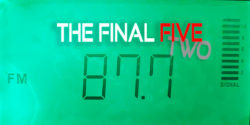
“We have a plan to continue operating on 87.7 after we go digital,” he said. “We think that it’s possible to operate with a vertically polarized analog FM audio carrier when we go back to ch. 6 for DTV. That signal will be horizontally polarized, of course, and there should be enough cross pol isolation to make it work.”

Lass admits that he really hasn’t tried this yet, but thinks it should work.

It never occurred to me that DTV stations would be permitted to continue broadcasting an analog FM audio signal, and I wonder if this is something that would require permission from the FCC.
(more…)


Analog TV Is Alive. It’s Radio.

A couple of weeks ago I was scanning the FM band as I made my short commute from my far-north Chicago neighborhood to WNUR in Evanston for a station meeting. At the bottom end of the dial I encountered a fading station playing a steady stream of smooth jazz with no DJ. I’d never heard the station before and I pretty much know every noncommercial station on the north side of Chicago and north shore ‘burbs. My first assumption was that it was a pirate station, perhaps run by a disaffected smooth jazz fan in protest of the recent loss of format stalwart WNUA.

WLFM 87.7FM & Channel 6

WLFM 87.7FM & Channel 6

Still listening to the station on the way home I heard commercials, but still no station ID, leaving me more confused. Listening a bit longer at home gave no more clues, so the internet I did search. I quickly learned that the station at 87.7 FM is not a radio station, but actually TV channel 6, WLFM-LP. And I was right that the broadcast was a direct reaction to the shuttering of WNUA.

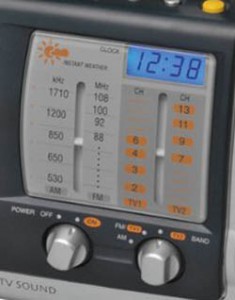
You see, analog TV channel 6 bumps right up against the bottom of the FM radio dial. TV sound is also frequency modulated, just like radio, so the sound for channel 6 can be heard at the very bottom of the dial. But, you might be thinking, “didn’t analog TV go away on June 12? Wouldn’t that kill WLFM?” Well, if you’re talking about a full-power station on channel 6, you’d be right. But WLFM is a low-power TV station (LPTV) and the digital changeover didn’t happen for LPTV.

(more…)