Radio Survivor’s Top 5 Commercial Radio Stations: #3 San Francisco’s KQAK-FM

Long gone, but not forgotten station "The Quake"

I am a college and community radio loyalist and these days I never listen to commercial radio unless someone else has put it on and I have no way to control the radio (during cab rides, in doctor’s office waiting rooms, and perhaps via cheesy hold button music, etc.).

Since coming up with a list of my favorite commercial radio stations is VERY difficult for me, I’ve had to turn to the last commercial radio station that I can proudly declare myself to have been a fan of: KQAK-FM out of San Francisco in the 1980s.

I’ve heard that people are most passionate about the music of their youth and that many never get past that period musically, becoming permanently stuck in the sounds of their teen years. Well, for me, I was a teenager smack dab in the 1980s and my favorite commercial station helped me transition from the heavier rock sounds that I listened to in the late 1970s (on KSJO and KOME) to the emerging new wave sounds of the 1980s.

“The Quake” was on the air from 1982 to 1985 and is most known for its “Rock of the ’80s” format (which they launched in April 1983 after an initial stint as an album rock station). The station went off the air in June 1985, just a few months before I headed off to college. Many of us were saddened about its demise and tearfully sat by our stereos tape recording its final hours of programming. Somewhere in a shoebox is my tape of the last hours of The Quake and tidbits from recordings by others can be found online.

The station played a mix of new wave, punk, rock, reggae, ska, pop and goth sounds. On “The Quake” I heard bands like Depeche Mode, Book of Love, Strawberry Switchblade, X, The Cure, Elvis Costello, Talking Heads, and Siouxsie and the Banshees for the first time.

I also enjoyed Alex Bennett’s morning show (take a listen to his first show on The Quake here) and found him to be much more entertaining and intelligent than his counterparts on other stations. He also introduced me to the Bay Area comedy scene, with his multitude of guests.

Quake DJs in general were a lot of fun, from the comedic Tim Bedore (with his segments like “The Bible According to Tim”) to the approachable, music-loving Big Rick Stuart. On his website, Rick Stuart shares some memories about The Quake, including the program director’s philosophy about adding music to the station. Rick writes, “I would sit in with Oz sometimes at music meetings and he would add weekly current songs with a nice theory. One for the boys, one for the girls, one for the older rock fans, and sometimes a weird song.”

For me, one of the lasting influences of the Quake was that it brought me to college radio. It opened my ears to a wider range of sounds and when it ceased broadcasting in June 1985 I switched my listening to the left side of the dial, becoming a college radio fan. I discovered all of the amazing stations at colleges south of San Francisco and started listening to KFJC, KZSU, KSJS, and KSCU. A few months later I was off to college near Philadelphia and became a fan of the student stations at University of Pennsylvania (WXPN) and Drexel (WKDU) and started DJing at my campus station WHRC.

Another “modern rock” station, Live 105, appeared on the commercial radio scene in San Francisco in 1986. Attempting to replicate some of The Quake’s adventurous programming, Live 105 caught my attention periodically from about 1989 to 1995 (when I couldn’t get college radio reception in my San Francisco apartment). But, my heart still belonged to the long-departed Quake and increasingly to college radio.


A Scholarly Look at Radio from a Transnational Perspective

Those of us who call ourselves radio fans are increasingly a small and devoted lot and the same can be said of radio scholars. It’s for that reason that I was super excited to find out about the international radio conference known simply as The Radio Conference.

This year’s event, The Radio Conference 2009: A Transnational Forum, was held in Toronto, Canada in July and featured academics from all over the globe talking about a wide range of topics including radio history, commercial radio in Canada, pirate radio in 1960s’ New Zealand, African-American CB Radio Culture, liberal implications of This American Life, and the impact of the British invasion on college radio in the 1980s.

I wasn’t able to make it to the event, but radio scholar and college radio DJ Nick Rubin wrote an excellent summary, which is posted on my Spinning Indie blog.


Radio Obsessive Profile #3: “Radio Sticker of the Day” Curator Greg Blouch

KOME Sticker

Recently I was tracking some college radio news when I ran across Greg Blouch’s website, “Radio Sticker of the Day.” Immediately I was taken back to my junior high school years when radio station stickers were a hot commodity. My classmate Ricky Kanazawa would spend most of our English class time focused on a stack of bright yellow and black KOME stickers and an exacto knife, carving up new, inspired, psychedelic creations. I’m not sure if Greg has tapped into this aspect of sticker art; but his website is a testament to the most visible radio station branding that there is.

KISR Sticker Courtesty Greg Blouch

KISR Sticker Courtesty Greg Blouch

I dropped Greg a note to find out what fuels his obsession for radio station stickers and learn more about his website, “Radio Sticker of the Day.”

It turns out that his fascination with stickers began in the 1980s, around the same time that my friends and I were plastering KOME, KSJO, and KMEL stickers (with a picture of a camel on them) all over our notebooks, windows, and Pee-Chee folders.

Over the years he’s accumulated around 12,000 stickers and largely credits the Internet for making it easier for him to contact stations. His site only features pictures of stickers that are in his collection. I love that attention to detail! On to the interview:

WYSO Sticker Courtesy Greg Blouch

WYSO Sticker Courtesy Greg Blouch

Jennifer Waits: How did you get started collecting radio stickers and what was your first sticker?

Greg Blouch: When I was 13 years old our family moved from Middleport, New York (in the western part of the state near Niagara Falls/Buffalo) to Celina, Ohio.  I was homesick and wanted to get my hands on something that reminded me of New York.

My favorite radio station had been 107.7 WUWU which was an offbeat, almost freeform, rock station heavy on the new wave music of the time (this was around 1982/1983.)  I wrote to the station and asked for a sticker which I promptly wasted by slapping it on a book cover for school.

(more…)


College Radio Read: Kill the Music

Kill the Music

Kill the Music

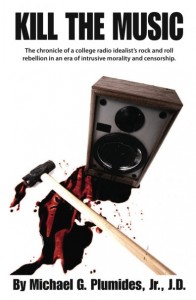
I love reading stories about radio and every time I run across a college radio mention in a book, my interest in piqued. In the months to come I’m going to work on compiling a list of college radio “must reads,” from the academic to the autobiographic. My first pick: Kill the Music.

Kill the Music: The Chronicle of a College Radio Idealist’s Rock and Roll Rebellion in an Era of Intrusive Morality and Censorship is a new book by Michael Plumides that in part looks back at his time in South Carolina in the late 1980s and early 1990s when he was a DJ at college radio station WUSC-FM.

In the book he gives an interesting glimpse of the student radio scene (including staff member drama) at a particular point in history.

The focus of the story also hinges on his time as the owner of the 4808 club, the site of an infamous incident at a GWAR show involving accusations of obscenity on the one hand and censorship on the other. I recently interviewed Michael about the book and about his time in college radio and here’s a choice excerpt from our chat in which he talks about the first college radio station where he worked:

Jennifer Waits: Tell me a bit about the first station where you DJ’d and when you were there?

Michael Plumides: The WLOZ-FM station, originally broadcast from UNCW on 91.3 (now public radio WHQR’s frequency) before being shut down by administrators in 1983 because of a drug scandal. Supposedly, the student broadcasters called out to their dope smoking customers on-air, using code language to indicate that certain packages had arrived. The death knell came when a deejay took a bong hit while broadcasting.

In the mid-eighties, WLOZ returned as “cable radio station,” requiring a special hookup to your cable TV. You had to go to Radio Shack and buy this coaxial antennae device to rig to your receiver. Needless to say, we had a deeply disturbed following. I was in on the “Cable FM” incarnation (90.9) in 1985 and 1986, where I acquired my first FCC license, and then I transferred back to USC. For a time in the late ’90s, WLOZ broadcast an extremely weak signal on 89.1 FM that could more or less only be heard on campus. That station ceased functioning in 2001. I understand they’re now a net broadcast.

In future posts I’ll share some books about college radio history and another personal narrative about college radio in the 1990s.


Is Twitter the New College Radio?

When I was a kid in the 1970s my parents would try to pry me away from the television, warning me that it was going to “rot my brain.” Yet, my dad also admitted to me that his parents made the same pronouncements to him about the dangers of listening to too much radio. Each generation seems to fear the latest technology and it’s almost cliched when parents demonize TV, video games, the Internet, Facebook, Twitter, and texting, when in fact these are all just new ways to communicate the same old stories, news, and entertainment.

I’ve been thinking a lot lately about how Twitter and Facebook are the new “radio” for the younger generation. It’s almost hard to believe that way back when we got our breaking news from the radio because today radio is often overlooked as a news source.

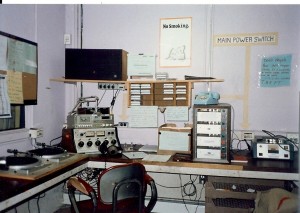
WHRC Studio 1987

WHRC Studio 1987

A few weeks ago I was at my college reunion and revisited the campus radio station WHRC. During my visit I talked to a lot of people about the station and the role that it played on campus in the 1980s. Everyone had bits and pieces of nostalgia to pass along, but what really amazed me was that several people had distinct memories of first hearing about the Challenger disaster in 1986 while listening to WHRC. At the time the campus-only station was piped in to the dining center and, in fact, the main WHRC audience was during meal times. So all of the people who I talked to were probably eating lunch in the dining center when they heard the news together about this tragedy.

Similarly, when Kurt Cobain died in 1994 (another defining tragic moment for my generation), the first people to mention it around my office had heard the news over the radio. However, this was also the first time that I remember hearing that the Internet was actually breaking news, as it was buzzing over word of Cobain’s death. This was during the early days of the Internet (I’m not even sure if we had email at my office yet), when those participating in online communities like The Well were trailblazing true hipster geeks. I’m pretty sure it was my friend’s sister who worked at Wired (a hip magazine about technology? Crazy!) who was getting some of these early reports on Cobain and passing the news along to those of us in technologically-deprived offices. (more…)