Archive for the ‘Information’ Category

Room-Sharing at CMJ Music Marathon in Radio Survivor Classifieds

What Do You Have to Sell, Donate or Swap?

An under-utilized feature on Radio Survivor is the free Classified Ads section on the upper-right side of the website. Our dream is that people will post radio-related events, job opportunities, requests for equipment, and more. I often run across people who are looking to find radio equipment for new stations and frequently hear about radio events that others are hoping to promote (conferences, radio station benefits, etc.), so the classifieds could be a useful clearinghouse for these announcements.

This week I heard from someone at a college radio station in Florida who is looking to save some money during the upcoming CMJ Music Marathon in New York City by having their college radio DJs share hotel rooms with students from other stations. We just added a classified ad for this and if you are interested, definitely contact the folks at Osprey Radio. If they don’t find some people to share rooms, they may not be able to go to CMJ due to the expense.

And, if this isn’t of interest, think about placing your own ad. Here are some of the things that I’d love to see posted:

-Radio equipment for sale, for free, or wanted

-Radio job postings (from job seekers and employers)

-Upcoming radio conferences and events

-Radio-related calls for papers for journals, books, conferences


Chile Earthquake and Tsunami Warnings: Shortwave Radio Providing Emergency Info & Communications

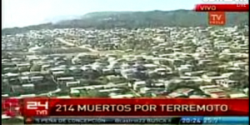
Live streaming local TV from Terremoto, Chile

In times of emergency shortwave radio, operated by both amateurs a/k/a hams and government agencies can provide an information lifeline when wired and cellular communications are disrupted. Right now shortwave is being used in the aftermath of the Chile earthquake this morning and in anticipation of tsunami waves in the Pacific.

According to Communications Quarterly news posted today, there are several frequencies being used in the amateur shortwave bands:

SSB frequencies: 10 meters – 28.300, 28.500 MHz 15 meters – 21.200, 21.350 MHz 20 meters – 14.200, 14.350 MHz 40 meters – 7.050, 7.095 MHz 80 meters – 3.738, 3.750 MHz (via CQ Public Service Editor Richard Fisher, KI6SN)

Chilean hams and emergency service agencies are asking that other amateurs keep these frequencies clear so that emergency communications are not impeded.

The communications on these frequencies may be difficult to hear on many radios because they’ll be using SSB, or single-sideband, a power-saving mode often used by hams to transmit longer distances using less power. These broadcasts will sound distorted on a regular shortwave radio, and require the use of a receiver that features SSB reception. I have such a radio, but in the RF interference zone of my Chicago apartment I’m having difficulty getting any clear reception.

I’ve been trying to hunt down some frequencies for Chile-based broadcast stations that use AM/normal mode on shortwave, but I am coming up empty. The only station I’m coming up with is Voice of Chile at 11,890 KHz listed at Radio Shack’s shortwave radio guide.

The National Hurricane Center is broadcasting tsunami updates at 14.300 MHz. I’m able to tune this in, but I’m getting too much interference to hear clearly. With luck people in Hawaii and elsewhere in the Pacific who need this information are receiving it better.

On the internet Ustream is offering a live stream of several local TV channels from Chile and Hawaii.

Thanks to NW7US and RadioGeek who have been providing emergency shortwave information on Twitter.


What is a Radio Survivor? Matthew’s P.O.V.

Moi, via an unglamorous basement cam shot.

Moi in the basement, via camcorder.

It’s way too early to start writing self-congratulatory histories of this web site, but since Jennifer asked for the back story on how we got started, who am I to refuse . . .

I first approached Paul Riismandel last Spring about creating what eventually became radiosurvivor.com because I was, and still am, concerned that discussion on the ‘Net about the state of radio has become marginal and fragmented. The conversation has become marginal because so much blogging on the future of media focuses on other technologies and venues, among them IP video, social networking, P2P, e-Books and other mobile applications. It has become fragmented because most of the big sites that report news about radio do so from the vantage point of a particular corner of the radio industry—streaming, terrestrial, podcasting—and almost always from the perspective of management.

The rest of the talk is propelled by solo bloggers whose wonderful sites ponder all kinds of interesting questions, but who rarely interact with each other. I wanted something more than that. Radiosurvivor.com’s mission, as I see it, is to stimulate dialogue about radio from a listener perspective. It is the listener, who does not have a monetary or employment investment in some corner of the status quo, who is in the best position to discuss the future of radio.

The big question is . . . what is radio? As it is being transformed by the Internet and wireless, what do we want from it as individuals? And how do we think radio can serve us as neighborhoods, cities, regions, and nations?

I am happy to report that Paul was very receptive to this idea. He contacted Jennifer, and 250 terrific posts later, here we are, drawing in many more page views a day than I ever imagined we would. Our contributor Helen Yamamoto should also be mentioned for her great work.

The domain name “radiosurvivor.com” is intended to evoke the crisis in which terrestrial radio finds itself today—with revenues and listening rates in near free fall, and the other, more recent platforms treading water at best. What do all of us who still believe in radio—we the “radio survivors”—do now? I’m hoping that our writing will draw in many more listener-oriented voices to offer answers to that question.


Radio Survivor launches Classified Ads and Events feature

When Voice Over pro Ron Reid of Lubbock, Texas contacted us about his services this week, we sadly informed him that  we’re not a radio show (we just like radio shows and write about them). But  it also became clear that Radio Survivor needed to add a new feature to its arsenal of widgets and plugins: a classified ad and events feature. And so it was done.

You can see Ron’s posting front and center, and you can post yours too, for free! If you’ve got a radio related job, are looking for work, have launched a new show, web site, or mobile app feature, or have a radio related event coming up, please do post. The notice will appear first on the list, and to the right on our ads and events box.

We only ask that you register with the site (oh, and the listing form will require a very easy adding test to make sure you’re not a bot). Enjoy!


Pirates on 87.9FM at Greater Risk?

87.9 FM pirate stations at risk?I was disappointed but unsurprised to learn about the end of Pirate Cat Radio’s unlicensed FM broadcast resulting from the FCC issuing a notice of apparent liability (NAL) to Pirate Cat’s operator Monkey Man a/k/a Daniel K. Roberts. However, I am surprised at how long Pirate Cat was able to make a go of it operating out in the open. Perhaps appearing on the Travel Channel’s No Reservations made it hard for the Commission to turn a blind eye much longer.

As Jennifer noted in her report, the FCC observed in a footnote to its NAL that, “the frequency used without authority by Roberts and PCR is 87.9 MHz, which is not allocated to the FM broadcast band.” Over email Jennifer asked me if using that frequency might be any sort of contributing factor for the FCC’s attention, especially in light of an unlicensed operator in Florida recently receiving a $2500 fine for broadcasting on the same frequency.

I was actually a little confused by the FCC’s footnote about 87.9 FM because I’d always understood that the frequency is considered part of the FM dial, though typically not assigned except under special circumstances. In fact, at present there are three stations licensed to 87.9 FM: KSFH in Mountain View, CA; K200AA in Sun Valley, NV, a translator in the Calvary Chapel of Twin Falls, ID CSN Network; and WA2XNX in Brazos, TX, an experimental station licensed to Federal Signal Corporation.

According to the Code of Federal Regulations title 47 section 73.501, “87.9 MHz, Channel 200, is available only for use of existing Class D stations required to change frequency.” These Class D stations are low-power 10 watt stations licensed prior to 1978, when the service ceased to exist. That’s the rule under which low-power high school station KSFH is licensed to 87.9 FM.

So, while it’s true that the Commission generally doesn’t license new stations to 87.9 FM, it’s simply not true that the frequency is not part of the FM broadcast spectrum as asserted in the NAL issued to Pirate Cat Radio. As to the question of whether using that frequency contributed to the FCC targeting Pirate Cat or the aforementioned Florida pirate, I think it’s quite unlikely. The NAL against the Florida pirate makes no mention of the frequency not being a legitimate part of the FM dial.

As far as the Commission is concerned any given unlicensed operator is no different than another. Each field office tends to have its own set of priorities about chasing down pirates, and looking at the list of enforcement actions you can definitely see that each office seems to have periodic bursts of action against unlicensed operators. By and large enforcement actions are complaint-based, and operating out in the open is more likely to result in a complaint than being clandestine.

I suspect that action against Pirate Cat, in particular, came about rather slowly, perhaps influenced by the positive publicity it received and the position of relative respect it has in the community. Of course, these factors will not stop the FCC from taking action against an unlicensed broadcaster; failing to take any action would only serve as an encouragement to others. But I do think that these factors complicate the Commission’s job, causing it to tread a little more carefully.

I think operating an unlicensed station on 87.9 FM is no more risky than operating on any other frequency. The fact that there are very few stations licensed to this frequency makes it attractive for pirates looking for a clear channel and to avoid interfering with other stations. The FCC’s recent decision that FM stations no longer need to protect channel 6 audio on the far left end of the dial may lead to erosion of this opportunity in some areas as more licensed stations encroach on 87.9 FM. Until then, the risk of being a pirate on 87.9 FM is due to being a pirate broadcaster, and nothing more.


The Clock Is Winding Down for Channel 6 Backdoor to FM

Regular readers may recall that I’ve been doggedly pursuing the minor phenomenon of analog TV channel 6 broadcasters exploiting their audio signal’s proximity to the FM dial to become radio broadcasters. At present the only analog TV stations capable of exploiting this backdoor are low-power TV stations which were not required to go digital this year.

Photo credit: Yukon White Light / flickr

Photo credit: Yukon White Light / flickr

However, the future viability of that idea became a little less secure this past week when the FCC’s Media Bureau announced (PDF) that beginning Oct. 27 it will end the protection of channel 6’s audio spectrum in areas where a formerly analog channel 6 moved to a new UHF channel when it went digital.

In effect, the FCC is just saying that now that in places where there’s now no analog or digital channel occupying the space next to 87.7 FM, there’s no point in expecting FM stations to avoid encroaching on it. What it doesn’t mean is any sudden increase in available noncommercial licenses at the far left end of the dial. This is because no application window for this class of licenses is scheduled in the near future.

It might allow a few existing noncommercial stations occupying frequencies from 87.9 to 88.5 or so to either raise their power, relocate their transmitter or otherwise improve their signal because they won’t have to protect the vacant channel 6 space any longer. Yet, this might be complicated by the upcoming January 25, 2010 filing window for new digital-only LPTV stations. VHF channel 6 spectrum space should still be in the offing for new LPTV stations, which could block any significant expansion of noncommercial FM into the area of 87.7 FM. However, none of these new LPTV stations will be analog. So they won’t be broadcasting an audio signal that will be heard on the FM dial.


Recording Radio for Fun, Games and Posterity

I started reading the Professor’s detailed travelogues of his AM and shortwave radio band excursions back when he was writing for WFMU’s Beware of the Blog. After he quit contributing to BotB I learned that he was keeping things going at his own Radio Kitchen blog.

The Professor belongs to a group of radio enthusiasts who record what are known as “airchecks,” which are simply off-air recordings of radio stations. Usually created as a form of historical record, air check recordings serve as an often valuable capture of what is an otherwise mostly ephemeral medium.

In the analog era airchecks were mostly recorded on boombox style radios with built-in cassette recorders. Enthusiasts often traded copies of these tapes with folks from other parts of the country or the world. You see before the internet that was the only way to hear what local radio sounded like somewhere else without traveling.

Only the fanciest radio cassette recorders come in woodgrain.

Only the fanciest radio cassette recorders come in woodgrain.

In the digital era you’d think that recording and sharing radio airchecks would be much easier, given the near ubiquity of digital audio and video recording devices. But while radios with built-in cassette recorders were omnipresent at any electronics or discount store in the 1970s through the 1990s, there are few digital equivalents in existence in the 21st century. Although Apple recently included limited FM radio recording capabilities into its newest iPod Nano, it only records up to 15 minutes, and has no AM reception. So what do you do to digitally record hours of AM or shortwave radio?

The Professor recently took up that very question. One solution one might consider is connecting your computer’s audio input to a radio. The big problem there, however, is that computers generate a ton of RF interference which can seriously mess up AM and shortwave reception. iPods and other MP3 devices wreak similar radio havoc.

In his long, but worthwhile and info-rich, post the Professor gives an overview of the state of recording radio digitally, giving a nice user review of C. Crane’s CC Witness radio, which includes an MP3 recorder.

Aside from recording my own radio programs (usually direct off the studio board), I’ve only dabbled in recording radio airchecks over the years. In the 20th century I also mostly used cassette recorders. Due to sloppy labeling practices I’ve mostly lost all of those tapes over the years. I’ve also done some recordings in the 2000s, primarily to capture source material off shortwave for unfinished audio art projects. I did most of those recordings on minidisc recorders which seem to be very well shielded compared to other digital recorders, injecting almost no noise into the signal. Dual minidisc recorders 2The last Hi-MD models let me upload the recordings directly onto my computer for sharing and manipulation. Hi-MD is also how I recorded my mediageek radioshow for podcast distribution up until last year.

I’m not sure that I will ever record enough radio airchecks to merit spending $179 on a dedicated digital radio recorder. But I sure am glad that such a device exists, keeping alive a hobby that documents the rich history of broadcasting that otherwise would just dissipate into the ether.


Unemployed Radio Broadcasters: the NAB Still Loves You (for $179).

Tough times necessitate creativity, not to mention a little bit of compassion. Not to be left behind the National Association of Broadcasters serves up both by offering what it’s euphemistically calling a “free agent rate” [scroll down to the bottom] which gives discounted registration of only $179 to its upcoming Radio Show convention. Radio magazine is little more direct in reporting that the discount is for unemployed broadcasters. Looking to avoid that word, the NAB instead likes to say that the rate is intended for “[r]adio broadcasters who are currently between jobs.”

The "free agent" entrance to the NAB Radio Show.

The free agent entrance to the NAB Radio Show.

Not to nit-pick, but to actually say someone is between jobs implies that there’s another one on the horizon. But given the way that the largest radio consolidators like Clear Channel and Cumulus have been laying off staff, it doesn’t seem like there’s too many radio jobs left waiting for all those “free agents,” unless we include operating the wireless intercom at the drive-through.

Somewhat ironically, the only Cumulus employees at the Radio Show might be those new “free agents” since, according to Jerry Del Colliano [scroll about half-way down], the company has forbidden its staff from attending. Whereas the newly “free” Clear Channel broadcasters will have the great pleasure of listening to their former boss, CEO Mark Mays, at the “Super Session Breakfast.” What a way to start the day! At 7:30 AM it just might be most tolerable with a hangover from the previous night keeping the B.S. obscured in a post-alcohol haze.

I hope you, dear reader, understand that I’m aiming my snark at the Scrooge McDucks running (or ruining) the likes of Clear Channel, Cumulus and the NAB. I intend no fun at the expense of the unlucky broadcasters unceremoniously kicked to the curb by Mr. Mays and Mr. Dickey. If these guys keep up their current mode of business, the “free agents” at the NAB Radio Show will outnumber the working broadcasters two to one, and they’ll have to pay the unemployed guys the $179 to show up.

The audacity to fire thousands of personnel and then magnanimously offer them a $120 discount to attend your industry’s biggest trade show exemplifies the attitude, misplaced priorities and sheer ignorant greed that is killing commercial radio.


Radio History Imprisoned at Cork’s Radio Museum Experience

Radio Museum at Cork City Gaol Heritage Centre, Ireland

Radio Museum at Cork City Gaol Heritage Centre, Ireland

Along with my obsession for radio I also have a special place in my heart for wax museums; so imagine my glee when I discovered the bounty to be found in Ireland at Cork’s Radio Museum.

One of my first stops during my vacation to Ireland last month, the Radio Museum Experience is located in the Cork City Gaol Heritage Centre. The gaol (or jail) opened in 1824 and housed prisoners until 1923. After the inmates left, radio set up shop on the old jail site.

Beginning on April 25, 1927, radio broadcasting began on the premises in the Governor’s house. The early station, 6CK, became part of the national radio network of Ireland: Radio Eirann (later Radio RTE) and broadcast from the old jail until the 1950s. (By the way Radio RTE has a portion of its website devoted to history of the network’s public service broadcasting, including photos from the 1920s.)

Wax Figures at the Cork City Gaol

Wax Figures at the Cork City Gaol

My trip to Cork’s “Radio Museum Experience” began with an audio tour of the jail; complete with cells filled with creepy wax figures.

As we ended that tour and returned the old school museum-issued cassette player/headphone combos we asked about the radio museum. We were told that it was closed because it wasn’t working. After we explained that we were there mainly to see the radio museum, they invited us upstairs to check it out.

I thoroughly enjoyed poking around the Radio Museum. I’m not entirely sure why it was closed, except for the fact that lighting was dim in places and some of the audio components weren’t working.

Radio Museum Artifacts

Radio Museum Artifacts

On display were collections of old radios, vintage broadcasting equipment, and a re-creation of the original studios of station 6CK. You could also catch tidbits of old radio broadcasts, see a map of early broadcasting stations from around the world, and read about the history of radio in Ireland. A bonus for me was seeing the corpse-like wax figure propped behind the board in the old studio.

Radio Museum Experience in Cork

Since I’ve been reading a lot about radio in the 1920s recently, my visit to the Radio Museum in Cork was timed perfectly for historical reflections.

I’m glad to see that these artifacts are being preserved and that there’s an opportunity for people to take a look at Irish radio history.

But it also saddens me that the exhibit wasn’t really open to the public. Hopefully it will be up and running again soon for all to enjoy. Otherwise it becomes yet another example of radio increasingly fading away from view.


Hooray for Radio Survivor!

four months oldWe’re almost four months old!
Thanks for being our readers!